To avoid these ads, REGISTER NOW!

New Metric to Inch ("SAE") Tool Interchangeability Chart

AdAstra

Well-known member
Joined
Aug 27, 2021
Messages
195
Made this for my own use in engineering design and for building smaller/field tool sets, and realized others might get benefit from it as well since the question of the interchangeability of various sizes seems to come up a lot.

The novel fit criterion is the additional* angular play between the two adjacent mm/inch sizes. The linear clearance distance is not as indicative since the size scale of the interface matters, it's really the rotational play that impacts interchangeability. It's not perfect but it's better than absolute linear gap.

*: "additional" because there will always be some gap based on the allowances and tolerances of the fastener and tool.

Keep on eye on the absolute gap as well, since as that increases, if you're interchanging in the wrong direction you could also run into situations where there is an interference fit based on tool/fastener tolerances.
 

Attachments

  • ! Metric Inch Tool Interchange Chart (keywords mm SAE Conversions Sockets Wrench) v1.4.pdf
    60.3 KB · Views: 486
Last edited:
To avoid these ads, REGISTER NOW!

Breaker49r

Member
Joined
Jan 4, 2023
Messages
16
@AdAstra thanks for this. If I'm reading this right, Green sizes are safe to interchange while Red is not?

I stumbled upon this as I'm looking for Spark Plug sockets, specifically the Koken's, and they do not offer SAE sizes. They have a 16mm and a 20.8mm which nearly equate to 5/8 and 13/16 respectively. Assuming I understand your chart, these should be safe to interchange?
 

Breaker49r

Member
Joined
Jan 4, 2023
Messages
16
^the sparkplug sockets will fit just fine, most of the world uses metric sparkplugs, which just happen to be the exact same sparkplugs as your 5/8" and 13/16" ones.
Aside from BMW and a few others, most I've found to have an SAE Hex size and a Metric thread size. But glad they're interchangeable.
 
OP
A

AdAstra

Well-known member
Joined
Aug 27, 2021
Messages
195
@AdAstra thanks for this. If I'm reading this right, Green sizes are safe to interchange while Red is not?

I stumbled upon this as I'm looking for Spark Plug sockets, specifically the Koken's, and they do not offer SAE sizes. They have a 16mm and a 20.8mm which nearly equate to 5/8 and 13/16 respectively. Assuming I understand your chart, these should be safe to interchange?
In general it's really more of a spectrum of safety... the tolerances, torque, and fastener materials also go into whether it will work or not. Green should be pretty dang safe, you'll have to use judgement/feel as you get further from that.

But yeah for the particular case of the spark plugs, I agree the "20.8 mm" size is intended to be interchanged with the 13/16" size. I also see references to a 20.6 mm size (which would be the direct conversion). Not sure why it's 20.8 vs 20.6, perhaps the plugs really are made slightly oversized to take up tool slop with non-sparkplug-dedicated sockets?
 

lamesalegend

Member
Joined
Jun 18, 2011
Messages
17
Thanks for sharing this chart. Would have like to see how 33mm and 1 5/16" correlated as far as lash angle. For me I use more SAE than metric but I don't keep my tool sets separate these individual metric are added to my SAE. As long as I have a full SAE set all I need for metric are
6mm
7mm
10mm
12mm
13mm
15mm
17mm
18mm
21mm
And if im working on a vehicle than I also need
14mm
22mm
but if its not a vehicle I can get by with 9/16 and 7/8 instead of the 14 and 22
 
OP
A

AdAstra

Well-known member
Joined
Aug 27, 2021
Messages
195
Thanks for sharing this chart. Would have like to see how 33mm and 1 5/16" correlated as far as lash angle. For me I use more SAE than metric but I don't keep my tool sets separate these individual metric are added to my SAE. As long as I have a full SAE set all I need for metric are
6mm
7mm
10mm
12mm
13mm
15mm
17mm
18mm
21mm
And if im working on a vehicle than I also need
14mm
22mm
but if its not a vehicle I can get by with 9/16 and 7/8 instead of the 14 and 22
33 mm isn't a standard metric fastener head size... curious if you know an application for it? I ran 32 and 34 since those are standard fastener sizes (even if 34 is quite obscure).

But if somehow you needed to, 33 should be a decent fit for 1-5/16", I calculate 1.0° of additional lash.
 
Last edited:

RoninB4

Well-known member
Joined
Jul 22, 2020
Messages
3,565
Location
Under My House
Made this for my own use in engineering design and for building smaller/field tool sets, and realized others might get benefit from it as well
-That was real nice of you to share this with the community. During my years as a mechanical designer I only had a calculator for conversion when needed. I'm sure others will find this useful.
 
OP
A

AdAstra

Well-known member
Joined
Aug 27, 2021
Messages
195
Interesting, thanks, learn something new every day!

I bet 33 mm started as a pseudo-metric size where someone put the closest metric number to 1-5/16" on their drawing, but then ordered fasteners to that spec, and viola, a whole new size that doesn't show up in any fastener standards.

I've updated the sheet (download in the original post) to also include 33 mm, as well as some other tweaks. Thanks again for the input!
 

Breaker49r

Member
Joined
Jan 4, 2023
Messages
16
In general it's really more of a spectrum of safety... the tolerances, torque, and fastener materials also go into whether it will work or not. Green should be pretty dang safe, you'll have to use judgement/feel as you get further from that.

But yeah for the particular case of the spark plugs, I agree the "20.8 mm" size is intended to be interchanged with the 13/16" size. I also see references to a 20.6 mm size (which would be the direct conversion). Not sure why it's 20.8 vs 20.6, perhaps the plugs really are made slightly oversized to take up tool slop with non-sparkplug-dedicated sockets?
Yea, many variables. Perhaps more important than the SAE/Metric listed size is their actual measurements between the flats. Some sockets are manufactured more precise than others. A user here showed the metric Koken to be much tighter than its 13/16 competitors.

It's relatively small sample size and isn't comparing to an equivalent or better brand of socket but it seems like 20.8mm is the target "real" size for a 13/16 spark plug. I know no socket (or box wrench) is exact to size for the sake of being able to easily mate the fastener, which also may not be true to size, to the socket. But I do wonder what standard, if any, is used to determine these tolerances?
 

rooster59

Well-known member
Joined
Nov 16, 2014
Messages
960
Location
Land of the Pines
Very nice chart. I need to add another column to figure fits with Chinese and Indian **** fasteners that come with everything. Some of the hex heads aren’t even symmetrical. Maybe those bolts are dualie SAE / metric heads.
 

Madjik Man

Well-known member
Joined
Dec 3, 2015
Messages
1,529
@AdAstra thanks for this. If I'm reading this right, Green sizes are safe to interchange while Red is not?

I stumbled upon this as I'm looking for Spark Plug sockets, specifically the Koken's, and they do not offer SAE sizes. They have a 16mm and a 20.8mm which nearly equate to 5/8 and 13/16 respectively. Assuming I understand your chart, these should be safe to interchange?

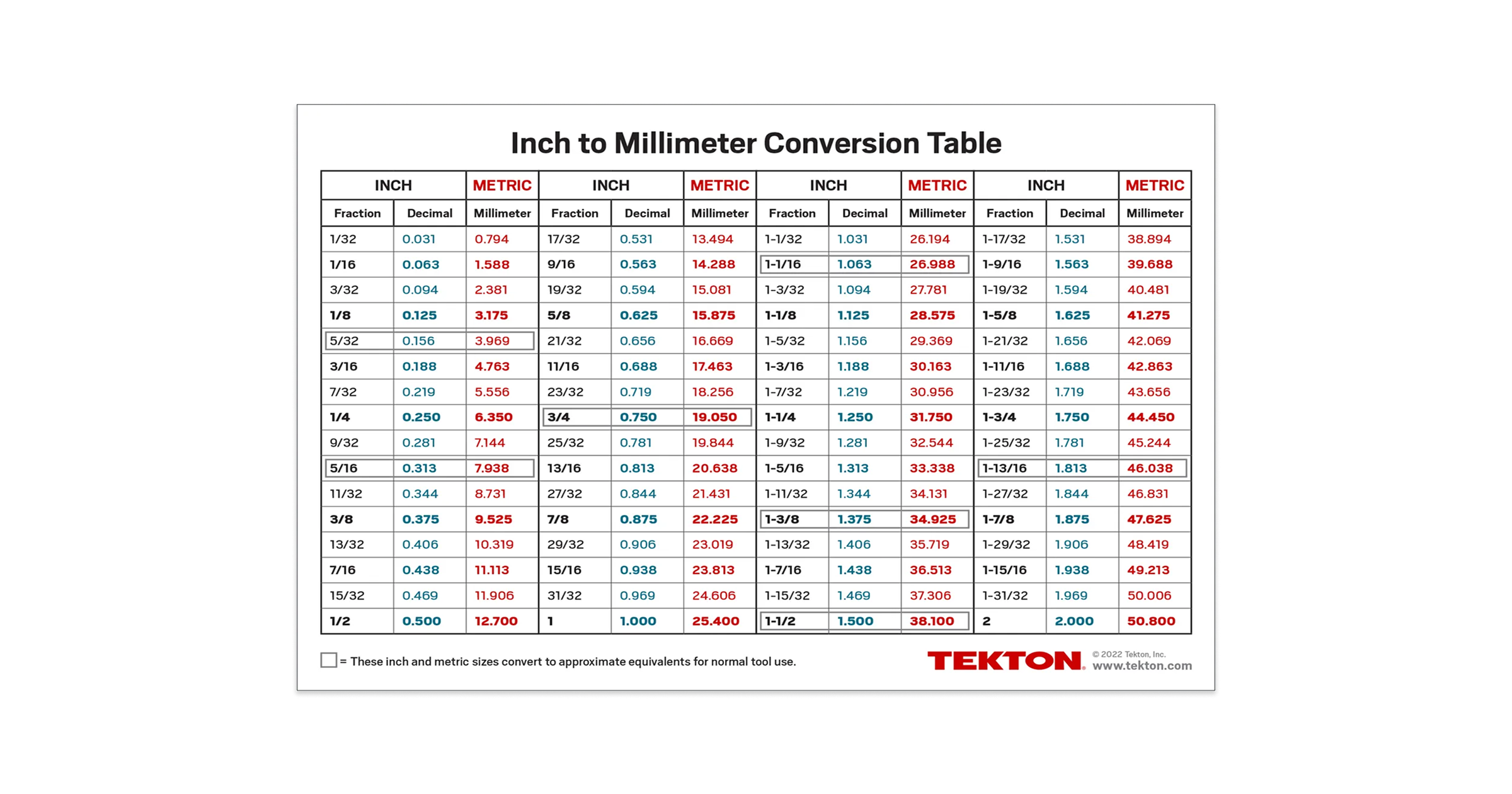
Tekton also has conversion cards where the metric/SAE equivalents are highlighted.

 
OP
A

AdAstra

Well-known member
Joined
Aug 27, 2021
Messages
195
Yea, many variables. Perhaps more important than the SAE/Metric listed size is their actual measurements between the flats. Some sockets are manufactured more precise than others. A user here showed the metric Koken to be much tighter than its 13/16 competitors.

It's relatively small sample size and isn't comparing to an equivalent or better brand of socket but it seems like 20.8mm is the target "real" size for a 13/16 spark plug. I know no socket (or box wrench) is exact to size for the sake of being able to easily mate the fastener, which also may not be true to size, to the socket. But I do wonder what standard, if any, is used to determine these tolerances?
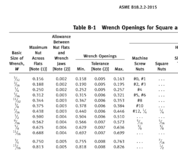
Yep, there is an "allowance" for debris, etc, and then a tolerance on top of that for manufacturing. And the fastener's max material dimension is the full nominal size.

These are in ASME B18.2.2 and ISO 691.

Per ASME, a 13/16 size tool has a minimum opening of .818" or... 20.78 mm!

So that is perhaps where that comes from, Koken is listing the actual target tool dimension, whereas people listing 20.6 are listing the converted nominal size.

All those sockets in the linked post are doing very well if we assume 13/16" is the nominal size, which appears to be the case.

Another possibility as mentioned earlier is that some spark plugs' nominal dimension is actually oversized to 20.8 mm to fit the corresponding tools with less gap... anyone got a manufacturer drawing of one? Or a copy of ISO 28741?
1677182664592.png
 
Last edited:
OP
A

AdAstra

Well-known member
Joined
Aug 27, 2021
Messages
195
55 closest to 2 3/16”. It’s a size I use a ton on excavator counterweights and my socket is stamped with both
Mmm good point, I phoned it in with the step sizes on inch socket sizes above 2", didn't look it see that they still use 16th steps that big! Will add those to sheet in a bit.
 
OP
A

AdAstra

Well-known member
Joined
Aug 27, 2021
Messages
195
55 closest to 2 3/16”. It’s a size I use a ton on excavator counterweights and my socket is stamped with both
Ok, added those sizes and also extended the chart up to 120 mm, updated version is attached to first post.
 
To avoid these ads, REGISTER NOW!

lamesalegend

Member
Joined
Jun 18, 2011
Messages
17
Wow AdAstra this chart is the best on I've seen. Pretty much what ive discovered thru use. If that's lash angle is less than 1degree and I can fit it on the faster than it works for my use. I have No need to keep both metric and SAE in my tool bags.
 

silkman

Well-known member
Joined
Feb 23, 2021
Messages
367
Location
Athens
I'm 48 and I havent touched a SAE fastener in my life. Nor a tool. :LOL:
(some whitworths yes)
 

humber2

Well-known member
Joined
Feb 13, 2011
Messages
1,768
Location
Downunder
33 mm isn't a standard metric fastener head size... curious if you know an application for it? I ran 32 and 34 since those are standard fastener sizes (even if 34 is quite obscure).

But if somehow you needed to, 33 should be a decent fit for 1-5/16", I calculate 1.0° of additional lash.

33mm also coincides with 3/4 Whitworth and the larger 7/8 BS

It is common on pre-war British cars eg Steering Wheel and Drop arm, crankshaft pulley, gearbox rear drive flange, differential drive flange, Rear axle hub nuts.

There always exists the real world where the tolerances can add up tight or loose between the wrench opening and the steel mill’s sizing of the hex bar used for the nut.

YMMV
 

AEAdam

Well-known member
Joined
May 27, 2023
Messages
2,762
Location
SE PA
Not obvious whether the mm or inch size is bigger or smaller. Should some of the deltas be negative? Is the intention using metric tools on inch fasteners? No key for the colors. Why isn’t 8mm green?

Instead of a tool centric approach, maybe it would be better if it was a fastener centric approach. For example: for a bolt with a 9/16” head, 13mm won’t fit, 14mm has xxxx slop - not recommended.

The novel portion of this, the angle is interesting-ish. Not sure I buy the idea that 1 deg of rotation on a 1/4” bolt is the same amount of bad as 1 deg on a 15/16” bolt.
 
OP
A

AdAstra

Well-known member
Joined
Aug 27, 2021
Messages
195
Not obvious whether the mm or inch size is bigger or smaller. Should some of the deltas be negative? Is the intention using metric tools on inch fasteners? No key for the colors. Why isn’t 8mm green?
They are listed sequentially in ascending size. It’s deliberately agnostic as to direction of substitution/conversion, so the deltas are absolute and apparent from the relative position of the two values.

The color gradation is somewhat subjective and up to the user and their requirements, roughly scaled based on my experience/best guess, but fastener harness will play a role. 8 mm gets the same formula rule as the rest…greenish but not a perfect fit.

Instead of a tool centric approach, maybe it would be better if it was a fastener centric approach. For example: for a bolt with a 9/16” head, 13mm won’t fit, 14mm has xxxx slop - not recommended.
It’s agnostic to either direction, idea is to compare fastener head in one unit system to tool in another. For your example, start at 9/16 at right column, if you think in inches then read the inch value of that fraction on adjacent column, compare it to metric tools in row above and below. Absolute delta is calculated for the closest fit of those, generally, but with an eye to standard metric sizes too, especially in the larger sizes. In a few cases the value is repeated to allow calculation to both the next size up and down.

The novel portion of this, the angle is interesting-ish. Not sure I buy the idea that 1 deg of rotation on a 1/4” bolt is the same amount of bad as 1 deg on a 15/16” bolt.
Yeah, short of FEM I didn’t have a better way to calculate it, and think it’s better than the linear gap. But as mentioned in notes you also need to consider linear gap and tolerances/allowances, or risk interference fit. All models are wrong, some are useful. Got a better one?
 
Last edited:

cherrybomb

Well-known member
Joined
Oct 18, 2016
Messages
892
Location
Near Madison Wi.
Nice helpful chart.Another part of the equation is the tolerance the manufacturer of the fastener used.Sometimes you just have to use what fits the best.
 

AEAdam

Well-known member
Joined
May 27, 2023
Messages
2,762
Location
SE PA
This is the chart I find helpful (if anyone cares): It obviously links tool sizes to national stds allowing you to predict (roughly) what tools you might need for a given vehicle. It also gives you a sense for what sizes are essential in a given set; Allens for example. Should you pay extra for that 7mm allen bit socket?

I would say, in my mind, this is similar to what your goal was; What are the fewest tools you can own to do XXXX? I personally get a little sick to my stomach when I put a metric socket on a SAE fastener. Just rubs me the wrong way!

Bolt Head Stds.jpg
 

drtyler

Well-known member
Joined
Jan 31, 2012
Messages
977
Looks like former member Adam.C posted this chart a few years ago. I remember it because I have it bookmarked and a paper copy printed. It's been useful.


This is the chart I find helpful (if anyone cares): It obviously links tool sizes to national stds allowing you to predict (roughly) what tools you might need for a given vehicle. It also gives you a sense for what sizes are essential in a given set; Allens for example. Should you pay extra for that 7mm allen bit socket?

I would say, in my mind, this is similar to what your goal was; What are the fewest tools you can own to do XXXX? I personally get a little sick to my stomach when I put a metric socket on a SAE fastener. Just rubs me the wrong way!

Bolt Head Stds.jpg
 
OP
A

AdAstra

Well-known member
Joined
Aug 27, 2021
Messages
195
For me the goal was primarily for design-for-assembly/maintenance, if I’m designing something that I want to go together/be maintained easily in the field, and have leeway on fastener choice (no major mass constraints, etc), I’ll pick fasteners that have wrenching sizes that will work with either a metric or inch tool kit. I supplement the chart with lists of fastener thread diameter vs wrenching sizes similar to one posted above.

Since the various standards are such a mess, I consolidated all that into the “standard metric size” column, but do use more detailed breakdowns where needed, but the global supply chain is so complex I think it’s a bad assumption to say “X country product, X standard used”

Secondary purpose is what sizes do I need to supplement a complete metric toolkit, or vice-versa to be able to handle common sizes of the other system. And to cross reference pseudo-metric sizes like small L wrenches without having to calculate it every time.
 

AEAdam

Well-known member
Joined
May 27, 2023
Messages
2,762
Location
SE PA
5/16" is the obvious answer. Make everything 5/16"! In my machine shop, I call it the machinist's friend. Any small screws I use for anything, I try to use 5/16" or 8mm.

3/4" is also pretty commonly used. Its the size of my drawbar, the bolt heads for my tee nuts, vise clamps etc etc. I only really need 2 wrenches at my mill, 3/4" and 5/16". There really isn't much in between that is that close. 16mm 5/8" is too close to 3/4" to be useful. 11mm 7/16" is close but 11mm isn't a metric std. So I could use an 11mm wrench on a 7/16" head, but what good is that really. 8, and 19mm really are pretty interchangeable.

Of course, a machine shop is not the same as what you might be doing/designing.
 

AEAdam

Well-known member
Joined
May 27, 2023
Messages
2,762
Location
SE PA
Looks like former member Adam.C posted this chart a few years ago. I remember it because I have it bookmarked and a paper copy printed. It's been useful.

good thanks! Yeah I have it my tool boxes - even just the torque values are helpful when you have nothing else.

Also, the rows are all the same thread. So a M6 could have a 10mm hex head or a T30 or a 5mm allen head. So if you lose a T30 screw, you could try the bolts you use a 10mm wrench on in its place.
 

dr_clyde

Well-known member
Joined
Jan 7, 2009
Messages
6,446
Location
Holland, MI
I just use whatever tool is needed for a given fastener. Never saw any point in worrying about what equals what across systems. I just use the socket or wrench that the fastener needs. I’ve had to repair a fair amount of messed up fasteners from people using the WRONG wrench though. Just because it almost works doesn’t mean it is right. Stripped socket heads, rounded hex heads, damaged countersinks, the list goes on.

If you are designing a system from scratch, for the love of all that is holy pick a system and stick with it for the WHOLE JOB. There’s a special spot in hell for engineers that mix metric and SAE on one machine. Almost as bad is mixing hex heads and socket heads. Just pick a system so I can predict what I’ll need. I try to buy dedicated hand tools for my machines and it just doesn’t make sense to use a mish-mash of whatever hardware you had laying around vs all socket heads or all hex heads or what have you.
 
OP
A

AdAstra

Well-known member
Joined
Aug 27, 2021
Messages
195
I certainly try to do that, but sometimes you need to source a motor from Germany with tapped metric flanges and a pump from the US and another bit from Japan and it works with Parker hydraulics and you’re interfacing to an Italian machine and Taiwanese electronics assemblies and….. besides that so many little bits like say plumbing hardware or U-bolts (at least in low volumes/McMaster lead times) are only readily available in inch sizes in the US. Yes it’s painful, and it’s a shame the US didn’t bite the bullet pre-industrialization and go metric.
 
Last edited:

Ratchet.

Well-known member
Joined
Jul 30, 2011
Messages
521
Location
Northwich England
Really useful chart, @AdAstra (y)


Working on construction equipment as my day job, and there is a mix of all sorts of standards, often on the same component... and to comlicate it sometimes parts manufacturers use non standard fastener sizes, example being a particular application on a machine i work on, it has a 5/8 bsp hose.. but with 28mm hex, usualy its 30mm or 1-1/8". When i first came across that i didnt have a wrench to fit as 28mm is a bit of an uncommon size.. i did however have an old 5/8 whitworth one (interestingly some 5/8 whitworth wrenches i have are dual marked as 28mm)

Also have had a few times where i've needed to use odd sizes not because i didnt have the correct one, but because of space contraints.. like using a vintage Snap on 9/32 drive 0ba socket and an adapter to use it with a 1/4 drive ratchet, because that combination gave the exact length to undo the m6 bolt holding in an ecu fitted in an excedingly stupid position under a hvac unit.
 

BarrelRoll

Well-known member
Joined
Jan 10, 2006
Messages
415
Location
Alaska
This chart is handy. I have it up on my tool box and used it the other day.

I just use whatever tool is needed for a given fastener. Never saw any point in worrying about what equals what across systems. I just use the socket or wrench that the fastener needs. I’ve had to repair a fair amount of messed up fasteners from people using the WRONG wrench though. Just because it almost works doesn’t mean it is right. Stripped socket heads, rounded hex heads, damaged countersinks, the list goes on.

If you are designing a system from scratch, for the love of all that is holy pick a system and stick with it for the WHOLE JOB. There’s a special spot in hell for engineers that mix metric and SAE on one machine. Almost as bad is mixing hex heads and socket heads. Just pick a system so I can predict what I’ll need. I try to buy dedicated hand tools for my machines and it just doesn’t make sense to use a mish-mash of whatever hardware you had laying around vs all socket heads or all hex heads or what have you.

There reaches a point where it's just not economical to have both metric and standard. I work on a couple German concrete pumps. There's a lot of 36, 41, 46, 55, 60, and 65mm fasteners on it. I go up to 32mm in metric combo wrenches, 17mm in angle wrenches, and 38mm in sockets. In SAE I go up to 2" in combo and angle wrenches and 2 1/2" in sockets. I'm having a hard to convincing myself to buy big metric stuff when the SAE stuff I have works. I had 1 36mm nut round off using a 1 7/16" wrench on it though I'm pretty sure it would have rounded off with a 36mm, it was literally concreted in. I'd like to add 55, 60, and 65mm wrenches or their SAE equivalents and a 65mm socket to my collection though I haven't pulled the trigger yet. My 3/4" drive sockets are shallow SAE, if I buy a deep 3/4" set I'll probably buy metric.
 
To avoid these ads, REGISTER NOW!
Top Bottom