To avoid these ads, REGISTER NOW!

New Natural Gas Installation - Code pointers?

JakeKohl

Well-known member
Joined
Feb 23, 2012
Messages
1,365
Location
Greenville, SC
I've got a buddy having natural gas service installed today. He wants to install a water heater now and other gas appliances later. Neither of us are very familiar with the code requirements for the internal line sizing, gas pipe, appliances, or venting. Could you guys give some pointers for code requirements pertaining to gas plumbing?

With regards to future appliances, there is probably a 60 foot run between the service entrance and a future gas cook stove. Mid-way between is to be a future combo heat-pump / natural gas furnace and a 40 gallon water heater. The water heater will be the first appliance going in soon. What size service line should he run to the tee for the water heater? Other considerations? Any help would be appreciated (hoping to avoid do-over and general inspector displeasure).
 
To avoid these ads, REGISTER NOW!

nwav8tor

Well-known member
Joined
Feb 21, 2012
Messages
239
Location
Spokane, WA
Search the internet for gas supply line sizing tables/charts. They should contain lots of the info you seek. Basically, you need to size for the BTU load and distance from the meter. For each fitting (ell, tee, etc.) you need to add a correction/degregation factor. It's hard to say what you need without more specific information but I'd GUESS that you'd need at least an 1-1/4" main line from the meter to your first tee for the water heater simply because that's what was installed in my house.

You can also search for gas appliance venting requirements on the net.

Good Luck
 

brewchief

Well-known member
Joined
Sep 20, 2008
Messages
2,370
Location
Michigan
If your talking average sized tank type water heater and a normal sized furnace and stove(nothing commercial) then pipe it in 1".
 

CNGsaves

Well-known member
Joined
Sep 26, 2012
Messages
13,233
Location
KS and OK
For the first main NG coming into house, BIGGER is better. My old house built in 50's has either 1 1/2" or 2" from the meter into the mechanical room, then step down from there for furnace, hot water heater, etc.

Put a shutoff down there on main big leg before the stepdown to give you flexibility for the future. Also, may want a dual-fuel stove some day (elec/NG) along with natural gas clothes dryer, so I would error on the big size on that incoming service leg. Then, you can step down to 3/4" at furnace, run long leg of 60 ft across house at 3/4", T off at furnace with 1/2" to hot water tank, etc. Good luck but pressure test everything, along with soapy leak test.
 

Stroked550

New member
Joined
Feb 18, 2010
Messages
4
I would run 1 1/4 for a main across the basement and tee off for any appliances. 1" is marginally big enough for a main depending on length. Jumping up one size to 1 1/4 more than doubles the flow capacity of the pipe. When looking at flow charts for low pressure gas always figure sizing using the longest run.
At 40 feet 1" is good for 273,000 btu's, 1 1/4 is good for 600,000 btu's. Seems like overkill but a hot water tank is around 40,000, furnace anywhere from 90,000 and up. Add in a stove and you will be at the limit of the 1".
 
OP
J

JakeKohl

Well-known member
Joined
Feb 23, 2012
Messages
1,365
Location
Greenville, SC
thanks for the input...another question. My buddy told me the gas company install guy said his pressure after the meter would be 2 psi. I thought the house side of the meter was normally 0.5 psi...does this vary from region to region (and obviously, it would affect the required pipe size).
 

Milton Shaw

Well-known member
Joined
Feb 11, 2011
Messages
4,837
Most natural gas appliances operate at 4" w. That's a whole lot less than 2 psi or .5 psi for that matter. Most gas meters around here deliver gas at about 7 to 10" W and then a step down regulator at the heater/appliance. Propane is usually regulated at 10"W to the burner and the line pressure is usually around 15 to 20"W. I had a propane tank put in and they used a 2psi regulator at the tank and then stepped it down to the 10"W at the backup generator. That may be where your friend got the 2 psi rating from. That pressure is inches of water. It takes 33 feet of water to equal 14.7 psi normal atmospheric pressure, so 4" water pressure is nothing and that's why it takes a big pipe to deliver gas a long distance.
 

CNGsaves

Well-known member
Joined
Sep 26, 2012
Messages
13,233
Location
KS and OK
For propane it might be common to have regulators at each appliance, but for Natural Gas the standard practice here in KS and OK is to have just one regulator for the whole house.

Gas company provides regulator BEFORE the NG meter which takes pressure down from GasCo to normal residential pressure of 7 to 8 inches water column (ie around .5 psi).
 

hammerlane

Active member
Joined
Jan 9, 2012
Messages
25
Location
OHIO
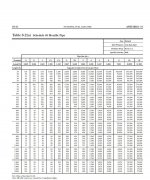
Found this table in the Natl Fuel Gas Code. It says that for instance 30 feet of 1/2 black pipe supplies 72 cub feet of natural gas at the criteria in the upper right corner of the table. Since 1 cub foot of natural gas is equal to 1015 BTU, this should be more than sufficient for a 50000 BTU grill.


Criteria in upper right corner says:
Gas- Natural
Inlet Pressure- Less than 2 psi
Pressure Drop- 0.3in w.c.
Specific Gravity- 0.60


also attached is an equivalent length pipe table. It says for instance that a 1 inch 90 is equivalent to 2.62 feet of black pipe
 

Attachments

  • NFGC table B3.2.jpg
    NFGC table B3.2.jpg
    155.5 KB · Views: 9
  • Table 6.2a.JPG
    Table 6.2a.JPG
    128.3 KB · Views: 8
To avoid these ads, REGISTER NOW!

enrare

Well-known member
Joined
Oct 17, 2011
Messages
425
I have a thread going here "sizing natural gas line" and in there someone posted a link to a fitting correction factor chart that nwav8tor refers to.

YOu should call your local/city building dept. Mine says all they look for is that 2009 International gas and fuel code & 2009 International residential building codes are met. Was told they did not care if work was done by a DIY'er or a licensed person, just that the work better follow the 2009 codes to the letter when they come to do the inspection. Was warned if work done by DIY'er be prepared for extra close scrutiny by the inspector.
 

BadgerBoilerMN

Well-known member
Joined
Aug 4, 2011
Messages
837
Location
Minneapolis
High pressure gas it not a DIY project. Get some professional help before someone gets hurt.

This the standard, but proper sizing of gas pipe takes some learning and some practice. At least have a professional size it and inspect the finished product. Most of what you have here is misleading at best.

Of course there is the skill thing...

Look up the International Fuel Gas Code.
 

enrare

Well-known member
Joined
Oct 17, 2011
Messages
425
Forgot to mention in my earlier post, your friend may want to get his home owners insurance stance before you guys get too far into this.
 

jlckmj

Well-known member
Joined
Dec 7, 2009
Messages
732
Location
SE Wiscosin
One thing you may want to have the installer do is to put a T in the area of where each future appliance will go. Then have them stub a short ****** off of the T and place a shut off. After the shut off, another short ****** and a cap.

That way you do not have to disrupt any existing appliances for any future additions.

Jim
 

BadgerBoilerMN

Well-known member
Joined
Aug 4, 2011
Messages
837
Location
Minneapolis
Isolating gas valves are normally fixed at a common manifold or at the appliance or both following most gas codes and common accepted practice. They must all be accessible.
 

hammerlane

Active member
Joined
Jan 9, 2012
Messages
25
Location
OHIO
gas it not a DIY project. Get some professional help before someone gets hurt.

There is no special science/tools to threading black pipe into fittings and being leak-free.

A couple pair of pliers and some elmers glue is all you need.:rocker::rocker:

Of course some common sense is required.

The only news stories Ive seen of natural gas explosions were when professionals were involved.
 
Last edited:

BadgerBoilerMN

Well-known member
Joined
Aug 4, 2011
Messages
837
Location
Minneapolis
Ya, I was out on one of those jobs the other day. It makes one believe in a benevolent God...

And hey, the pipe dope goes on the outside of the pipe! Thank you.
 
To avoid these ads, REGISTER NOW!
Top Bottom