
You are using an out of date browser. It may not display this or other websites correctly.
You should upgrade or use an alternative browser.
You should upgrade or use an alternative browser.
New ratchet
- Thread starter elidas
- Start date

Shiftless
Well-known member
Possibly Whitworth?
Chillylulu
Member
- Joined
- Mar 20, 2017
- Messages
- 19
Probably refers to the bolt size.
Early wrenches did that.
Chilly
Early wrenches did that.
Chilly
Richard Cranium
Well-known member
neat, very neat. thanks for posting
Shiftless
Well-known member
Probably refers to the bolt size.
Early wrenches did that.
Chilly
Yes, that is the Whitworth system. Still in use. Anybody own a British motorcycle?
Chillylulu
Member
- Joined
- Mar 20, 2017
- Messages
- 19
Yes, that is the Whitworth system. Still in use. Anybody own a British motorcycle?
If they do, they know that those wrench sizes changed around the middle of the last century.
Whitworth and American (SAE) wrenches, although marked with the same bolt size, would have different size openings. I have both in my collections, and you can easily see the difference. Although Whitworth wrenches are marked with the bolt size, that is where the similarity ends. I have both types of wrench. American industry used an (old designation "USS" or "SAE") ASME UNC bolt. British bolt head sizes are different.
A UNC 3/8" nut is 9/16"across the flats. Whitworth bolts measure ~23/32" across, ~5/32" bigger. Well at least in that time frame. The Whitworth standard changed in 1951. Then a 3/8" bolt would have a 29/32" head.
It kind of helps explain some of those weird **/32" socket sizes, eh?
The United States did not adopt Whitworth as a standard, ever. I would argue that the Whitworth Wikipedia article is misleading. The Wikipedia "Screw Thread" wiki is more accurate in the discussion of Whitworth thread use in the US : "During the 1840s through 1860s, this standard was often used in the United States and Canada as well, in addition to myriad intra- and inter-company standards."
From the ASME website, about the USS/SAE/UNC fasteners.:
"But by the 1880s, the system had triumphed, as machines with interchangeable parts — from typewriters to locomotives — flooded the national economy. Known originally as the Sellers or Franklin Institute threads, they became the United States Standard threads. Other systems of screw threads have since come into widespread use. But down to the present day, William Sellers' innovation remains a ubiquitous standard. Take a quarter-inch nut from a Portland, Maine, hardware store and it will reliably fit a quarter-inch bolt in Portland, Oregon. The economy and simplicity of this elegantly rational system represents William Sellers' legacy and the enduring quality of fine mechanical engineering."
Unlike other American innovations like fast food restaurants, I don't think the "triumph" lasted that well. Metric standard seems to be the winner.
Chilly
Chillylulu
Member
- Joined
- Mar 20, 2017
- Messages
- 19
We use a similar ratchet with a fixed socket today on bolts for installing underground piping. I think I remember those being the heavy pattern.
Here is an ASME bolt chart, but some (including 3/4") have a heavy size:
Bolt Dia. Wrench Size
1/4 -------7/16 or 3/8
5/16 ----------1/2
3/8 -----------9/16
7/16 ----------5/8
1/2 -----------3/4
9/16 ---------13/16
5/8 ----------15/16
3/4 ---------1 1/8
7/8 ---------1 5/16
1 -------------1 1/2
1 1/8 --------1 11/16
1 1/4 --------1 7/8
A wrench for 3/4" bolt with a USS/SAE/UNC heavy head would measure 1 1/4" across the flats.
A spanner for a 3/4" Whitworth bolt would measure 1 3/16" across the flats. Right in the middle of the two american sizes.
Chilly
Here is an ASME bolt chart, but some (including 3/4") have a heavy size:
Bolt Dia. Wrench Size
1/4 -------7/16 or 3/8
5/16 ----------1/2
3/8 -----------9/16
7/16 ----------5/8
1/2 -----------3/4
9/16 ---------13/16
5/8 ----------15/16
3/4 ---------1 1/8
7/8 ---------1 5/16
1 -------------1 1/2
1 1/8 --------1 11/16
1 1/4 --------1 7/8
A wrench for 3/4" bolt with a USS/SAE/UNC heavy head would measure 1 1/4" across the flats.
A spanner for a 3/4" Whitworth bolt would measure 1 3/16" across the flats. Right in the middle of the two american sizes.
Chilly
Last edited:
Private Lugnutz
Well-known member
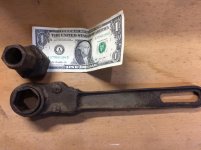
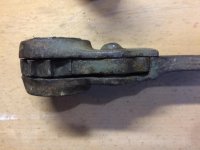
Really? An 8-sided female drive? I'd like to see a photo of the ratchet without the socket on it. And also some photos of the socket by itself. Also, what is the rest of the marking on the ratchet? Edit: I can't read what follows the word "PRODUCTS". Edit2: Also, a quick Google search indicates that a Demuth Steel Products in Pennsylvania has been making farm buildings (silos, etc) for a hundred years. Off the top of my head guess is this was used in fabrication.My wrench has an octagon drive.
Last edited:
Private Lugnutz
Well-known member
Primitive hex drive ratchets and pressed steel sockets were very popular in pre-fab construction. My bet is on it being a tool used by the farm building company.




Private Lugnutz
Well-known member
Agreed. Heavy duty. As is the crude open tooth ratchet. What is the drive size? 3/4"?
Note that Demuth has offices in PA, Chicago, and Canada. Still might be the same company.
Note that Demuth has offices in PA, Chicago, and Canada. Still might be the same company.
Chillylulu
Member
- Joined
- Mar 20, 2017
- Messages
- 19
That's for underground piping. The through hole is for the all-through rod to go through.
When a fireline enters a building underground just inside the foundation / wall an elbow turns the pipe up and through the floor to a flange just above the floor. There has to be some kind of restraint or the flange would just push right out of the fitting below. There are all kinds of flanges or gland followers that bite into the pipe, but many fire marshals require all-thread rod between the elbow and the flange.
When I served my apprenticeship in the 80's, before I became a system designer / engineer, it was common for the site utilities guy (who worked for the developer) to run the underground supply to 5'-0" outside the building. The 5'-0" was where the building contractor took over from the site guy.
We would take it in the last 5'-0" and up to the above floor flange. We ran rod from the site line to the elbow, and from the elbow up to the flange. We also ran complete firelines.
I've used that type of ratchet many times. I own a Lowell brand one. They are made today, mine was bought in the mid 90's. The sockets aren't pressed normally, but cast steel. So is the body. The sockets are usually held on with a retaining ring , but normally you only need the 3/4" because bigger pipes just need more rods. Up to 24", if I am remembering right. So you buy a 3/4" ratchet not planning on ever changing socket sizes.
I'm guessing that if your socket measures 1-3/8" across the flats that it was for older, heavier nuts. Sometimes we'd get an odd bigger nut from the shop. Toss it or have to use an adjustable.
Chilly
When a fireline enters a building underground just inside the foundation / wall an elbow turns the pipe up and through the floor to a flange just above the floor. There has to be some kind of restraint or the flange would just push right out of the fitting below. There are all kinds of flanges or gland followers that bite into the pipe, but many fire marshals require all-thread rod between the elbow and the flange.
When I served my apprenticeship in the 80's, before I became a system designer / engineer, it was common for the site utilities guy (who worked for the developer) to run the underground supply to 5'-0" outside the building. The 5'-0" was where the building contractor took over from the site guy.
We would take it in the last 5'-0" and up to the above floor flange. We ran rod from the site line to the elbow, and from the elbow up to the flange. We also ran complete firelines.
I've used that type of ratchet many times. I own a Lowell brand one. They are made today, mine was bought in the mid 90's. The sockets aren't pressed normally, but cast steel. So is the body. The sockets are usually held on with a retaining ring , but normally you only need the 3/4" because bigger pipes just need more rods. Up to 24", if I am remembering right. So you buy a 3/4" ratchet not planning on ever changing socket sizes.
I'm guessing that if your socket measures 1-3/8" across the flats that it was for older, heavier nuts. Sometimes we'd get an odd bigger nut from the shop. Toss it or have to use an adjustable.
Chilly
Last edited:
Private Lugnutz
Well-known member
Lowell made all kinds of special structural ratchets. They made non-reversible ratchets with 3/4, 1, 1-1/8 and 1-1/4 square drives just to turn big nuts on tanks and other large armored vehicles in WWII.
Williams made an early "through" or "pass-through" ratchet to the one you've got they called the "Superector." It was for any structural work. If I recall correctly, it was a spline drive. The teeth in the ratchet fit ridges in the sleeve of the socket. The through hole allowed it to be used on bolts or threaded rods of any length.
My money is still on that being an in-house wrench, made by someone else for Demuth Steel Products, or by Demuth Steel Products themselves for their own use, for erecting their own agricultural industry structures. That may have included large irrigation systems, akin to Chilly's underground piping experience. I think the same concept would be in play on anything put together with a long threaded rod, though.
I could be wrong, of course. Please report back if you find out anything else on it.
Williams made an early "through" or "pass-through" ratchet to the one you've got they called the "Superector." It was for any structural work. If I recall correctly, it was a spline drive. The teeth in the ratchet fit ridges in the sleeve of the socket. The through hole allowed it to be used on bolts or threaded rods of any length.
My money is still on that being an in-house wrench, made by someone else for Demuth Steel Products, or by Demuth Steel Products themselves for their own use, for erecting their own agricultural industry structures. That may have included large irrigation systems, akin to Chilly's underground piping experience. I think the same concept would be in play on anything put together with a long threaded rod, though.
I could be wrong, of course. Please report back if you find out anything else on it.
