To avoid these ads, REGISTER NOW!

New Shop Panel Review - Dedicated lighting circuits?

gsuty17

Well-known member
Joined
Mar 12, 2018
Messages
119
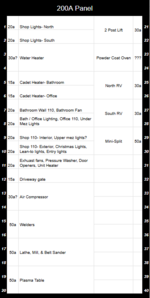
I'm about ready to start wiring my new shop and was wondering if anybody had any advice on how I should group my breakers? e.g. what should and shouldn't be combined. This is vaguely logical to me, but not sure what is best practice. I also will likely go with 240v cadet heaters since I have the room in the panel.

Any thoughts? Mostly just unsure what is typically done regarding lighting; dedicated circuits for it or not, etc. This is a one man hobby fab shop, so little to no risk of running too much duplicate 240v equipment at the same time. This is in Oregon, also.
1734111100336.png
 
To avoid these ads, REGISTER NOW!

u2slow

Well-known member
Joined
Nov 20, 2011
Messages
3,590
Location
BC
I prefer dedicated lighting circuits, and making any 'home run' a 3wire run so that it can either do a mwbc, or a spare switch leg.
 

acer66

Well-known member
Joined
Dec 4, 2010
Messages
4,418
Location
Western North Carolina
Not knowing the shop size but 2 20A circuits sound big/tall at least by my standards with led’s.

Not sure about the north and south layout but I would do them in a way that the shop is somewhat lit everywhere when one goes out.

I have a 22x22’ shop with three rows of lights.
Outside ones on one and the center one on another circuit.
 

WildBill

ALLIANCE MEMBER
Joined
Aug 20, 2021
Messages
2,013
Location
PNW
I would definitely run dedicated lighting circuits.

Just a PSA on cadet heaters. I deal with a lot (100s) of those 240v cadet heaters in apartments and houses around here. They have a bad failure mode where one of the heater coils breaks and shorts to metal, that combined with the usual single pole switch sends 120v through half the coil. This causes it to heat up partially, but a lot of people don't notice in the summer until the smell something hot or notice a big increase in their power bill from it running 24/7. It also makes it so when you touch it you can get hit with 120v. I've seen dozens fail this way now and the new ones look the same inside so I don't think its fixed, we have better luck with the really old ones just because the heater coil wires are beefier. If they don't break they are really nice but I wouldn't use one after seeing dozens fail in an unsafe manner. I have two new old stock (probably 15 year old) ones I keep thinking about putting in one of my bathrooms because I like them, but just can't do it after replacing so many of them. I also unfortunately have not found any decent drop in replacement for them.
 

sparky 1971

Well-known member
Joined
Oct 9, 2018
Messages
7,972
Location
Central Iowa
I'd keep the lights separate, but two circuits is probably extreme unless it's a really big shop with a whole bunch of lights. One circuit with a switch for each half is probably plenty, but since this is GJ, two circuits is better and a breaker for each light is perfect.. It's not really a big deal, but I try to keep the high current stuff like the compressor and oven close to the main, top or bottom will depend on whether the panel is top or bottom fed.
 
To avoid these ads, REGISTER NOW!

larry4406

Well-known member
Joined
Jan 27, 2006
Messages
19,256
Location
Northern Virginia
I'd keep the lights separate, but two circuits is probably extreme unless it's a really big shop with a whole bunch of lights. One circuit with a switch for each half is probably plenty, but since this is GJ, two circuits is better and a breaker for each light is perfect.. It's not really a big deal, but I try to keep the high current stuff like the compressor and oven close to the main, top or bottom will depend on whether the panel is top or bottom fed.

Thank you for this! Makes perfect sense!

I always wondered why the 240V breakers tended to be closest to the main when panels were finaled out.
 

sparky 1971

Well-known member
Joined
Oct 9, 2018
Messages
7,972
Location
Central Iowa
Thank you for this! Makes perfect sense!

I always wondered why the 240V breakers tended to be closest to the main when panels were finaled out.
There are a couple of reasons in my thought process. 1) to keep the busbar from carrying the entire load of whatever happens to be running and 2) to keep from having to deal with the larger (#10, 8, and possibly 6) wires the full length of the panel. Of course, when the panel is bottom fed #2 goes out the window.
 
OP
G

gsuty17

Well-known member
Joined
Mar 12, 2018
Messages
119
I should have gave more info-
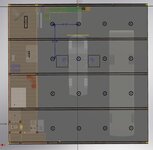
Main overhead lights of my 48x48 shop will get dedicated circuits for sure. 16x Lithonia round high bay led’s draw 1.625amps each at highest output = 26 amps total. 13 amps per circuit is over 80% load on a 15 amp breaker. I understood that to be max planned load?

Layout is below.

I was more worried about code for lighting in the bathroom and office I’ve attached, as well as exterior lights. e.g. should I just use my interior 110 circuit to power my exterior entry door light or should I plan an exterior circuit for ALL of my outside lights. Etc.

And no, I don’t know what I’m doing. I can be safe, calculate loads and size stuff, but this is not my area of expertise haha as you can tell.

IMG_9413.jpeg
 
OP
G

gsuty17

Well-known member
Joined
Mar 12, 2018
Messages
119
I would definitely run dedicated lighting circuits.

Just a PSA on cadet heaters. I deal with a lot (100s) of those 240v cadet heaters in apartments and houses around here. They have a bad failure mode where one of the heater coils breaks and shorts to metal, that combined with the usual single pole switch sends 120v through half the coil. This causes it to heat up partially, but a lot of people don't notice in the summer until the smell something hot or notice a big increase in their power bill from it running 24/7. It also makes it so when you touch it you can get hit with 120v. I've seen dozens fail this way now and the new ones look the same inside so I don't think its fixed, we have better luck with the really old ones just because the heater coil wires are beefier. If they don't break they are really nice but I wouldn't use one after seeing dozens fail in an unsafe manner. I have two new old stock (probably 15 year old) ones I keep thinking about putting in one of my bathrooms because I like them, but just can't do it after replacing so many of them. I also unfortunately have not found any decent drop in replacement for them.
Wow, thanks for the info! If you were me and doing a new install what would you suggest? A 120v cadet?
 

u2slow

Well-known member
Joined
Nov 20, 2011
Messages
3,590
Location
BC
e.g. should I just use my interior 110 circuit to power my exterior entry door light or should I plan an exterior circuit for ALL of my outside lights. Etc.
Depends on the count. I would load up a circuit, LED goes a long ways. Only a few might be outside.

I would consider some wall/side lighting (strips) and reduce your highbays. Mine are on the edge of shelving at 8'.
 

WildBill

ALLIANCE MEMBER
Joined
Aug 20, 2021
Messages
2,013
Location
PNW
Wow, thanks for the info! If you were me and doing a new install what would you suggest? A 120v cadet?
I have not seen them fail the same way, but they are probably only about 25% of the ones I deal with. Looking at them they seem to have safer spacing around the coils and they wouldn't have two lines bringing power in like the 240v versions, so they are not going to fail in such a dangerous way if they do fail. The few 120v versions I have replaced just had a broken coil, nothing bad happened besides they stopped working. They are not as powerful as the 240v version, but I would trust them a lot more.
 

AC-WC

Well-known member
Joined
Jan 22, 2023
Messages
773
Location
NE, Indiana
OK, since you have a 48X48 the 20 amp light circuits make sense for the main building. I would also double check the lumens output of each light. There's a lumens calculator you can find that compensates for ceiling height. You may still be able to do 15 amp.
If you're doing a circuit for bath, office lights and outlets 15 amps should do fine since you're planning on a circuit for the heater. Bath outlet should be a GFI if within 3 ft of water.
Water heater could go to 20 if you have a small 5 gal heater. They are only 110 volts/2000 watts.
I would do 20 amps for outlets but no more than that unless you know you have something with high power. 2 circuits, 1 per side of building. I would also include exterior lights with your 20 amp outlets, same for exterior door light. I really doubt they would pull that much current even with a couple of tools running.
Your 220 circuits seem to be appropriate amps.
 

imma_stocker

Active member
Joined
Sep 22, 2024
Messages
43
Location
Waller Texas
We're in the same boat. I'm running 2 lighting circuits 15A each through 14/2, one for ceiling lights using a duplex single pole switch (Half and half with 12A total draw) then another for wall lights on single switch sharing receptacle for extension cord to run outside (unlikely to need wall lights if I'm using that plug).

Curious what main panel you're going to use? So many acronyms and specific terminology about them I'm spending too much time researching what means what instead of running wires. All I know about main panel is I do not want to rewire the thing, ever.
 
To avoid these ads, REGISTER NOW!
Top Bottom