To avoid these ads, REGISTER NOW!

New to Forum - Insulation question

bhermes

Member
Joined
Feb 21, 2016
Messages
5
I have a already built 50x30 metal bulding. I am going to finish off a 27x16 area. I am located in Louisville, KY and mostly concerned with heating in the winter. Mostly when temperature outside is 30-50F.

My initial thought was to stud the walls and just use Fiberglass insulation. I was also going to create a joisted ceiling at 10 feet and do the same fiberglass insulation.

Two of the walls will be outside and two inside the building. The outside walls will have a 2-3 inch air gap from the steel building to the studs.

I am planning on an electric heater of some king but have to decided at this point.

The space will just be used for random projects and I really would like to do this as cheaply has possible.

I have seen a lot of posts but it just seems to come down to how much money you are willing to spend.

Any advice would be appreciated? Anyone insulate with fiberglass rolls?

Thanks.
 
To avoid these ads, REGISTER NOW!

tomroblee

Well-known member
Joined
Jan 11, 2006
Messages
446
Location
Indiapolis, IN
In the mid 1980's my neighbor in Indianapolis, IN built a 22' x 40' detached garage. As I recall, he used 8' walls on top of a course of two of concrete blocks. His back wall was cut into a bank, so about the bottom half was poured concrete.

He walled off a 16' x 22' bay as a work area with an insulated overhead door and a man door leading to the rest of the garage. In the winter he left a 1500 watt heater (generally at low setting) to keep things from freezing. When he wanted to work in the garage he turned on a second and third 1500 watt heater when they were needed.

My neighbor used 2x6 studs 16" on center for the walls and trusses 2' on center for the ceiling. I would recommend using 6" studs to give you a much insulation as possible. Spacing the studs 24" apart would give you more room for insulation. If you are planning on hanging much on the walls, consider using some blocking in the areas where you might want to attach heavy objects to the walls. Use as much insulation as you have room for and/or can afford.

You might also want to think a while about what you want to use for ceiling joists. You might be able to get by with using 2x6's if all you want to support is a ceiling and insulation. However, you might want to use this area for light storage at some future date (if you building has sufficient height). It might also be great to have a beam or two in strategic places across the ceiling in case you might want to attach a hoist at some future time.
 

tomroblee

Well-known member
Joined
Jan 11, 2006
Messages
446
Location
Indiapolis, IN
In the mid 1980's my neighbor in Indianapolis, IN built a 22' x 40' detached garage. As I recall, he used 8' walls on top of a course of two of concrete blocks. His back wall was cut into a bank, so about the bottom half was poured concrete.

He walled off a 16' x 22' bay as a work area with an insulated overhead door and a man door leading to the rest of the garage. In the winter he left a 1500 watt heater (generally at low setting) to keep things from freezing. When he wanted to work in the garage he turned on a second and third 1500 watt heater when they were needed.

My neighbor used 2x6 studs 16" on center for the walls and trusses 2' on center for the ceiling. I would recommend using 6" studs to give you a much insulation as possible. Spacing the studs 24" apart would give you more room for insulation. If you are planning on hanging much on the walls, consider using some blocking in the areas where you might want to attach heavy objects to the walls. Use as much insulation as you have room for and/or can afford.

You might also want to think a while about what you want to use for ceiling joists. You might be able to get by with using 2x6's if all you want to support is a ceiling and insulation. However, you might want to use this area for light storage at some future date (if you building has sufficient height). It might also be great to have a beam or two in strategic places across the ceiling in case you might want to attach a hoist at some future time.
 

theoldwizard1

Well-known member
Joined
Feb 22, 2011
Messages
43,158
Location
SE MI
My initial thought was to stud the walls and just use Fiberglass insulation. I was also going to create a joisted ceiling at 10 feet and do the same fiberglass insulation.
Heat rises. You need at least double the amount of insulation in the ceiling as compared to what you have in the walls.

Two of the walls will be outside and two inside the building. The outside walls will have a 2-3 inch air gap from the steel building to the studs.
GOOD ! That gap will save a lot of energy and probably make your build go easier/faster !

I am planning on an electric heater of some king but have to decided at this point.
You absolutely need to check into a mini-split heat pump. Perfect for this type of application. Better quality mini-splits will continue to provide heat at near 100% efficiency down to near 0F. They are also more efficient when cooling than a typical A/C unit.
 

Ohmthis

Well-known member
Joined
Jan 20, 2013
Messages
3,013
Location
Outside of Louisville KY
Bhermes, good to see another boy from the ville. Is your building a pole type or stick frame? I have a pole barn with 4 x 6 posts. I plan to frame out between posts with 2 x 4 horizontally on 24" centers. Then r19 insulation. That should give a real good wall. If you are framing the ceiling too, you can put something like r19 again and then run r30 perpendicular to give you a great roof envelope. Where abouts are you located?
 
OP
B

bhermes

Member
Joined
Feb 21, 2016
Messages
5
Thanks for the replies. Pole barn. Located off Gene Snyder and Beulah Church.

I was planning on 2X4 on 16 in centers but 24 in may make more sense.

And yes I do plan on framing the ceiling at 10 feet with 2x6's and some plywood for storage.

Do you plan on any type of thermal/vapor barrier?

I like the idea of a 1500 W heater and adding another heat source when using. Just need to calculate cost for running the heater.

Any comments on vapor film barrier would be appreciated. Can you buy fiberglass with the barrier already added. is it extremely expenses.

Thanks in advance.
 
OP
B

bhermes

Member
Joined
Feb 21, 2016
Messages
5
Just did a quick calculation and just having the 1500W heater on will cost about $100/mo during the winter months. Maybe 3 months. This seems a little high for what I am needing but maybe the only way to get the room up to reasonable temperature when I want to work.
 

Ohmthis

Well-known member
Joined
Jan 20, 2013
Messages
3,013
Location
Outside of Louisville KY
I live out in LaGrange area, but work in town. I plan on putting plastic on after the insulation as my vapor barrier. You can buy craft or Kraft (some people spell it differently) faced insulation. That's the type with paper on one side. Just put it up to the manufactures instructions. I understand the prices of things. My shop has been coming along slowly because I'm paying cash for all of it. A little here and there. I'm not any real help now (I'm down with a broken ankle) but if you need some help (I'm an electrician/HVAC tech) just pm me. Good luck!
 
To avoid these ads, REGISTER NOW!
OP
B

bhermes

Member
Joined
Feb 21, 2016
Messages
5
So I will be deciding on 2x4 vs 2x6 wall construction. 2x6 more expensive initially but may be better in the long run.

Do I need to put a vapor barrier on the outside of the 2x4 wall. Basically metal wall, 2-3 inch air gap, vapor barrier, 2x4 wall with insulation.

How about on the inside of the wall?

Thanks.
 

tomroblee

Well-known member
Joined
Jan 11, 2006
Messages
446
Location
Indiapolis, IN
The theory of vapor barriers is that you are trying to prevent water vapor from warm, moist air from condensing when it reaches a surface that is cooler than the dew point. In northern climates the warm moist air is generated inside the house (from cooking, baths, showers, etc.) and a moisture barrier is put on the inside walls to keep the moist air from reaching the colder outside walls or colder attic. In southern climates the vapor barrier is generally placed on the outside wall to keep the steamy summer air from reaching the inside walls that have been cooled with air conditioning.

Many years ago the use of vapor barriers was uncommon and not really needed because buildings were generally pretty drafty, uninsulated, and not air conditioned. Putting a vapor barrier on the inside walls and ceiling of your heated room is probably a good idea--especially if your activities will be generating much moisture. Paper faced insulation is often used as a vapor barrier. Stapling plastic sheeting over the insulated studs and ceiling joists is even better. In instances where a vapor barrier hasn't been installed a person can use special paints that act as a vapor barrier.

Your estimate of $150 per month to operate a 1500 watt resistance heater full blast 24/7may be in line. I looked at the Louisville Gas & Electric website and it quoted about $.09 per KWH for residential heat which would equate to about $65 per month. However, the $.09 per KWH didn't include the numerous riders or sales tax. It's hard to predict whether you would need to run the heater on high setting 24 hours per day very frequently. A heat pump could save you a bundle of $$ over a several year period of time. The offset is that modern heat pump capable of heating down to zero degrees will cost a bundle of money while a 1500 watt milk house heater is probably less than $30 (and it's about time for the end of the season sales at your local box store.)

Using 2x6 for the walls will allow about a 50% higher R value than you can get with a 2x4 wall. If you stick with 2x6 for the ceiling with plywood on top for storage you will be limited to about R19 insulation in the ceiling. It would be nice to have double that amount.

The one thing that hasn't been mentioned is ventilation. An air tight room will require less heat in the winter, but could be a real sweat box in the summer without air conditioning. My neighbor's "shop" bay of his garage had an overhead door that was opened in warm weather and he seemed to thrive on working in the heat. If you build an enclosed room without any windows or doors to the outside you may need to add air conditioning for the summer and possibly eliminate beans and hard boiled eggs from your diet.
 

rburke65

Well-known member
Joined
Nov 10, 2007
Messages
12,349
Location
Canfield, Ohio
Why would studs at 24" on center give you more insulation than at 16" on center.? Because you are using less studs...less wood?
 
Last edited:

Ohmthis

Well-known member
Joined
Jan 20, 2013
Messages
3,013
Location
Outside of Louisville KY
Why would studs at 24" on center give you more insulation than at 16" on center.? Because you are using less studs...less wood?

My thought on this is that wood is an insulator, but not as good as fiberglass, cellulose, or foam. If it was we'd put saw dust in the walls. So the less wood the more insulation.
 

tomroblee

Well-known member
Joined
Jan 11, 2006
Messages
446
Location
Indiapolis, IN
Most websites seem to post the R value of a 3 1/2" stud in the R4 to R4.5 range. Fiberglass insulation is generally quoted as R13 (but high density fiberglass may go up to R19?)

An interesting website showing the calculation of the R value of a wall assembly.

http://www.coloradoenergy.org/procorner/stuff/r-values.htm

In a structural situation I would be more prone to use 2x6 studs with wider spacing rather than 2x4 studs with narrower spacing. I would imagine that the stud spacing on a room that is built just to hold heat in could be even wider than 24" if a person could find economical insulation and wall covering materials that would fit.

The OP stated that he intended to use 2x6 ceiling joists, then place plywood over the top for storage. That may make the wall structure a little bit more "load bearing" (and subject to a bit more thought about stud size, spacing, and bracing as well as top plate design.)

Ceiling span tables suggest that using 2x6 ceiling joists to span a 16' wide room is stretching the limits even if the joists are not covered with plywood and used for storage.

http://www.southernpine.com/span-tables/joists-rafters/
 
OP
B

bhermes

Member
Joined
Feb 21, 2016
Messages
5
I teach high school engineering and one of the things we do is calculate wall R values and heat transfer. I will check cost vs using 2x4's or 2x6's vs the increase in overall R value. I may decide to use 2x8's in the ceiling to give a little more room for insulation and to provide better span support.

The window for summer heat is an issue. Although I have two large overhead doors on the front of the building and one large sliding door on the back, the corner I am finishing has no door or windows to the outside. My initial thought is to use this area mainly in the winter. I may add a window later.

Any more suggestions on cheap heating. The 1500W heaters seem to make sense for my use but open for more suggestions.

Thanks.
 

lewisb

New member
Joined
Feb 16, 2015
Messages
3
Location
Quebec, Canada
Why would studs at 24" on center give you more insulation than at 16" on center.? Because you are using less studs...less wood?

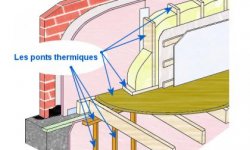
The studs will transfer the cold from the outside more easily. It's called ''pont thermique'' in French (thermal bridge in English:confused:).

Just to let you know that when you have R20 wall with 2x6-16''...it's actually Reff=13 because of the studs between the wall. Stud being R7 combine with your insulation of R20. So ''less'' stud is better
 

Attachments

  • test.jpg
    test.jpg
    12.5 KB · Views: 12
  • ponts_thermiques.jpg
    ponts_thermiques.jpg
    21.1 KB · Views: 13
Last edited:
To avoid these ads, REGISTER NOW!
Top Bottom