To avoid these ads, REGISTER NOW!

newbie basics

perhellion

Member
Joined
Nov 10, 2008
Messages
6
Long time lurker, first post.
I am in the early stages of planning my shop. Hope for 30 x 40, but that may be a bit ambitious. It seems that all discussions of people building shops have gotten beyond the basics. I am not having much luck searching on this question, hence my first post.
Around my home ( North Carolina), I have seen plenty of shops, and they are generally stick built, pole barn (although I did not know that is what what you call that kind of construction), metal (either corrugated or not), concrete block, or occasionally brick.
My question for this stage of planning is a comparison of the pros and cons and relative costs of these types of construction.
I know that I want the structure to be relatively climate controlled (so insulated and kept within say 45 to 85°).
Thanks in advance.
 
To avoid these ads, REGISTER NOW!

ItsNemo

Well-known member
Joined
Mar 5, 2016
Messages
4,805
Location
Canada
Stick build it if you're going to finish inside and insulate...the initial cost for the building is higher but makes everything else easier. It also allows you to finish the outside in a lot of ways to match the neighbourhood/existing structures.
 

doublearon98

Well-known member
Joined
Oct 7, 2017
Messages
676
Location
Hamton, Arkansas
As itsnemo said, you should go with stick built if you want to keep the temps in that range. Metal buildings are usually cheaper depending on where you live, but at the cost of garbage efficiency ratings, plus I just wouldn't have a metal building.

Sent from my SM-G930V using Tapatalk
 

gtae07

Well-known member
Joined
Mar 6, 2015
Messages
2,964
Location
Fayetteville, GA
Depending on where you live there may be some restrictions on construction type. I built my shop in an HOA-managed neighborhood, and that limited the height (8ft), construction method (stick built), and finish (vinyl matching the house). But, with stick-built I used 2x6 walls and my shop is thus better-insulated than my house is. Add a mini-split and it's nice and comfortable.
 

OccupantRJ

Well-known member
Joined
May 15, 2009
Messages
10,981
Location
Eastern North Carolina
I live in NC also. I say stick built with no more than 12 foot ceiling height, and that would allow for an auto lift. 9 foot otherwise. Plywood or osb exterior sheathing with your choice of exterior covering. 1/2" plywood walls on interior allow hanging and mounting things anywhere, and it shear braces the building tremendously for hurricane season.

Architectural shingles or metal roof. Pressure treated bottom plate. Foam seals between bottom plate and stem walls. Insulated walls and ceiling. Heat pump. Keep wood wall structure at least 8 inches above ground. Treat for termites as you start with floor. Cheaper then. Rest room with sink if possible. I used a sewage pump station.

60 amp or larger for power. Run extra conduits underground for later uses. My shop is built like this, and it will stay at 45 inside when it is in the 20's outside, so heating only requires about 20 degrees boost. Door open the other day when working in it, no AC previously running. Outside temp was 88. Inside was 80.

If you are handy, you can also do all or most of the work yourself in stages as money and time allows.
 
Last edited:

gmtech

Well-known member
Joined
May 22, 2018
Messages
85
Location
nc
I'm in NC as Well and I'm the process of getting started building a garage. While I have a 28x28 attached garage that I work out of now, it's just too cramped with the wife's car, golf cart, kids bikes etc so I need a dedicated shop. I've looked into all options. Stick built to somewhat match my house was my first thought. But after getting quotes upwards of $50k for a 32x32x12, that option was quickly ruled out. Next I was on to a 30x30x12 pole barn. I'm dealing with a sloping lot that has roughly 30" of slope over a 30' span. This was going to be a cost factor as the pole barn poles have to go 4' into "undisturbed" soil. So falling back on my $20k budget I'm settling on a 30x30x12 metal "carport style" garage built on a 8" block foundation with a 6" slab. Foundation is supposed to be started this week. Still deciding on door sizes but I'm leaning towards 2 10x10 doors and possibly if budget allows, 2 12x10 doors. The building will come fully insulated and I plan to line the interior walls with verticle roofing tin for a finished look. While not idea, it fits the need and budget.

Sent from my SAMSUNG-SM-G890A using Tapatalk
 

rburke65

Well-known member
Joined
Nov 10, 2007
Messages
12,349
Location
Canfield, Ohio
Previous poster said ‘no more than 12’ side wall’..... if your consideraing a lift, make sure your lift does not require 145”!! Yes it all comes down to money and build codes. If you want to finish the inside, stick build it.
 

ItsNemo

Well-known member
Joined
Mar 5, 2016
Messages
4,805
Location
Canada
Previous poster said ‘no more than 12’ side wall’..... if your consideraing a lift, make sure your lift does not require 145”!! Yes it all comes down to money and build codes. If you want to finish the inside, stick build it.
Best way to deal with that is a small stem wall, 6-12" above finished floor height and grade. This can give you an inside height of 12'6" or so and that extra bit of room over 12' even without having to try to use taller than 12' studs. Also prevents a lot of moisture issues you'd otherwise have.
 

stm317

Well-known member
Joined
Aug 8, 2017
Messages
1,339
Stick built is going to cost more upfront, and take longer to construct, but it can be nicer and costs about the same as a pole barn with a finished interior.

If you need to get the building up quickly, or your budget is tight and you'll need to finish it in stages, the pole barn approach provides a lot of flexibility. My 32x48 pole barn went from a bare spot in my lawn to an enclosed building with slab in 5 working days. That meant that I could keep some of my stuff out of the elements while I work on finishing the interior to my liking. It would've taken several weeks to get a stick built structure to that point.

Whatever method you choose for construction, it might be best to try and keep your dimensions divisible by 4 or 8 Since many building materials come in 4ft or 8ft lengths. This results in less waste which means that it can be faster, and cheaper to build a 32x48 than say a 30x50.
 
To avoid these ads, REGISTER NOW!
OP
P

perhellion

Member
Joined
Nov 10, 2008
Messages
6
Thanks so far.

To address some points brought up in the discussion:

no HOA - never make that mistake again
no city limits and plenty of land, so no restrictions on what the building looks like
ubiquitous - many types are common, that is the problem in making my decision
no lift - not enough car work to justify
please add your real world quotes -the $50 K versus 20 K example was very informative
What is wrong with the metal buildings? One example says their metal building is insulated, and I have seen metal buildings that are insulated, but I have also read several posts saying they are difficult if not impossible to insulate. Please add any thoughts along these lines. No one has mentioned concrete block, so is that more expensive?
 

JamesW84

Well-known member
Joined
Jul 13, 2015
Messages
827
Location
Springfield, MO
You can insulate metal buildings. Usually, they use the vinyl-backed roll insulation.
What I found:

Metal:
Usually pay someone to erect it. No framed walls to hang stuff on. Goes up quickly. Strong. Concrete must be poured before install.

Pole Barn: Concrete is optional. You pour after the building is up if you want it. No framed walls to hang stuff on. Some people roll insulation horizontally and lay it on top of each previous layer since they don't have studs. I don't like the idea of poles in the ground to rot (usually rot at the ground level), but it's a very popular building method. Perma-Column concrete "poles" would keep the poles out of the ground, but they run about $100 each, so that could get expensive. Pretty much have to use metal to finish the outside and the roof.

Stick built with Slab on Grade: You pour your slab and build your walls on top of the slab with no footing or foundation walls. This might be ok if you have a well compacted base and rebar or wire mesh (I'd go rebar). If you have all of the weight of the building on the edges of the slab, they could push the sides down and cause the concrete to pull apart in tension, which is what the rebar is good for.
.
Stick built with footer and foundation wall. Floating floor poured inside. Your floor is allowed to float insde the foundation and is not attached to the rest of the structure. You can finish the inside walls or not. Easy to insulate with roll insulation. Will take longer to build and cost more. You can finish the outside how you want. You could do metal or shingle roof if you spec your trusses for it.
 
OP
P

perhellion

Member
Joined
Nov 10, 2008
Messages
6
One I forgot - is 1/2" plywood thick/strong enough for hanging whatever you want without having to hit a stud?
 

ItsNemo

Well-known member
Joined
Mar 5, 2016
Messages
4,805
Location
Canada
One I forgot - is 1/2" plywood thick/strong enough for hanging whatever you want without having to hit a stud?
Not whatever you want. Most stuff like shovels, single tools, etc. no problem...but shelving or hose reels or cabinets I'd still aim for a stud.
 

Jhoff310

Well-known member
Joined
Jan 2, 2012
Messages
876
Location
Perrysburg Ohio
Stick built for sure--easier to finish inside and out.

Stick built requires studs every 16" on center with a sill plate on the bottom and a double top plate on top.
Pole barn is 4 X 4 post construction with 2x lumber connecting said posts. the post can vary from 24" to 48" on center.

The stick built will cost a few bucks more upfront, but is worth it in the end.
 

My Old Tools

Well-known member
Joined
Jun 4, 2014
Messages
5,428
Location
Hamrick Lake, TX
In a counter opinion, I love my metal building. I had an overhead crane (2000# lift) designed in and a clear span 30x20 loft. It's well insulated. I don't hang stuff on walls much and it's easy to set shelving, benches, or cabinets where ever you want. If you have to have hanging space, just stand up a stud wall and cover it with plywood. It doesn't have to be every wall. As to finishing, the outside is done when built, the inside is your option.
 
OP
P

perhellion

Member
Joined
Nov 10, 2008
Messages
6
There seems to be a huge difference in - stick built is a few dollars more -- and 50k for stick vs 20k for metal. I know the quote depends on size, but is a "little more" for stick buiit really 250% of the cost of a metal building?
 

matt_i

Well-known member
Joined
Mar 14, 2008
Messages
10,725
Location
SE Michigan
Keep in mind the cost of the metal building package (i am assuming red iron here) gets you a truckload of steel parts (kit).

Now you take the plans over to a P.E. who designs the foundation. $20k worth of concrete work later (paraphrasing its typically a grade beam setup with big monolithic blocks hidden under the "floor" to handle the concentrated loads of the columns and their reactions to side forces like wind) you now have a slab that's appropriate to erect the building on. The erectors will probably want $10k so you are now close to the $50k.

I'm not trying to push you either way. I like the look of traditional stick built with higher pitched roofs and overhangs on sidewall and endwall. I think they are easier to wire with NM than a metal building where everything has to be conduit and unistrut.
 

gtae07

Well-known member
Joined
Mar 6, 2015
Messages
2,964
Location
Fayetteville, GA
Stick built with Slab on Grade: You pour your slab and build your walls on top of the slab with no footing or foundation walls. This might be ok if you have a well compacted base and rebar or wire mesh (I'd go rebar). If you have all of the weight of the building on the edges of the slab, they could push the sides down and cause the concrete to pull apart in tension, which is what the rebar is good for.

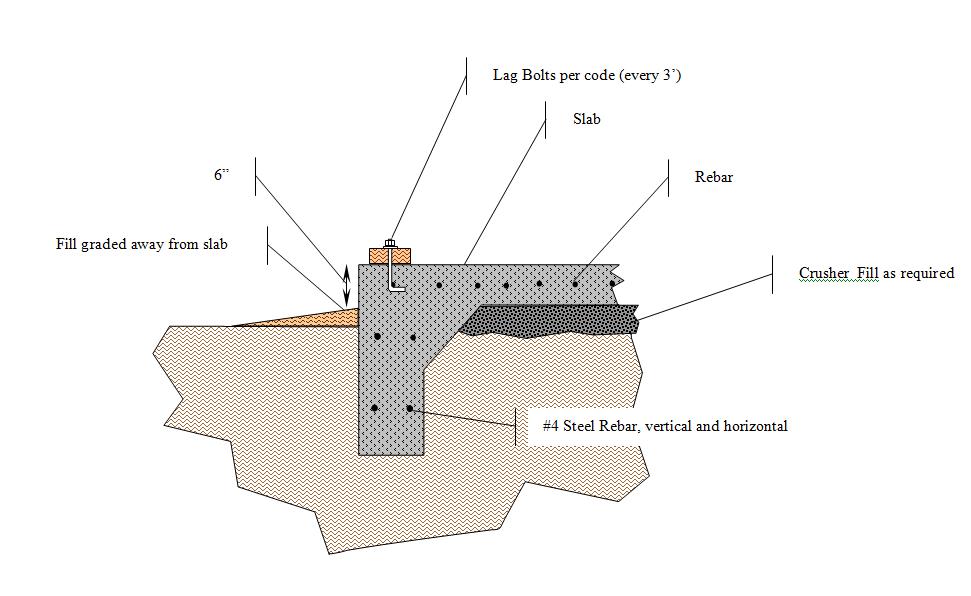
Uhh, monolithic slab has footers too.

Slab-Details.jpg


The perimeter of the slab gets thickened; depth depends on local requirements. Around here the requirement is 12" below grade (no frost concerns). And reinforcement is required that ties these footers into the slab itself.

This is used for most residential construction around my area--our water table is very high and we're not that high off of sea level. Though I think our j-bolts are an 18" spacing requirement due to hurricane wind loads...
 

My Old Tools

Well-known member
Joined
Jun 4, 2014
Messages
5,428
Location
Hamrick Lake, TX
Keep in mind the cost of the metal building package (i am assuming red iron here) gets you a truckload of steel parts (kit).

Now you take the plans over to a P.E. who designs the foundation. $20k worth of concrete work later (paraphrasing its typically a grade beam setup with big monolithic blocks hidden under the "floor" to handle the concentrated loads of the columns and their reactions to side forces like wind) you now have a slab that's appropriate to erect the building on. The erectors will probably want $10k so you are now close to the $50k.

I'm not trying to push you either way. I like the look of traditional stick built with higher pitched roofs and overhangs on sidewall and endwall. I think they are easier to wire with NM than a metal building where everything has to be conduit and unistrut.
30x40x12 on flat ground is about $35k here all in including concrete, erection, and insulation, no inside finishing.
 
OP
P

perhellion

Member
Joined
Nov 10, 2008
Messages
6
matt_i -- clear explanation of added cost for the slab when you get quote for a metal building
my old tools -- thanks for a size/type/dollar estimate -- any others from other members?
 
To avoid these ads, REGISTER NOW!
Top Bottom