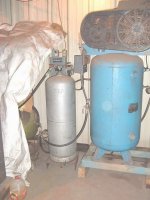
Depends on the facility and type of use. In an industrial environment of any size, generally you are going to have rotary screw compressors, which run more or less constantly and can be sized to put out enough air to supply anything you need. Most systems of this nature will have one or more air receivers, to give a bit of cushion for variation in demand. Generally the tanks are large relative to what you would have in a home shop, but somewhat small relative to the compressor and its output (vs. what you would see with a reciprocating compressor). An air receiver is essentially an air battery- it only does any good when there is opportunity to recharge it. So if your average air draw is more than what your compressor is putting out, it doesn't matter how big of a tank you have, you're going to run out of air. More air storage can be advantageous where there is a lot of demand variation- for example if you have a media blast operation that is not used regularly, that will draw a tremendous amount of air, but maybe for only a few minutes at a time. So your choices are to either buy a huge (and expensive) compressor that can more or less keep up for the few minutes of extremely high draw, but then is way oversized for the rest of the time, or build storage capacity in the system to help provide extra air for those high draw periods. A smaller compressor can then recharge the receiver in times of lower demand. Even at that, though, applications with very high air demand can drain even a large receiver very quickly. In other applications where demand is closer to constant, it makes more sense to have less storage capacity. Variable speed compressors have changed things in recent years as well, basically allowing the compressor to vary its output to meet demand.




 Manufacturing facilities will run large rotary screw compressors. Smaller body shops and auto shops will run multiple large displacement reciprocating (piston) air compressors.