
So a little over two years ago I purchased my parent's acreage when my mother passed away. The house had a garage roughly 42x30 with a dirt floor, studs for walls with buffalo board, and vinyl siding for the skin. My original intentions were just to have a contractor dig out some of the dirt floor and then pour in a concrete slab with a floor trench for drainage and have new garage doors put in. After the first contractor missed the start date by a month I talked with a smaller construction company that was willing to start that week. The contractor pushed hard to install in floor heat, so I decided that I would at least get the infrastructure in place, and at a later time add in a boiler. The floor looked so nice I opted to have the walls and ceiling drywalled and insulated you know just for when I put in the boiler.
So I have been shopping around and looking at different boilers, I was really sold on the Electro Industries EZB-ECO, however, you need to purchase them from an authorized dealer. Everyone I called to order one seemed disinterested and failed to return my calls when I mentioned I was going to install it myself. So I found I could order the Nextgen Boiler on Home Depot's website. After researching it and calling to talk to someone at Nextgen to discuss the features, I found it was similar to the EZB-ECO I was looking at, a box on the wall with everything inside, contained in a nice small package. Since it was Home Depot I was able to purchase it and have it shipped to my home for free.
When the box arrived it was wet with water dripping out of it also from the inside of the cabinet as well. It clearly had been handled poorly and one of the bottom sides was bent in slightly but nothing I couldn't unbend with my hands. I checked for any other damage but a hard drop on the side was all that I could find. I gave it some time to air out and dry the internal components before putting any electricity in it.
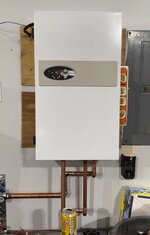
I went with the 12 Kwh boiler, so to power it I installed a 60amp breaker along with 6/2 wire, I actually bought 6/3 and didn't use the red wire, don't ask me why, maybe subconsciously I was a glutton for punishment fighting that thick *** wire through the insulation and wall studs. I also installed a 12/2 line on a new 20 amp circuit to power the pump. I was very unimpressed with the way they wanted me to mount it on the wall. All that came with the 75lb boiler were two small lag bolts with plastic expanding anchors. There was no way I was going to hang this with those cheap *** anchors in drywall only, so I screwed in a backing piece of plywood to the wall studs and used the lag bolts through that. The design is to leave the heads out a little bit because there are notches on the back that fit over them, you can then tighten them from the inside through the front.
When looking at the boiler internals you cannot see the air expansion tank, which is located behind a vertical mid-panel in the box and is visible from the backside. I used 3/4 copper line to the supply and return lines from my manifold. Mounting the box and getting the lines and electricity hooked up took maybe an hour, I spent more time dicking with the copper because the supply and return lines on the boiler are side by side, so I needed to pipe back towards the wall then bring it back off the wall to connect to the supply line. After flushing the system, I cleaned the magnetic filter of any debris, then filled everything with my glycol mix, and started it up.
For a thermostat, I just bought a cheap digital Honeywell that is programmable using the mindset I would rather it heat the floor up more at night during off-peak hours and try to avoid it running during the day when electricity prices are a premium. There is a connection in the box for running it during off-peak hours, and I still need to contact the electric company and find out what they need to do in order to utilize that function. I only used a two-wire thermostat wire, connecting the white and red to the thermostat in their respective locations.
My glycol transfer pump allowed me to get the system to 14psi, however, the supply temp was causing a light to flash on the panel, after reading the manual I learned it is common with cold start-ups with colder incoming fluid so I just let it do its thing and it corrected it by itself a started functioning as it should. So now it's been running for about two hours. Overall I am impressed with how easy it was to do by myself, hanging it on the wall by myself really sucked, but it was manageable. If you're looking for an affordable easy to purchase, easy-to-install system that is clean looking I would recommend this at this time. Now the thing could take a **** on me in a week and my thoughts would change. But this review is about the installation and not the functionality and performance at this time. I will update with how everything is working over time but for now, I am pleasantly surprised and happy I went this route.
The red light on the panel indicates that the heating element is on, the thermostat is not mounted anywhere yet and is just up so my dogs won't eat it.
So I have been shopping around and looking at different boilers, I was really sold on the Electro Industries EZB-ECO, however, you need to purchase them from an authorized dealer. Everyone I called to order one seemed disinterested and failed to return my calls when I mentioned I was going to install it myself. So I found I could order the Nextgen Boiler on Home Depot's website. After researching it and calling to talk to someone at Nextgen to discuss the features, I found it was similar to the EZB-ECO I was looking at, a box on the wall with everything inside, contained in a nice small package. Since it was Home Depot I was able to purchase it and have it shipped to my home for free.
When the box arrived it was wet with water dripping out of it also from the inside of the cabinet as well. It clearly had been handled poorly and one of the bottom sides was bent in slightly but nothing I couldn't unbend with my hands. I checked for any other damage but a hard drop on the side was all that I could find. I gave it some time to air out and dry the internal components before putting any electricity in it.
I went with the 12 Kwh boiler, so to power it I installed a 60amp breaker along with 6/2 wire, I actually bought 6/3 and didn't use the red wire, don't ask me why, maybe subconsciously I was a glutton for punishment fighting that thick *** wire through the insulation and wall studs. I also installed a 12/2 line on a new 20 amp circuit to power the pump. I was very unimpressed with the way they wanted me to mount it on the wall. All that came with the 75lb boiler were two small lag bolts with plastic expanding anchors. There was no way I was going to hang this with those cheap *** anchors in drywall only, so I screwed in a backing piece of plywood to the wall studs and used the lag bolts through that. The design is to leave the heads out a little bit because there are notches on the back that fit over them, you can then tighten them from the inside through the front.
When looking at the boiler internals you cannot see the air expansion tank, which is located behind a vertical mid-panel in the box and is visible from the backside. I used 3/4 copper line to the supply and return lines from my manifold. Mounting the box and getting the lines and electricity hooked up took maybe an hour, I spent more time dicking with the copper because the supply and return lines on the boiler are side by side, so I needed to pipe back towards the wall then bring it back off the wall to connect to the supply line. After flushing the system, I cleaned the magnetic filter of any debris, then filled everything with my glycol mix, and started it up.
For a thermostat, I just bought a cheap digital Honeywell that is programmable using the mindset I would rather it heat the floor up more at night during off-peak hours and try to avoid it running during the day when electricity prices are a premium. There is a connection in the box for running it during off-peak hours, and I still need to contact the electric company and find out what they need to do in order to utilize that function. I only used a two-wire thermostat wire, connecting the white and red to the thermostat in their respective locations.
My glycol transfer pump allowed me to get the system to 14psi, however, the supply temp was causing a light to flash on the panel, after reading the manual I learned it is common with cold start-ups with colder incoming fluid so I just let it do its thing and it corrected it by itself a started functioning as it should. So now it's been running for about two hours. Overall I am impressed with how easy it was to do by myself, hanging it on the wall by myself really sucked, but it was manageable. If you're looking for an affordable easy to purchase, easy-to-install system that is clean looking I would recommend this at this time. Now the thing could take a **** on me in a week and my thoughts would change. But this review is about the installation and not the functionality and performance at this time. I will update with how everything is working over time but for now, I am pleasantly surprised and happy I went this route.
The red light on the panel indicates that the heating element is on, the thermostat is not mounted anywhere yet and is just up so my dogs won't eat it.
![Image[342].jpeg](/forum/data/attachments/1654/1654606-7076ea5fd52ccc5ea916374439a26ae0.jpg)
![Image[343].jpeg](/forum/data/attachments/1654/1654607-feb762019b613f5b1f31fc09760580e6.jpg)
![Image[347].jpeg](/forum/data/attachments/1654/1654613-348b9e1164670f5e3b0632d5c174cde3.jpg)
![Image[345].jpeg](/forum/data/attachments/1654/1654614-51cf8a1f8ab9929f09bc77751c4c0ae3.jpg)
![Image[348].jpeg](/forum/data/attachments/1654/1654610-294964564d8df6c606e1c1a28d4036be.jpg)
