To avoid these ads, REGISTER NOW!

Nitrogen regulator

bluedog225

Well-known member
Joined
Jan 31, 2012
Messages
3,237
Location
Texas
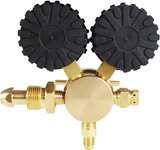
I dragged this home from Restore. Airco, Davis, Bournoville(?).

I don’t know anything about nitrogen. I will need to nitrogen test my lines on the mini split I install one day. And I thought this might come in handy.

No obvious damage though it has seen some years. Is there something I should do in terms of having it inspected or calibrated prior to use?

Thanks

IMG_0502.jpegIMG_0503.jpeg
 
To avoid these ads, REGISTER NOW!

rlitman

Well-known member
Joined
Oct 18, 2010
Messages
24,576
Location
Long Island
I suspect being nitrogen, there's not a lot to worry about. it will leak or it wont, it will adjust or it wont.
As with any high pressure cylinder regulator, I'd look at the safety relief. Make sure there is a burst disc or relief valve, and that it's not blocked or plugged. With old regulators, a failed diaphragm can release full cylinder pressure into the low pressure side, and if the relief valve isn't working, even nitrogen can make things go bang.

Relief valves are quite fail-safe, so I, like you, wouldn't be too concerned, so long as it doesn't look like some idiot jammed a plug in somewhere because it was "leaking".

For those not familiar with what I'm talking about, relief valves come in many forms, but one such example is in the 3 O'clock position in this picture:
61GsL-zFgoL._AC_UF894,1000_QL80_.jpg
 

Meursault74

Well-known member
Joined
Apr 1, 2019
Messages
21,866
Location
Southern California
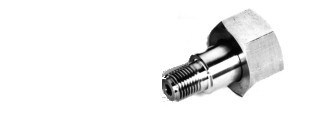
I don’t think that’s the correct connection for n2. Should be like post 3.
That was my thought as well, but it sometimes depends on the tank. The Nitrogen tanks I use have regulators that look like post 3

I know in my lab, the compressed air is different than compressed nitrogen / argon. The air looks like the one bloodog posted. Hydrogen looks like that as well, but has some divots on the flats and it's reversed thread. This system is almost idiot proof.

I found that CGA 679 for N2 looks like the one in the picture. I've never used it though

1714711265049.png


The fittings can be changed to match the tank.
 
To avoid these ads, REGISTER NOW!

metalmagpie

Well-known member
Joined
Nov 1, 2011
Messages
796
Location
Seattle
Airco purchased Davis Bournonville a long time ago, over 100 years ago in 1922. I am guessing that the lenses on those gauges are made of glass. It is no longer legal to sell replacement lenses for those gauges. You may be able to find glass of the right diameter and thickness and grind the taper on the outside with diamond tools but it would be an extreme effort for little payback.

I doubt anyone has made replacement diaphragms and seats for that regulator for at least 60 years.

If it works, use it. But don't expect to be able to fix it.

One thing to keep in mind, a large percentage of the earth's atmosphere is nitrogen. It's not a particularly dangerous gas. So I'd go ahead and attach the regulator to your N2 tank and try flowing some nitrogen under different pressures. See if it works or not. Here is my quick and dirty regulator test procedure:

Crack tank valve open briefly to blow out dirt.
Attach the regulator to the tank.
Unwind the pressure handle until loose.
Open the tank valve
1. Is pressure showing on the high pressure gauge? (should be YES)
2. Is any gas flowing? (should be NO)
Close the tank valve
3. Watch high pressure gauge. Does it fall rapidly? (should be NO)
Leak test using solution (a few drops of dish detergent in water work OK).
4. Any leaks? (should be NO)
Open the tank valve again.
Wind in the pressure handle until gas just starts to flow.
Block the gas flow with your thumb.
5. Watch low pressure gauge. Do you see a low steady reading? (should be YES)

This series of checks takes just minutes to perform. It will catch leaky seats and diaphragms or other leaks and it will verify the integrity of the handle/spring system. These areas are where most regulator problems happen. If your regulator passes, then go ahead and put it into service and see how it does.
 

PoorOwner

Well-known member
Joined
Feb 10, 2007
Messages
5,032
Location
CA
You will close the valve on the HVAC gauge.. so this doesn't really need to be perfect
I would clean it out to make sure it's not going to blow garbage into the lines though.
 

metalmagpie

Well-known member
Joined
Nov 1, 2011
Messages
796
Location
Seattle
You will close the valve on the HVAC gauge.. so this doesn't really need to be perfect
I would clean it out to make sure it's not going to blow garbage into the lines though.

So you're saying his nitrogen regulator is an HVAC gauge? And what do you mean by "this doesn't really need to be perfect"? And it sounds like you're worried the thing is full of mouse turds.
 

PoorOwner

Well-known member
Joined
Feb 10, 2007
Messages
5,032
Location
CA
So you're saying his nitrogen regulator is an HVAC gauge? And what do you mean by "this doesn't really need to be perfect"? And it sounds like you're worried the thing is full of mouse turds.

No, OP said he would need to test this HVAC so he will have a HVAC guage hook up on his AC. After filling about 300 PSI of nitrogen he would close the HVAC guage's knob. The nitrogen tank and this reg can be removed.
 
To avoid these ads, REGISTER NOW!
Top Bottom