To avoid these ads, REGISTER NOW!

No Vapor Barrier

nwav8tor

Well-known member
Joined
Feb 21, 2012
Messages
239
Location
Spokane, WA
I live in climate zone 5 and am getting ready to install a 75K natural gas Big Maxx heater in the 800 sq ft attached garage with 9' ceilings. The walls and ceiling are already sheetrocked so I'll use blown-in insulation for both the walls and the attic above the ceiling. I know that there was no vapor barrier installed before the sheetrock, so my question is this: What does that mean in this situation? Will this cause serious problems for me or is it simply just a factor of not being done in the most energy efficient way?

Thanks,
Paul
 
To avoid these ads, REGISTER NOW!

dirttracker18

Well-known member
Joined
Aug 10, 2009
Messages
3,191
Location
Slate River, ON
It will mean big inefficiencies.

A well sealed building does more than good insulation. Although they are part of a good package. The insulation slows the exchange of warm and cold while the VB stops the movement of air, speeding that exchange of heat and cold.

Use an online heat loss calculator with and without VB and you will see the difference.

If you heating intermittently you can just live with it but can run the risk of mold in the walls. Not a definite but a possibility.
 
Last edited:

e-tek

Well-known member
Joined
Dec 19, 2007
Messages
10,690
Location
Saskatoon, SK
I think VB would be critical in an "attached" garage - especially if you're ever going to bring in a wet or snow-covered vehicle. As you likely know, the VB stops moisture from going though the wall to condensate on the insulation, or freeze against the siding in winter, only to melt later and affect the siding.
You're in luck though - some paints can act like a VB. Research them a bit and you'll find that by sealing and painting with the correct material, you can get almost the same barrier as with properly installed plastic. Make sure to seal around light fixtures and switches. Another help would be a fan running that pulls moist air out. I have a window fan running in my shop most of the year - it ***** heat\fumes from the cars out in summer and moisture at other times.

Hope that helps - we'll see what the pro's say!
 

kb2tha

Well-known member
Joined
Oct 4, 2010
Messages
495
Location
Delaware County, NYS
Closed cell spray foam would be a solution although spendy. Closed cell acts as a VP when applied in thicknesses over 3". Around here, closed cell is selling for $.85 per sf per inch of thickness applied.
 

Full Throttle

Well-known member
Joined
Nov 8, 2011
Messages
285
Closed cell spray foam would be a solution although spendy. Closed cell acts as a VP when applied in thicknesses over 3". Around here, closed cell is selling for $.85 per sf per inch of thickness applied.

he can't use closed cell foam when the walls are alread sheetrocked,

I would us it in the attic though
 
OP
N

nwav8tor

Well-known member
Joined
Feb 21, 2012
Messages
239
Location
Spokane, WA
I understand the theory of VB and an airtight envelope preventing moisture movement into the wall/ceiling cavities, however, how practical is that in a typical garage? Wouldn't the articulated garage doors (even though each panel is insulated with foil-faced stryrofoam sheets) be the weak link that prevents the garage from being airtight? Wouldn't it be easier for any moisture in the garage to escape through the garage doors and their associated air gaps rather than penetrating through sheetrock into the walls and ceiling?

I didn't know there was such a thing as VB paint, but unless it's really cost prohibitive, I'll probably prime the walls and ceiling using such a product.

What would be worse (i.e. from a moisture penetrating the walls/ceiling and freezing/melting/ruining insulation/causing mold standpoint), trying to keep the garage at a constant temp (say 55F) at all times, or just heating to 60-65F when I'm working and letting it go down to 35-40 when I'm not out there?

Paul
 

pattenp

Well-known member
Joined
Jun 4, 2008
Messages
10,175
Location
Virginia - USA
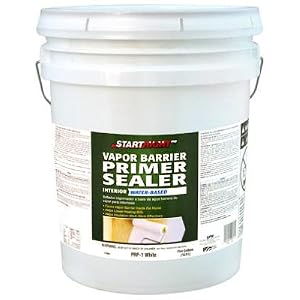
$67 for 5 gal on Amazon

41SXtODnWjL._AA300_.jpg
 

jumpingryan

Well-known member
Joined
Jan 17, 2009
Messages
89
Location
Ontario, Canada
Oil based paints and primers can act as a form of a vapour barrier. This was commonly used in older houses without vapour barrier.

It would likely require 1-2 coats of oil based primer, and then a coat of oil based paint to be effective. I would recomend 2 primer and 2 coats of paint to completely make it a "true" vapour barrier.

For the interior of houses I rarely use oil based stuff due to clean-up & possible health issues and it really isn't necessary as compared to modern latex blends for everyday finishes of walls and trim.

I did use oil based recently for a used oil tank I bought for my garage. Due to modern insurance and oil inspectors obsession with surface rust on oil tanks (despite the fact it is less than 8 years old), I gave it a coat of oil based paint prior to installation. We have a 20 year limit on interior oil tanks in Ontario. The oil paint gave a nice finish on metal, and for future metal projects that require durability, I will be repeating. I just threw out the brushes when I was done, and anything I poured the paint into.

When dealing with oil based paints, ensure you let whatever tools you will be disposing of air dry in the open before disposal. While I haven't heard of it, oily rags have caused fires when tossed in a can, and I treat oil based paints the same way even though I have no justification to. Just let your brushes/rollers/cans dry in the open before you toss them if your local area allows.

At this stage, the oil based stuff is probably your only solution.... it will really seal in your drywall finish, and it will be a very durable finish.

R
 

kippieland

Well-known member
Joined
Oct 22, 2011
Messages
1,123
Location
Western Washington
I understand the theory of VB and an airtight envelope preventing moisture movement into the wall/ceiling cavities, however, how practical is that in a typical garage? Wouldn't the articulated garage doors (even though each panel is insulated with foil-faced stryrofoam sheets) be the weak link that prevents the garage from being airtight? Wouldn't it be easier for any moisture in the garage to escape through the garage doors and their associated air gaps rather than penetrating through sheetrock into the walls and ceiling?

I didn't know there was such a thing as VB paint, but unless it's really cost prohibitive, I'll probably prime the walls and ceiling using such a product.

What would be worse (i.e. from a moisture penetrating the walls/ceiling and freezing/melting/ruining insulation/causing mold standpoint), trying to keep the garage at a constant temp (say 55F) at all times, or just heating to 60-65F when I'm working and letting it go down to 35-40 when I'm not out there?

Paul

We live in the same city...hi neighbor! My take on this is two-fold. First, anytime hot meets cold vapor is formed and mold will grow....and it happens quick even where we live. My dry vent popped off for a couple of months (without use knowing) and mold had already started to grow....in the garage that is unheated. Second, trying to heat a garage all the time is true waste of money and energy. You would be better off to heat it when using it and to turn it off afterwards.

In our area new houses are built to have garage as a cold zone....its not a good idea to turn a cold zone into a warms zone like our houses.....thats why your point is correct the garage doors are a weak link because it was never intented to be a warm zone. Do you know what R-values you put or will be in the walls and Attic? In Spokane Valley, the minimum R-value in a basement is an R-21....I know the walls are close to that R-value so I am not sure you can get enough in the walls with blown it. Even if you get enough insulation in, you will still be wasting a ton of energy and dollars to heat a room all the time, given that it was never designed to be that. I would love that heater in my Shop (which is uninsulated) for when I am in there during the cold....it sounds awesome!
 

6768rogues

Banned
Joined
Nov 28, 2007
Messages
4,524
Location
Western NY
Heat moves from places of high heat to places of low heat and water vapor moves from places of high water vapor to places of low water vapor.
Say your building is 60 degrees inside and it is 10 degrees outside. The inside of your insulation is warm and moist, the outside is cold and dry. Heat and water vapor try to escape through the insulation. At some point between inside and outside, the temp will reach the freezing point. That is where the water vapor will freeze in the insulation. Repeat the process a few times and you will have soaked insulation and all the problems that go with it.
I would at least use a good vapor retarding paint.
 

BadgerBoilerMN

Well-known member
Joined
Aug 4, 2011
Messages
837
Location
Minneapolis
First, your heater is a least twice too big, likely 3x.

Next, 2"-2# foam can be injected in existing walls, and should be installed first over the finished ceiling with cellulose.
 

Dick in Wisconsin

Well-known member
Joined
Mar 3, 2012
Messages
3,048
Location
Shawano, Wisconsin
When dealing with oil based paints, ensure you let whatever tools you will be disposing of air dry in the open before disposal. While I haven't heard of it, oily rags have caused fires when tossed in a can, and I treat oil based paints the same way even though I have no justification to. Just let your brushes/rollers/cans dry in the open before you toss them if your local area allows.

R

My cousin had some drop cloths that he'd used underneath something he painted. Waited until they dried out real good, folded them up and put them under his work bench. This guy is very clean person in the shop, spotless. He had the garage door open late one afternoon. The door of course was facing west. Suddenly the garage was consumed in flames. Fire chief sad it was from the oil based drop cloths! Spontaneous combustion. Very dangerous.
 
OP
N

nwav8tor

Well-known member
Joined
Feb 21, 2012
Messages
239
Location
Spokane, WA
First, your heater is a least twice too big, likely 3x.

Next, 2"-2# foam can be injected in existing walls, and should be installed first over the finished ceiling with cellulose.

My heater is probably larger than I need, but 2x to 3x? I doubt it! I had access to either 45K or 75K Mr Heater Big Maxx's. According to their heater sizing chart, for my size garage, a 45K heater should provide about a 45F temp rise. I got the next larger size to be able to handle a future garage addition and due to the fact that I knew my insulation situation wouldn't be ideal and I was worried about heat loss...

Paul
 

Deltarat

Well-known member
Joined
Nov 29, 2006
Messages
341
Do we need VB here in the south-Ms? I don't have it in my house and do not see it in new construction here. I don't have any signs of mold.
 
To avoid these ads, REGISTER NOW!
OP
N

nwav8tor

Well-known member
Joined
Feb 21, 2012
Messages
239
Location
Spokane, WA
Kippieland,

Well, Hello to you too, neighbor! Without heat or insulation, my 3-1/2 car garage rarely got below freezing (at least the water stored out there has never frozen) but it certainly is too cold for extended work periods. I know it'll be hard to effectively insulate, but with the large heater, I think I can keep it comfortable while I am out there.

With the blow-in Attic Cat insulation I got from HD, I can get R13 to R15 in the 2x4 walls and can get anywhere fro R19 to R49 in the ceiling depending on how deep I lay it. I installed 1" rigid foam in the garage doors which should only give me about R-5. With those constraints, I probably won't go more than R-25-30 in the garage attic. Definately will use a VB primer on the drywall before the finish coat.

With the 75K heater and low temperature thermostat I have, I could lower the garage temp down to 35-40F when I'm not working and hopefully raise it rather quickly to 60-65 when I want to work comfortably. I'll just have to wait and see how it works...

Paul
 
Last edited:

Highbeam

Well-known member
Joined
Feb 15, 2011
Messages
2,292
Location
Mt Rainier foothills, WA
Funny. In western WA, modern construction doesn't use plastic for the VB anywhere. The homes are built and then painted with the VB paint and/or enough latex paint to provide the barrier. This is a mold/water issue and not an efficiency issue.

As far as energy savings, if you have properly finished the sheetrock with taped joints then just where do you expect heated air to leak into the attic? The air sealing is done with the sheetrock. Your efficiency is only slightly better, if at all, with a plastic VB.
 

kippieland

Well-known member
Joined
Oct 22, 2011
Messages
1,123
Location
Western Washington
Kippieland,

Well, Hello to you too, neighbor! Without heat or insulation, my 3-1/2 car garage rarely got below freezing (at least the water stored out there has never frozen) but it certainly is too cold for extended work periods. I know it'll be hard to effectively insulate, but with the large heater, I think I can keep it comfortable while I am out there.

With the blow-in Attic Cat insulation I got from HD, I can get R13 to R15 in the 2x4 walls and can get anywhere fro R19 to R49 in the ceiling depending on how deep I lay it. I installed 1" rigid foam in the garage doors which should only give me about R-5. With those constraints, I probably won't go more than R-25-30 in the garage attic. Definately will use a VB primer on the drywall before the finish coat.

With the 75K heater and low temperature thermostat I have, I could lower the garage temp down to 35-40F when I'm not working and hopefully raise it rather quickly to 60-65 when I want to work comfortably. I'll just have to wait and see how it works...

Paul

If you go with that plan of turning it down and then up when you are in it, the vapor barrier wouldn't be an issue, since condensation wouldn't be such a big deal. I would dump more of the insulation in the attic then in the walls since heat rises and that where most of the heat goes. The walls wouldn't be such a big deal how much is in, if any.

As long as your not trying to convert it into a warm zone from a cold then real goal would be to keep the heat from escaping as fast. Thats the goal of the thin pole building insulation. Plus, in the summer it will keep it a bit cooler as well.

Sounds awesome to me and make sure you make a thread in the garage forum for use to droul over!:thumbup:
 

kippieland

Well-known member
Joined
Oct 22, 2011
Messages
1,123
Location
Western Washington
Funny. In western WA, modern construction doesn't use plastic for the VB anywhere. The homes are built and then painted with the VB paint and/or enough latex paint to provide the barrier. This is a mold/water issue and not an efficiency issue.

As far as energy savings, if you have properly finished the sheetrock with taped joints then just where do you expect heated air to leak into the attic? The air sealing is done with the sheetrock. Your efficiency is only slightly better, if at all, with a plastic VB.

The use of the VB is code in this area unless the use of a seamless foam board or spray foam. Since we have to heat for a such a LONG extended period of time in the winter, we have a great change of condensations issues. It happens quite fast here...we took down the VB in our basement to add foam and with in few days, condesnation was everywhere.Where as over there mold growth is definitely the bigger issue.

It is funny the differencies between the two areas. You can get away with a lot less because of the higher temps in the winter, where here we have to have higher R-values for both extremes....summer...keep the AC in and winter keep the heat in. Also, we heat more with Natural gas here because it is the most efficient at low temps....but I personally have an electric heat pump that turns off at 35 degrees. On the other hand, we don't do any of the things you guys do for water removal around the house. When we lived in Granite falls ALL our gutters where piped to the main waste line. Here they just dumb on the ground....but it doesn't rain anything like over there. I would say, Western WA is more advanced then use....we are ALWAYS 10 years behind!
 
OP
N

nwav8tor

Well-known member
Joined
Feb 21, 2012
Messages
239
Location
Spokane, WA
Funny. In western WA, modern construction doesn't use plastic for the VB anywhere. The homes are built and then painted with the VB paint and/or enough latex paint to provide the barrier. This is a mold/water issue and not an efficiency issue.

As far as energy savings, if you have properly finished the sheetrock with taped joints then just where do you expect heated air to leak into the attic? The air sealing is done with the sheetrock. Your efficiency is only slightly better, if at all, with a plastic VB.

Highbeam,

Not sure if plastic VB is code here or not or when it started to be required. I do know I have it down in the basement, but not everywhere above ground... I'm planning to just use the VB paint primer in the garage since I hope that was also used on the rest of the house when it was built 16 years ago. Garage IS completely rocked, taped and mudded.

I know the VB is for moisture control which retards mold, but it also prevents saturation of the insulation which would decrease the efficiency of the insulation. My main insulation inefficiency worries were/are only being able to get R-15 in the walls and only R-5 on the garage doors. Some serious potential for heat loss there, but better than no insulation at all!

Paul
 
Last edited:
OP
N

nwav8tor

Well-known member
Joined
Feb 21, 2012
Messages
239
Location
Spokane, WA
If you go with that plan of turning it down and then up when you are in it, the vapor barrier wouldn't be an issue, since condensation wouldn't be such a big deal. I would dump more of the insulation in the attic then in the walls since heat rises and that where most of the heat goes. The walls wouldn't be such a big deal how much is in, if any.

As long as your not trying to convert it into a warm zone from a cold then real goal would be to keep the heat from escaping as fast. Thats the goal of the thin pole building insulation. Plus, in the summer it will keep it a bit cooler as well.

Sounds awesome to me and make sure you make a thread in the garage forum for use to droul over!:thumbup:

Definately will have more insulation in the attic since that'll provide the best temperature control - summer and winter. Mine will be a fairly simple garage renovation, not much to drool over here. Certainly not like some of the garages/shops I've seen here on the forum. I will post pics later when there's something to show other than a lot of stuff waiting to be mounted/installed...

Paul
 

jjpp

Well-known member
Joined
Mar 20, 2011
Messages
190
Location
michigan
Can someone with a home older than 15-20 years old please climb up in their attic and pull back some insulation and check for vapor barrier and mold, my bet is you won't find either. Truth is most homes built even today aren't built with vapor barrier. With that said I think a garage that is only heated part time will have higher moisture levels and that may cause an issue after awhile.
 

kippieland

Well-known member
Joined
Oct 22, 2011
Messages
1,123
Location
Western Washington
Can someone with a home older than 15-20 years old please climb up in their attic and pull back some insulation and check for vapor barrier and mold, my bet is you won't find either. Truth is most homes built even today aren't built with vapor barrier. With that said I think a garage that is only heated part time will have higher moisture levels and that may cause an issue after awhile.

Very true about his garage...no need if its not a warm zone. I have a 20 year old house and it has VB. Older then that don't but they are not built as tight as modern houses. It depends on insulation codes and climate where you live....since I live in the same town I am more fimilar with them.
 

jumpingryan

Well-known member
Joined
Jan 17, 2009
Messages
89
Location
Ontario, Canada
Can someone with a home older than 15-20 years old please climb up in their attic and pull back some insulation and check for vapor barrier and mold, my bet is you won't find either. Truth is most homes built even today aren't built with vapor barrier. With that said I think a garage that is only heated part time will have higher moisture levels and that may cause an issue after awhile.

Building science & code does vary by region. It depends on your area, but in Canada, all homes built have to have a 6 mil vapour barrier.... 4 mil is just too thin.

A vapour barrier is part of the system, and I would always add it into a garage that was built from scratch.

With an attached garage it will assist in stopping migration of fumes from a garage into a house (that and 5/8" drywall with min two coats of plaster finish).

With any garage I built, I would still add vapour barrier unless closed cell spray foam is used. After the fact is just too late, or a downright pain to retrofit. Most of the pros who care about their job, even if they don't insulate the ceiling with blown in, if they finish the ceiling with drywall, they add vapour barrier before drywall. The cost is minimal, and is easily built into the estimate.

R
 

walrus

Well-known member
Joined
Nov 12, 2008
Messages
11,682
Location
Maine
Can someone with a home older than 15-20 years old please climb up in their attic and pull back some insulation and check for vapor barrier and mold, my bet is you won't find either. .

Why? because the house is a sieve, newer homes are tighter or should be anyway.
 

rsa

Well-known member
Joined
Mar 3, 2011
Messages
300
Location
Between Raleigh and Fayetteville, NC, USA
A better name for a "vapor barrier" is a Class I Vapor Retarder.

In your climate zone, you do need to provide an interior vapor control layer, but unless the heater puts out as much moisture as a spa or pool, you neither need, nor should want, a Class I Vapor Retarder. References and more detail are included in this post.
 

Highbeam

Well-known member
Joined
Feb 15, 2011
Messages
2,292
Location
Mt Rainier foothills, WA
For the purposes of this thread....

A plastic sheet is a VB, enough of the right kind of paint is also a VB. I never said that homes aren't being built with a VB in western WA but that they do not use plastic for the VB. It's just way way cheaper to spray a coat of that VB paint on as a primer coat than to mess with plastic sheets.

My home was built in 1963 and foil faced batts were used in the walls and attic so yes, a VB was used even 50 years ago.

I prefer the sealing properties of the plastic sheet but I also recognize that by the time you screw 1000 holes into it with staples, lighting, and sheetrock screws it is not perfect. Still better than painted on and why not use plastic and the painted on stuff. Even regular latex paint acts to block vapors to some extent.

Good point above about how an improper VB can lead to efficiency problems once enough water has soaked through to saturate the insulation. I was thinking more along the lines of actual heated air leakage which will be stopped with a complete layer of sheetrock. Vapors can still pass through though.
 

rsa

Well-known member
Joined
Mar 3, 2011
Messages
300
Location
Between Raleigh and Fayetteville, NC, USA
...if you have properly finished the sheetrock with taped joints then just where do you expect heated air to leak into the attic? The air sealing is done with the sheetrock.
Between the drywall and the bottom plate, at perimeter rough openings, etc.

To address those areas, the Airtight Drywall Approach uses gaskets, foam or caulk. Not all the place they specify are intuitively obvious to me, but I assume some of the places that they recommend measures beyond mudding and taping has to do with reliability of the joint.

It doesn't apply in the OP's situation, but there are those who prefer an exterior air barrier.
 

Highbeam

Well-known member
Joined
Feb 15, 2011
Messages
2,292
Location
Mt Rainier foothills, WA
At the bottom plate? This is air sealing for the living space and if you seal everything above the floor then it is not unlike a bell or bowl in water. The air bubble is trapped. The floor level openings are least important. We are trying to avoid the chimney effect.

Rough openings are the same whether you depend on the sheetrock or on plastic, you still have a penetration to seal.
 
To avoid these ads, REGISTER NOW!
Top Bottom