To avoid these ads, REGISTER NOW!

Noob Question: Arc Gouging

sberry

Banned
Joined
Jun 18, 2005
Messages
35,747
Location
Brethren, Michigan
A buzzer isn't much of a power supply for air carbon arc. Sure, most of this stuff is possible, a lot of it impractical and some of it rather obsolete. Some I never used. If you don't have one you need it, buy a torch and a grinder.
Its one thing to be stuck and melt something off with a rod but it isn't good for real fabrication. Not saying it cant be done. I lost my air arc head in a fire, I might have borrowed one then, don't recall but some came up for sale on the Hobart forum and Rocky D and I each bought one for 50$ which was great, mine was like new and they were 300 or so, havnt used it since that must be close to 15 years.
I have used them a lot, big ones, used them on 600A machines. They have their place.
 
Last edited:
To avoid these ads, REGISTER NOW!

sweet victory

Well-known member
Joined
Jun 9, 2016
Messages
1,263
Location
USA
Your memory is correct. I used to do structural welding at a shipyard and air arcing was a great tool for back gouging.
 
OP
H

Hoopy Frood

Well-known member
Joined
Sep 17, 2016
Messages
56
Location
Maine, USA
Okay, I know this is an old thread, but I wanted to put in the final update!

The suggestions to just crank up the buzzbox and burn through material for rough cutting has been a WONDERFUL success!

For the record my buzzbox is a 1991 Craftsman "Infinite Amp Arc Welder" 240V. I was using 1/8" Harbor Freight "Vulcan" 6011 rods.

I tried with both wet (soaked) rods and dry rods. The wet ones (soaked for a few hours) did work much better than dry rods (lasted longer).

It cut through 3/16" steel like butter with a surprisingly narrow kerf at about 180 amps on my 91 Craftsman. With the same current setting I easily cut through 1/2" round stock. The last thing I tried was 1" round stock but I gave up after two electrodes only got about 2/3 through it.

I can't remember if it was this thread or my ex-father-in-law that said this solution is good for up to 3/4" steel. With my testing I'd say that rule of thumb sounds very reasonable.

I still have two pieces to cut for my pallet wrecking bar project... so that is still a work in progress. The homestead gardening and fencing projects have taken all of my time up until the past couple days. It's nice to finally be making things happen with metal!
 
OP
H

Hoopy Frood

Well-known member
Joined
Sep 17, 2016
Messages
56
Location
Maine, USA
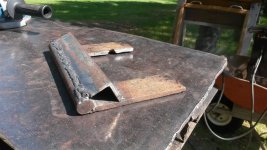
While the gouging/cutting questions have been well addressed in the thread a couple people requested an update on the project that gave rise thread in the first place: cutting parts to make a pallet wrecking pry bar.

I had a different thread going to help me through my first troubleshooting steps as I started out. But, after cutting out the first parts for my pallet pry bar, today was the day to try assembling the head of the pry bar.

The design was inspired buy JDCD Design on YouTube:

This is my first ever REAL attempt to build something with metal. Everything was scrounged from junk piles. It's ugly as sin and full of bad spots. But you can only learn by trying!

I still have to cut our the handle sleeve and weld it on, then assemble the handle. But rough as this is I think it's reasonably solid. Feels great to not only clear the hurdle of getting the setup up and running and sourcing materials, but to actually have a project beginning to come together.

I need to practice a lot more, but it's happening! Thank you all again for your help!
 

Attachments

  • 1-Front (Medium).jpg
    1-Front (Medium).jpg
    148.9 KB · Views: 27
  • 2-Side (Medium).jpg
    2-Side (Medium).jpg
    146.9 KB · Views: 26
To avoid these ads, REGISTER NOW!
OP
H

Hoopy Frood

Well-known member
Joined
Sep 17, 2016
Messages
56
Location
Maine, USA
Final Update:

Success! I cut many of the pieces to make my pallet pry bar using the high-amp-plunge-and-saw technique with the HF "Vulcan" 6011 1/8" rods. Materials were 1/8" to 1/2" thick.

With the HF Vulcans I found you don't want to soak them in water for more than an hour or the flux coating starts to unbind and fall off. But the soaked rods lasted MUCH longer than dry rods. The cutting was a cinch with even a relatively small kerf (about 1/4") with a little practice.

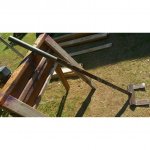
The pry bar is a success!! My welding is really pretty bad, but it's at least functional. And every project I do is a chance for more practice. Since many showed an interest in the pry bar (and not just the cutting technique) here are some pictures of the finished product made entirely from scrounged scrap.

It will work with 5" pallet stringers (common on solar panel pallets) which no store-bought pallet pry bar could do. The center of the pry bar handle is 1/8" angle iron (1.5"). That's the weak link. Totally sufficient for MOST prying needs, but not rigid enough for super HARD prying. Oh well! The Sawzall will make short work (and not require de-nailing) of anything the pry bar cannot handle.

Thank you all for your helpful suggestions and getting this noob started and moving down the road of homesteader-type of fabrication! The only way from here is up! :bowdown:

pry bar1.jpg pry bar 2.jpgpry bar 3.jpg
 

hefnerconstructionlc

Well-known member
Joined
Nov 1, 2016
Messages
665
Location
Kansas
All right good deal. It’s nice to see somebody actually ask a question and follow up with how it turned out on a post for once. And to be honest for your first stick welding project, those welds don’t look too bad. A little more practice on beads and I think you’ll have it. Great job.
 
OP
H

Hoopy Frood

Well-known member
Joined
Sep 17, 2016
Messages
56
Location
Maine, USA
All right good deal. It’s nice to see somebody actually ask a question and follow up with how it turned out on a post for once. And to be honest for your first stick welding project, those welds don’t look too bad. A little more practice on beads and I think you’ll have it. Great job.

I don't always close out threads properly but it is my goal to do so; I just forget sometimes.

But I really appreciate all the advice and perspective you all are willing to share! So I'm happy to do follow up :)

Thank you very much for the encouragement! I'm still making lots of mistakes, but at least I can feel when things are "right" and I can tell what's going wrong the rest of the time (almost always poor technique on my part). I need a lot of practice and there is still so much more to learn, of course.

But to make something that works on my first try is a great way to stay motivated to keep practicing. I've got two more projects in the queue, as well.

Thanks again!
 
To avoid these ads, REGISTER NOW!
Top Bottom