To avoid these ads, REGISTER NOW!

Noob tries to use a Screw Chek’r

iwoodsman

Member
Joined
Dec 20, 2024
Messages
8
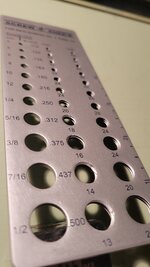
I am suffering from serious ignorance of the history of fasteners. I bought a nifty thread-gauge Screw Chek’r card and started going through the buckets of screws in my house going back to the 1950s, and found that almost no screws old or new were matched by the card… they wouldn’t fit anywhere. The card does outright say that it works for bolts, cap and machine screws only, which tells me that I seem to have a huge collection of “other” screws and maybe metric screws. I Googled a while and didn’t find anyone with my exact confusion. I think I just need an experienced human to confirm for me that the ecosystem of screws really is that large and varied. And that the Screw Chek’r is that limited in it’s scope. And… is there a thread gauge that works with more screws, like wood screws and anchor screws?
In the pic, the few bolts that worked in the card are on the left. A sample of the rejects is on the right.
IMG_3127.jpeg
 
To avoid these ads, REGISTER NOW!

mrjaw14

Well-known member
Joined
May 22, 2012
Messages
1,958
Location
Nashville, TN
Is that actually for checking threads? To me it looks like you put a fastener in a hole and see what drill size may be needed

Edit: tried to read the instructions and it seems to be a little of both. Where’d you get that screw checker?
 

paulsomlo

Well-known member
Joined
Jul 16, 2013
Messages
3,890
Location
Northern Colorado
I think your screw checker is probably OK - the vast majority, if not all of the screws on the right are either wood screws or sheet metal screws. The important parameters are the # size and length; I use wood and sheet metal screws all the time, but I couldn't tell you what tpi they are, it's not important. And many of those are tapered anyway, your screw checker is no good there.

All those on the right don't get sorted here, I just throw them in a bucket. If I want to id the machine screws on the left, I use a caliper and a thread gage (leaf type).
 

msharley

Well-known member
Joined
Sep 20, 2021
Messages
14,084
Location
Central Pennsylvania
Is that actually for checking threads? To me it looks like you put a fastener in a hole and see what drill size may be needed

Edit: tried to read the instructions and it seems to be a little of both. Where’d you get that screw checker?
Yep.

It checks threads.

There are different drill requirements for the various tap/thread pitches of a given diameter.
 

RTM

Well-known member
Joined
May 13, 2019
Messages
13,181
Location
SF Bay Area
Yup, wood screws and at least one sheet metal screw in that right hand mix.

Your screw checker is really built for modern screws, where every screw of a known diameter has the same pitch (threads per inch) or maybe 3 for coarse, regular, and fine.

As I am frequently screwing around with vintage tools, going back to the late 1880s at times, so a modern tool is pretty useless. I have both metric and SAE thread pitch gauges, a digital caliper, and a couple of better screw checkers that tell you the diameter of the screw and the pitch separately. And then for more modern and simple stuff I have a series of standard fine and metric, from number ONE in SAE to quarter inch, and similar in metric.

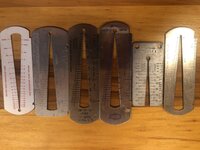
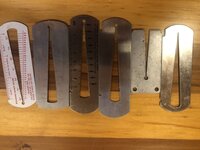
(Leaf type) pitch gauge
PXL_20250106_012723575-X3.jpg

Diameter and pitch for easy stuff, SAE and Metric (better screw checker)
PXL_20250106_012749828-X3.jpg

Easy sizes pitch and thread checker, regular and fine I think, (sizes printed on the face)
PXL_20250106_012807007-X3.jpg

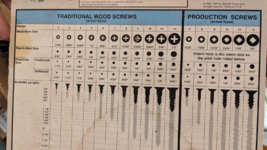
And for wood screws, this chart from some woodworking magazine works.
PXL_20250106_012851706-X3.jpg
 
Last edited:

RTM

Well-known member
Joined
May 13, 2019
Messages
13,181
Location
SF Bay Area
Is that actually for checking threads? To me it looks like you put a fastener in a hole and see what drill size may be needed

Edit: tried to read the instructions and it seems to be a little of both. Where’d you get that screw checker?
Can you actually see threads in that. I've seen a few with 1-2 threads, others are just thru holes.
 

geneg

Well-known member
Joined
Oct 19, 2020
Messages
468
Location
Midwest
or these:
I also have quite a few of the popular mechanics paper screw charts hanging around.

Wood & tapered screws are by shank diameter & length.

Machine screws (stove bolts) & bolts are by diameter & tpi or metric sizing
 

Attachments

  • IMG_0278.JPG
    IMG_0278.JPG
    635.2 KB · Views: 19
  • IMG_0295.JPG
    IMG_0295.JPG
    601.6 KB · Views: 16
  • IMG_0268.JPG
    IMG_0268.JPG
    560.6 KB · Views: 13
  • IMG_0270.JPG
    IMG_0270.JPG
    739 KB · Views: 29
Last edited:
OP
I

iwoodsman

Member
Joined
Dec 20, 2024
Messages
8
Exactly the perspective I needed, thanks everyone, also for the good suggestions on decoding wood screws. For those who asked, the Screw Chek’r from Ruelle Industrial was, so I read, the first with that screw-in card that reveals diameter plus thread gauge. The patent expired in the early 70s, Amazon has them plus several similar things available.
 

cherrybomb

Well-known member
Joined
Oct 18, 2016
Messages
892
Location
Near Madison Wi.
Your screw checker actually has two for SAE and two for metric,good quality.Just sort your wood screws by diameter and length,I don't recommend slotted ones unless your matching up a refurbish on a old piece of furniture
 

Beerhippie

Well-known member
Joined
Oct 13, 2023
Messages
9,811
Location
Far NE Oregon
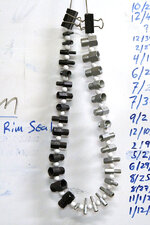
I like this style:

54342473893_0ac7f704de_b.jpg

Metric/SAE, fine and coarse. I sorted probably 50 lb of stainless fasteners with it last winter. I still have another 50 to go.

I just wish there was an easy way to remove them from the cable when checking a thread size on a machine, but be able to replace them on the cable. I may end up ditching the cable and making a rack for them.
 
Last edited:
To avoid these ads, REGISTER NOW!

HoosierMark

Well-known member
Joined
Jan 31, 2013
Messages
1,442
Location
Southeast IN
Beerhippie I have those sets also. My Do it Best store has a set mounted on a board. one set has the. Threads for bolts and one set for nuts.
 

Beerhippie

Well-known member
Joined
Oct 13, 2023
Messages
9,811
Location
Far NE Oregon
Beerhippie I have those sets also. My Do it Best store has a set mounted on a board. one set has the. Threads for bolts and one set for nuts.
Fine if you can bring the part to the board. Not so fine if you need to determine a thread size on a piece of fixed equipment.
 

Beerhippie

Well-known member
Joined
Oct 13, 2023
Messages
9,811
Location
Far NE Oregon
I was going to go for one of these, but just scrapped the buckets of screws I hae no time to go through.

I figure I saved far more time on hardware store runs than I spent sorting the fasteners. Of course, all I've sorted so far were the smaller--7/16" and down--stainless fasteners. The steel ones may wait for a while....

But having a nicely organized bin of the most common sizes right at hand is... handy.
 

mikey03

Well-known member
Joined
May 17, 2024
Messages
2,106
Whatever you do don’t do what I did at one point which is to try different thread restore taps until one lined up. After I tried all three m10 x 1 and 1.25 and 1.5 and none fit too good I knew I made an error in judgement. Then I bought a pair of thread gauges one metric one sae I actually went snap on because they were made in US and only like 10 bucks each new.

then I made a spreadsheet on my phone that breaks down fraction inch to decimals so I could use a digital caliper to find sae sizes diameter

i also tried using my caliper to measure threads but it’s hard so that’s why I got those gauges. Because for metric you got to measure the distance between the threads and honestly kind of hard to hold the caliper 0.25mm apart and tell the difference.

and for sae you got to count the number of threads that occur over a certain distance I think maybe 1 inch? and it was easy to move the caliper to 1 inch or whatever it is but then to count the threads and keep track is hard even with young eyes 😂
 

NoahG

Well-known member
Joined
Feb 24, 2013
Messages
1,055
Location
Detroit, MI
Yup, wood screws and at least one sheet metal screw in that right hand mix.

Your screw checker is really built for modern screws, where every screw of a known diameter has the same pitch (threads per inch) or maybe 3 for coarse, regular, and fine.

As I am frequently screwing around with vintage tools, going back to the late 1880s at times, so a modern tool is pretty useless. I have both metric and SAE thread pitch gauges, a digital caliper, and a couple of better screw checkers that tell you the diameter of the screw and the pitch separately. And then for more modern and simple stuff I have a series of standard fine and metric, from number ONE in SAE to quarter inch, and similar in metric.

(Leaf type) pitch gauge
PXL_20250106_012723575-X3.jpg

Diameter and pitch for easy stuff, SAE and Metric (better screw checker)
PXL_20250106_012749828-X3.jpg

Easy sizes pitch and thread checker, regular and fine I think, (sizes printed on the face)
PXL_20250106_012807007-X3.jpg

And for wood screws, this chart from some woodworking magazine works.
PXL_20250106_012851706-X3.jpg
I need those plastic gauges. Any chance you could scan that chart? I like the old ones better than modern designs.
I like this style:

54342473893_0ac7f704de_b.jpg

Metric/SAE, fine and coarse. I sorted probably 50 lb of stainless fasteners with it last winter. I still have another 50 to go.

I just wish there was an easy way to remove them from the cable when checking a thread size on a machine, but be able to replace them on the cable. I may end up ditching the cable and making a rack for them.
I bought these for the shop I now manage 5 years ago when I first hired on. They’re still blowing minds when I show them to new hires.
 

RTM

Well-known member
Joined
May 13, 2019
Messages
13,181
Location
SF Bay Area
Any chance you could scan that chart? I like the old ones better than modern designs.
This one? That one is a magazine freebie, might have another copy. If not will take to work n scan, getting the scale right is important.

1740332067286.png
 

Bubba Fett

Well-known member
Joined
Jun 11, 2018
Messages
1,516
Location
Eastern NC
I have attempted to sort screws before, but never by thread. That requires more patience than I have. I normally sort them as:
Wood Screws/Drywall Screws and Machine Screws, and each is then sorted by head type (Slot, Phillips, Torx, Hex, and then size. However sizes are very general, and I typically go by the recess size instead of thread. For example, Phillips #3 machine screws would be grouped together. I sort security screws and set-screws as well but not by size, since they are less common.

That seems to work pretty well, but a thread checker could be handy for picking out screws.


There are times when fasteners cause a minor existential crisis:

At what point screw not a screw, but a bolt instead? If it is driven directly into another material (wood, sheet metal, etc.) then I consider it a screw, but if it goes through the material, and is secured by a nut, then I consider it a bolt. But a lot of machine screws fit both categories, depending on usage. And what about lag bolts? Those are clearly screws, are they not?

How is my OCD able to cope with this?
 

Beerhippie

Well-known member
Joined
Oct 13, 2023
Messages
9,811
Location
Far NE Oregon
I need those plastic gauges. Any chance you could scan that chart? I like the old ones better than modern designs.

I bought these for the shop I now manage 5 years ago when I first hired on. They’re still blowing minds when I show them to new hires.
They double as an extremely steam-punk necklace!

My problem with removing the gauges from the cable and making a rack is that I have more storage room for things hanging than sitting flat.
 

Beerhippie

Well-known member
Joined
Oct 13, 2023
Messages
9,811
Location
Far NE Oregon
I have attempted to sort screws before, but never by thread. That requires more patience than I have. I normally sort them as:
Wood Screws/Drywall Screws and Machine Screws, and each is then sorted by head type (Slot, Phillips, Torx, Hex, and then size. However sizes are very general, and I typically go by the recess size instead of thread. For example, Phillips #3 machine screws would be grouped together. I sort security screws and set-screws as well but not by size, since they are less common.

That seems to work pretty well, but a thread checker could be handy for picking out screws.


There are times when fasteners cause a minor existential crisis:

At what point screw not a screw, but a bolt instead? If it is driven directly into another material (wood, sheet metal, etc.) then I consider it a screw, but if it goes through the material, and is secured by a nut, then I consider it a bolt. But a lot of machine screws fit both categories, depending on usage. And what about lag bolts? Those are clearly screws, are they not?

How is my OCD able to cope with this?
Just to make sure you're confused, there a full-thread and partial-thread screws and bolts. Our Commonwealth brothers call the full-thread ones set- or grub-screws and the partial thread are screw and bolts.

At least, that's how I think it works... them folks talk kinda funny.
 

mikey03

Well-known member
Joined
May 17, 2024
Messages
2,106
Why do you need to know exact wood screw sizes? I always just figured you could eyeball something that would fit. I didn’t think it was as serious as bolts. But I’m no woodworker so please school me on this

you don’t want a wood screw that will punch thru the other side. And prob need some clearance even so it doesn’t deform the other side maybe 3/4 of the depth is max

but also your not sending the coffee table into space so you don’t need to use a 18 inch screw if you can fit an 18 inch screw so using the biggest one that would fit doesn’t seem to be a right gauge honestly
 

Beerhippie

Well-known member
Joined
Oct 13, 2023
Messages
9,811
Location
Far NE Oregon
Why do you need to know exact wood screw sizes? I always just figured you could eyeball something that would fit. I didn’t think it was as serious as bolts. But I’m no woodworker so please school me on this

you don’t want a wood screw that will punch thru the other side. And prob need some clearance even so it doesn’t deform the other side maybe 3/4 of the depth is max

but also your not sending the coffee table into space so you don’t need to use a 18 inch screw if you can fit an 18 inch screw so using the biggest one that would fit doesn’t seem to be a right gauge honestly
For mounting hardware, you definitely want them to fit the countersink.
 

RTM

Well-known member
Joined
May 13, 2019
Messages
13,181
Location
SF Bay Area
Why do you need to know exact wood screw sizes? I always just figured you could eyeball something that would fit. I didn’t think it was as serious as bolts. But I’m no woodworker so please school me on this

you don’t want a wood screw that will punch thru the other side. And prob need some clearance even so it doesn’t deform the other side maybe 3/4 of the depth is max

but also your not sending the coffee table into space so you don’t need to use a 18 inch screw if you can fit an 18 inch screw so using the biggest one that would fit doesn’t seem to be a right gauge honestly
When attaching two boards together, usually into a Tee shape, the unthreaded portion of the wood screw is preferred to be as long as the top board is thick, or a bit longer, so you can pull them together. If the threads bite in the top board, you will strip the threads you cut in one of them, and hope it’s the top board.

There used to be screw size calculators, if the vertical leg of the Tee is x/y inches, you want z sized screw, minimum of aa inches long for maximum holding power.

There are more thoughts than that, but that’s the two easy ones that jump to mind.
 
Last edited:

Beerhippie

Well-known member
Joined
Oct 13, 2023
Messages
9,811
Location
Far NE Oregon
When attaching two boards together, usually into a Tee shape, the unthreaded portion of the wood screw is preferred to be as long as the top board is thick, or a bit longer, so you can pull them together. Is the threads bite in the top board, you will strip the threads you cut in one of them, and hope it’s the top board.

There used to be screw size calculators, if the vertical leg of the Tee is x/y inches, you want z sized screw, minimum of aa inches long for maximum holding power.

There are more thoughts than that, but that’s the two easy ones that jump to mind.
A wood screw with threads too long for the job will usually result in "bridging", where the threads actually prevent the two boards from being drawn tight together. The problem can also be addressed by using a stepped drill bit that leaves a clearance hole in the top board--like most bits made for use with pocket-hole jigs. Then you just have to worry about having the right size stepped bit....
 
To avoid these ads, REGISTER NOW!
Top Bottom