shamrock12
Well-known member
First of all, I am a huge fan of their (Norseman) drill bits and have several of their sets plus some S&D individual bits. As many of you already knew, they are known for top notch USA made drill bits. So I am not in any way trying to bash them but rather to just share my honest experience.
So I recently had a small project that I was working on. I was adding a hydraulic deflector on my 3-point rear snowblower and that was when I noticed that my tractor top link ball socket seemed a bit loose on the implement side (the snowblower). A quick investigation revealed that the manufacturer of snowblower cut a few 11/16” holes at the top link bracket and supplied a 5/8” pin. This is rather odd because the snowblower is setup for category one and most compact tractors are category one which uses 3/4” pin for top link. So as you can image, there was a bit of slop. So I decided I want to correct this by simply enlarging the existing holes to 3/4” and buy a new 3/4” pin which would match the diameter on tractor’s top link. I recall seeing Norseman’s “Hole Hog” style drill bits designed for enlarging S&D holes in their catalog awhile ago and was planning to order one. Then I saw their newly released “Step Reamers” and was surprised by their advertisement that they can work in material up to 1/2” thick.
http://www.norsemandrill.com/HSS-GR-Step-Reamer.php
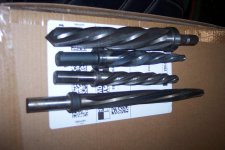
Their reamers seemed really intriguing to me but to be honest, I also was a bit skeptical about their claim about reaming really thick materials as well. But knowing Norseman, I thought I would give them a try. So I ordered their 3-piece set through Harry Epstein online two days ago and it came to my door today. (Great service by them, as always). Opened up the set tonight and it has the look of quality all over it and appeared to be very well made. I really was looking forward to try them out, so I wasted no time chucking up their medium sized reamer (which has the 3/4” that I needed). Grabbed a bottle of quality cutting lubricant and gave it a good coating. The 11/16” section of the reamer slides through the hole, a bit snug but with only very little effort because of paint coating inside the hole. I started drilling at low speed with minimal pressure out of caution and to monitor how this reamer would respond. It started smoking right away (cooking the oil) and was making some nice chips. So I keep adding oil liberally as it would continue to smoke even though I was taking it fairly easy. This reamer “drilled” through the 1/4” thick A36 steel like butter. I was really impressed. In fact, I was so impressed that my doubt about their reamers immediately went away. So I went over to the other side to do the second hole. Added some more oil before starting, of course. Again, using only low-moderate speed, it started smoking again as usual but not for very long. And when I say smoking, I’m not talking about a full blown coal burning steam locomotive. Just the typical ones you see when drilling with an ordinary drill bit with liberal amount of lubricant to keep it cool. Then after drilling about halfway through I noticed that it wasn’t generating as much chips as the first hole did and that it was taking a bit longer too. Neither less, I finished the second hole after adding a little more pressure (again, 1/4” thick A36 steel) but it did leave behind some burrs on the exit hole. The first one hardly had any. Not certain what was going on, I decided to enlarge a couple more holes (the snowblower has two different positions for attaching the top link to, with each position having two holes) to see if it is the reamer or if I had a bad hole. Positioned the reamer into the third hole, lubricated it and started drilling. Not much was happening. Oiled some more and bumped up the speed a bit but nothing much still. So I put even more pressure on it and got it going but still was very slow. So I really cranked up the pressure by putting my body weight against the drill and eventually got the third hole reamed out. The exit burr has progressively gotten worse. So my excitement about this reamer set is rapidly turning into a big disappointment. But the job still is not finished yet as I still had one more hole to enlarge. Lined up the reamer, oiled and I tried my mightiest to get it to start reaming but it only got about 1/32” of the way through 1/4” thick material, so I was like screw this and took out my 1/2” carbide burr bit chucked into my die grinder and enlarged the 4th hole until it was just under 3/4”. Then I finished off the job with the reamer. It did leave behind even worse burrs at the exit.
I am not sure what happened or why it’s performance went downhill so quickly. After cleaning up the reamer, I really couldn’t see or tell what or where the issue is. I am sure this reamer set is not designed for daily production run but rather for occasional hole enlarging. But if it can only do it’s job for one thick hole before it’s performance would quickly deteriorate downhill then it definitely is not worth $100 for the set at all.
Again, I am only sharing my experience with you so that you would not get disappointed like I did. I mean, I really had my hope up with this set, but I guess my instinct was right in the first place that their claim of being able to drill up to 1/2” thick seemed far reaching for a step reamer. Don’t get me wrong, I’m fairly sure this set would work well on thin sheet metals but definitely not thick sheets or plates. Norseman does make excellent drill bits, but they really missed their mark on this one.
So I recently had a small project that I was working on. I was adding a hydraulic deflector on my 3-point rear snowblower and that was when I noticed that my tractor top link ball socket seemed a bit loose on the implement side (the snowblower). A quick investigation revealed that the manufacturer of snowblower cut a few 11/16” holes at the top link bracket and supplied a 5/8” pin. This is rather odd because the snowblower is setup for category one and most compact tractors are category one which uses 3/4” pin for top link. So as you can image, there was a bit of slop. So I decided I want to correct this by simply enlarging the existing holes to 3/4” and buy a new 3/4” pin which would match the diameter on tractor’s top link. I recall seeing Norseman’s “Hole Hog” style drill bits designed for enlarging S&D holes in their catalog awhile ago and was planning to order one. Then I saw their newly released “Step Reamers” and was surprised by their advertisement that they can work in material up to 1/2” thick.
http://www.norsemandrill.com/HSS-GR-Step-Reamer.php
Their reamers seemed really intriguing to me but to be honest, I also was a bit skeptical about their claim about reaming really thick materials as well. But knowing Norseman, I thought I would give them a try. So I ordered their 3-piece set through Harry Epstein online two days ago and it came to my door today. (Great service by them, as always). Opened up the set tonight and it has the look of quality all over it and appeared to be very well made. I really was looking forward to try them out, so I wasted no time chucking up their medium sized reamer (which has the 3/4” that I needed). Grabbed a bottle of quality cutting lubricant and gave it a good coating. The 11/16” section of the reamer slides through the hole, a bit snug but with only very little effort because of paint coating inside the hole. I started drilling at low speed with minimal pressure out of caution and to monitor how this reamer would respond. It started smoking right away (cooking the oil) and was making some nice chips. So I keep adding oil liberally as it would continue to smoke even though I was taking it fairly easy. This reamer “drilled” through the 1/4” thick A36 steel like butter. I was really impressed. In fact, I was so impressed that my doubt about their reamers immediately went away. So I went over to the other side to do the second hole. Added some more oil before starting, of course. Again, using only low-moderate speed, it started smoking again as usual but not for very long. And when I say smoking, I’m not talking about a full blown coal burning steam locomotive. Just the typical ones you see when drilling with an ordinary drill bit with liberal amount of lubricant to keep it cool. Then after drilling about halfway through I noticed that it wasn’t generating as much chips as the first hole did and that it was taking a bit longer too. Neither less, I finished the second hole after adding a little more pressure (again, 1/4” thick A36 steel) but it did leave behind some burrs on the exit hole. The first one hardly had any. Not certain what was going on, I decided to enlarge a couple more holes (the snowblower has two different positions for attaching the top link to, with each position having two holes) to see if it is the reamer or if I had a bad hole. Positioned the reamer into the third hole, lubricated it and started drilling. Not much was happening. Oiled some more and bumped up the speed a bit but nothing much still. So I put even more pressure on it and got it going but still was very slow. So I really cranked up the pressure by putting my body weight against the drill and eventually got the third hole reamed out. The exit burr has progressively gotten worse. So my excitement about this reamer set is rapidly turning into a big disappointment. But the job still is not finished yet as I still had one more hole to enlarge. Lined up the reamer, oiled and I tried my mightiest to get it to start reaming but it only got about 1/32” of the way through 1/4” thick material, so I was like screw this and took out my 1/2” carbide burr bit chucked into my die grinder and enlarged the 4th hole until it was just under 3/4”. Then I finished off the job with the reamer. It did leave behind even worse burrs at the exit.
I am not sure what happened or why it’s performance went downhill so quickly. After cleaning up the reamer, I really couldn’t see or tell what or where the issue is. I am sure this reamer set is not designed for daily production run but rather for occasional hole enlarging. But if it can only do it’s job for one thick hole before it’s performance would quickly deteriorate downhill then it definitely is not worth $100 for the set at all.
Again, I am only sharing my experience with you so that you would not get disappointed like I did. I mean, I really had my hope up with this set, but I guess my instinct was right in the first place that their claim of being able to drill up to 1/2” thick seemed far reaching for a step reamer. Don’t get me wrong, I’m fairly sure this set would work well on thin sheet metals but definitely not thick sheets or plates. Norseman does make excellent drill bits, but they really missed their mark on this one.
Last edited: