To avoid these ads, REGISTER NOW!

Nuts specifically for welding to broken hardware.

2ndGearRubber

Well-known member
Joined
Mar 24, 2014
Messages
14,185
Location
Pittsburgh
Trying to upgrade my methods, I am mostly ignorant about the fine details of welding . The shop has basic 1/2, 9/16, and 5/8 nuts in our stock. IIRC these are basic zinc coated hardware, low grade, just for bolting exhausts together mostly.

So when welding, I've found talk of the zinc or other coatings interfering with the best possible connection. I'm looking for what type of nut I should acquire to maximize connection to broken exhaust manifold studs and similar.

The ID I think would be ideal would be 9/16 for most hardware I'm removing. Is this just a case of buying raw/uncoated nuts and maybe washers and that being the best option? I'd probably buy 100 on McMaster or similar so if a few cents per unit would provide a better material I'd buy that. Is grade particularly relevant when I'm frying the nut to a broken bolt with a 120v Argon/CO2 fed MIG?

Thanks in advance.
 
To avoid these ads, REGISTER NOW!

garfunkle24

Well-known member
Joined
Mar 18, 2008
Messages
3,431
Location
Saskatoon, Canada
The shop has basic 1/2, 9/16, and 5/8 nuts in our stock.

The ID I think would be ideal would be 9/16 for most hardware I'm removing.

Even thought the size doesn't matter much I have to assume you're referring to wrench sizes vs nominal/thread sizes? I don't see you extracting much **** that big per nominal size in automotive.

Ideally I like plain steel fender washers (can be hard to find local) and plain flange nuts.

Drilling a hole in the end of the broken bolt/stud (as if you were drilling for an extractor but not as deep) will also help the weld penetrate. This gets some of the weld further below the major shear line where the nut/washer you welded on meets the surface of whatever you are extracting from. Not having one straight shear line helps to not break the weld.

Also be aware than a lot of "plain" hardware may have some form of oil/wax on them so degrease prior to welding.
 
OP
2

2ndGearRubber

Well-known member
Joined
Mar 24, 2014
Messages
14,185
Location
Pittsburgh
Even thought the size doesn't matter much I have to assume you're referring to wrench sizes vs nominal/thread sizes? I don't see you extracting much **** that big per nominal size in automotive.

Ideally I like plain steel fender washers (can be hard to find local) and plain flange nuts.

Drilling a hole in the end of the broken bolt/stud (as if you were drilling for an extractor but not as deep) will also help the weld penetrate. This gets some of the weld further below the major shear line where the nut/washer you welded on meets the surface of whatever you are extracting from. Not having one straight shear line helps to not break the weld.

Also be aware than a lot of "plain" hardware may have some form of oil/wax on them so degrease prior to welding.

I'm sorry, yes, wrench size. IIRC the 9/16 is a 3/8 NC fastener. 5/16 and 1/2 respectively for 1/2 and 5/8. My brain doesn't think in SAE very often.

Normally I don't use a washer, just the nut. I'll keep in mind the shear line aspect. Normally I grind them clean with a carbide burr, cut-off wheel, or cookie.
 

scooby074

Well-known member
Joined
Oct 26, 2008
Messages
5,303
Location
Nova Scotia
There is such an animal as a weld nut but Ive never tried them.

On tough ones, I usually wend a washer (fender or Heavy Duty style if it will fit) on the broken stud, then weld the nut onto the washer.

I saw a test once of a welding rod designed to weld onto broken studs broken below the surface that had special flux to protect the bore, but the manufacturer escapes me, I think it was one of those industrial vendors like Bowman who put on the demo.

Edit: I think this was the rod in a different package https://canadaweldingsupply.ca/products/stud-xtract-broken-bolt-extraction-welding-electrode
 
Last edited:

garfunkle24

Well-known member
Joined
Mar 18, 2008
Messages
3,431
Location
Saskatoon, Canada
In my experience black oxide doesn't interfere much if at all, with a weld of this type. I just get some uncoated stuff cos I can.

As pointed out above the washer makes a huge difference. If you get one with an ID about 60-70% of what you're extracting you can get a nice plug weld in there without too much risk of welding the stud to the head or whatever. After this I like to peen the weld which also helps shock the fastener a bit. At this point the weld of the nut to the washer is fairly easy and unimportant.

As I said, most uncoated hardware is in fact coated in oil. Regardless and/or if unsure there's nothing wrong with oiling til you need them and just degrease with brake cleaner or fire.
 
Last edited:

Wrench97

Well-known member
Joined
Jun 23, 2018
Messages
12,372
Location
Southeastern Pa
Black oxide or plain steel is my first choice, heating the broken piece first does a couple things like burn off any grease/dirt/oil and by heating/cooling may break the bond between the pieces.
Try to stay away from the zinc plating the fumes are not good for you.
 
To avoid these ads, REGISTER NOW!
OP
2

2ndGearRubber

Well-known member
Joined
Mar 24, 2014
Messages
14,185
Location
Pittsburgh

Looks like this might fit the bill. Thank you for all the input thus far.
 

danielbuck

Well-known member
Joined
Apr 15, 2014
Messages
964
soaking in household vinegar (for a few days) or citric acid (for a few hours) will strip the zinc coatings. I do that any time I'm welding coated hardware. Both can be dumped down the drain afterwords and don't require gloves. Although vinegar does smell pretty strong if it's indoors :LOL:
 

whateg01

Well-known member
Joined
Mar 13, 2006
Messages
11,911
Location
doo dah, kansas, usa
soaking in household vinegar (for a few days) or citric acid (for a few hours) will strip the zinc coatings. I do that any time I'm welding coated hardware. Both can be dumped down the drain afterwords and don't require gloves. Although vinegar does smell pretty strong if it's indoors :LOL:
Muriatic acid is fast but don't store it in the garage
 

danielbuck

Well-known member
Joined
Apr 15, 2014
Messages
964
Muriatic acid is fast but don't store it in the garage
it's definitely way faster, but I don't like working with such a harsh chemical. Much more difficult to store, work with and dispose of. It does have the advantage of speed though!
 

whateg01

Well-known member
Joined
Mar 13, 2006
Messages
11,911
Location
doo dah, kansas, usa
it's definitely way faster, but I don't like working with such a harsh chemical. Much more difficult to store, work with and dispose of. It does have the advantage of speed though!
Storage is really the biggest issue with it. The fumes will cause stuff to rust. I have a plastic tote that I keep it by the garden shed where the jug lives. I take the old to the house hold hazardous waste place every couple years and buy a new one next time I need it just to be sure the plastic jug doesn't become brittle and fall apart when I'm picking it up. Disposal is easy for the quantities I normally need to use for de-plating hardware. Just pour it into a bucket of baking soda and water.
 

Old Man Roger

Well-known member
Joined
Apr 6, 2017
Messages
18,285
Location
Palm Coast Florida
Storage is really the biggest issue with it. The fumes will cause stuff to rust. I have a plastic tote that I keep it by the garden shed where the jug lives. I take the old to the house hold hazardous waste place every couple years and buy a new one next time I need it just to be sure the plastic jug doesn't become brittle and fall apart when I'm picking it up. Disposal is easy for the quantities I normally need to use for de-plating hardware. Just pour it into a bucket of baking soda and water.
It’s AMAZING what some fumes can do. I had a plastic jug of some chemical, I can’t even remember, crack. It didn’t even leak fluid, but the fumes were heavier than air, so they just hung around the floor of my garage. All the rubber on every caster wheel in my garage just became brittle and fell apart. That’s about 12 casters destroyed because of fumes.
 

BD1

Well-known member
Joined
Mar 18, 2007
Messages
4,602
Location
north side
For 1/2'' and 5/8'' I use ''Extra Heavy Nuts''. There's a lot more metal to work with and a larger size wrench helps.
 

Beerhippie

Well-known member
Joined
Oct 13, 2023
Messages
10,462
Location
Far NE Oregon
Muriatic--hydrochloric--acid is nasty stuff, for sure, but it will de-grease and remove any coatings. For any long-term use, don't use it as it leaves chlorides on/in the surface of the metal which will lead to serious rust problems down the line. Those chlorides are hard to remove.

And, yeah, don't store it inside. I, too, learned that the hard way.
 

Bigblue&Goldie

Well-known member
Joined
Mar 12, 2009
Messages
10,811
Location
AZ
ACE Hardware has "weld nuts" in the bulk bins. They're non-coated. Luckily, here in AZ I don't run into this often. Usually the heat from the weld process does 99% of the work breaking loose the rust, so the nut is the least important part of the equation.
 

Zewnten

Well-known member
Joined
Jun 11, 2017
Messages
1,880
CAT uses extra thick black oxide washers for a lot of their assemblies. I save these for broken bolts/studs and nuts. The extra thickness makes for better weld in my opinion and I’ve had more success with this than anything else. I also spray a non flammable penetrating fluid into at is cools so it wicks down the threads then hit it with my 1/4 or 3/8 cordless on the lowest setting to break it the rust free.
 

Oregon rock crusher

Well-known member
Joined
Jun 28, 2016
Messages
1,937
Location
West of Salem
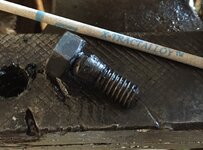
I'm not so sure it's a special nut that leads to success with broken bolt extraction. I do often use heavy hex nuts though and on bolts smaller than 5/16 I run a taper reamer in the nut to give more room for rod so I can get to the broken bolt. I mostly use X-tractalloy rod for this as it works well even when the bolt is broken part way down the threaded hole. You just hold it centered and the slag protects the thread until you get to the top and then you work the puddle out over the nut. Works very well for this but it is not cheap. Most rods work for flush broke bolts but I still prefer these. Ed.
 

Attachments

  • IMG_4130.jpg
    IMG_4130.jpg
    574 KB · Views: 24
  • Welded extracted screw 220.JPG
    Welded extracted screw 220.JPG
    347 KB · Views: 15
To avoid these ads, REGISTER NOW!
Top Bottom