

You are using an out of date browser. It may not display this or other websites correctly.
You should upgrade or use an alternative browser.
You should upgrade or use an alternative browser.
O-rings to eliminate floppy socket universal and flex joints
- Thread starter jeremy v
- Start date
Jim Diesel
Well-known member
Thanks for the tip mate. I might play around with it tomorrow at work. I was only just using one today for an air compressor of a Unimog
crackit
Well-known member
Thanks for the research!
gdocktor3
Well-known member
Oh wow that's genius. Here I've just been throwing mine in a cardboard box at the bottom of my tool box and letting them fade into the past... Thanks!
KnurledNut
Well-known member
Nice write up jeremy. The o-rings do work well. Im sure this info will come in handy.
Techie1961
Well-known member
Cool! Thanks for sharing that tip. Definitely going to use it.
Wamsutta
Well-known member
Do the O-rings limit the full range of motion in anyway?
Ah
Not to piss on your parade.
But they work better if you warranty them.
My snap on stay where they are positioned and when they need ****** I give them to my SO guy and he gives me new.
I have exchanged about 6 in 30 years, they are my go to sockets.
Not to piss on your parade.
But they work better if you warranty them.
My snap on stay where they are positioned and when they need ****** I give them to my SO guy and he gives me new.
I have exchanged about 6 in 30 years, they are my go to sockets.
WhiffySpark
Well-known member
- Joined
- Oct 22, 2009
- Messages
- 6,252
No they don't. The O-ring can get pinched in the hinge area during flex but the rubber is pretty soft and it squishes quite easily, and that usually only happens if you are trying to push the functional angle limits of the flex joint. If the O-ring is pinched too hard it will sometimes pop out of position on one or two corners of the flex joint and you will just have to flip it back into the flex joint channel when you are done using the socket.
The O-ring does not hold everything super rigid, it holds a flex socket so that even with zero internal hinge pin resistance the socket can be angled into any position by hand and when you let go it will stay there on its' own. That's what most people need in order to feed a flex socket into a tight area and place it on a bolt head without any secondary assistance or hassle.
With a socket on a universal joint the hinge usually won't stay fixed in place (due to the weight and leverage of the socket hanging off the end) but the O-ring will still give you much more control over how the socket is oriented than you had originally. If you occasionally need a more rigid connection when using a universal joint you can still use the trick of wrapping the joint with electrical tape as a secondary aid. Each wrap of the tape makes the joint a little bit more rigid while still allowing the socket to rotate and flex during use.
Yup. The green ones seem to resist being cut when they are squeezed better.
One of the best tips I've ever picked up on this site
littleponderosa
Well-known member
Thanks for the tip.
Bill
Bill
928'er
Well-known member
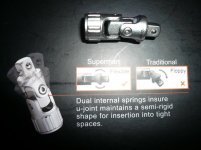
I've got a 3 piece set of the Triangle "Superman" spring loaded universals (also have a 19 piece 1/4" drive set). Really nice, well made tools.
Supposedly German designed, but made in Taiwan. Triangle tools were available through Sears, but seem to have since disappeared. Wish I'd picked up the 3/8" and 1/2" drive sets while they were still available....
Supposedly German designed, but made in Taiwan. Triangle tools were available through Sears, but seem to have since disappeared. Wish I'd picked up the 3/8" and 1/2" drive sets while they were still available....
Attachments
Last edited: