To avoid these ads, REGISTER NOW!

Odd Original Construction Causing Wood to Rot

wyb2

Well-known member
Joined
Dec 27, 2012
Messages
188
Location
Southern NH
Hi all,

I finally got around to replacing some rotting trim around the man door to my garage and found some interesting construction hidden behind it. I'm not at a total loss as to what to do, but I am interested in getting some opinions from the people on here as I've seen some pretty clever stuff on this site.

For the most part the house seems decently well built, but I do find shortcuts here and there, and they always seem to relate to preventing wood rot. My guess is at least one of the guys who had a hand in building this house was from a much more arid part of the country (or a much more arid country). The reason this trim was rotting in the first place was because none of the vinyl trim that is supposed to direct water away from the door frame is not installed properly, so it was really just funneling water into the wall behind the trim.

Anyways, the part I'm interested in right now is how they built the small section of wall between the man door and the garage door. It makes no sense to me, and it's rotting pretty good. Here is a picture I took with the trim off and labeled.


Here is a picture of the other side that shows the rotting.


Some extra background: the aluminum door sill used to be loose, so last year I pulled it up to see what the problem was to find it was installed on top of wood. This wood (2x6's if i remember) was laid flat and installed below ground. Needless to say it was rotting. I started about pulling it up and found 2x6 after 2x6 stacked of top of one another going deeper and deeper underground. Finally after the 4th board I hit concrete, so I mixed up a couple bags quickrete, filled the hole and set the sill plate directly in the quickrete using the door as a fixture.

In the future I'm probably going to try and replace all those untreated 2x4's with pressure treated ones, but right now I need to get the side of my house closed back up before it rains later this week.
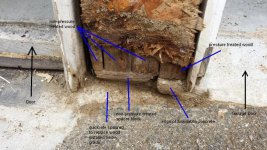
 

Attachments

  • 20131013_153030 edit.jpg
    20131013_153030 edit.jpg
    150.9 KB · Views: 20
  • 20131013_155723 edit.jpg
    20131013_155723 edit.jpg
    151.8 KB · Views: 20
To avoid these ads, REGISTER NOW!

kbs2244

Well-known member
Joined
Nov 11, 2006
Messages
14,065
Is this an attached or detached garage?
It may make a code difference.
Either way, you have some major rebuilding to do.
Those bunched 2x's are what support the header over your doors.

You are going to need to build a temp support wall, tear down what is there, pour a new curb, then rebuild the wall.
You will most likely need to raise the hight of the current headers to be able to use standard height doors.

This is not a week end project.
 
OP
W

wyb2

Well-known member
Joined
Dec 27, 2012
Messages
188
Location
Southern NH
Is this an attached or detached garage?
It may make a code difference.
Either way, you have some major rebuilding to do.
Those bunched 2x's are what support the header over your doors.

You are going to need to build a temp support wall, tear down what is there, pour a new curb, then rebuild the wall.
You will most likely need to raise the hight of the current headers to be able to use standard height doors.

This is not a week end project.

It is attached, it's actually an under-garage, so there are rooms of the house above it. The only good news that I forgot to include is that it isn't (or shouldn't be) a major load-bearing wall, as it's on the "end" of the house (as in parallel to the roof trusses). I'm not trying to imply that I wouldn't need a temporary support structure, I definitely will, just that this problem shouldn't bring the whole house down anytime soon.

Thanks for the input, I hadn't thought about the possibility of having to raise the header
 

tcianci

Well-known member
Joined
Feb 7, 2009
Messages
4,242
Location
Walpole, Ma
I can tell you from experience that it won't need any type of temporary support while you're fixing it. Noting in going to move in the amount of time you're going to have that opening cut up. Your best bet would be to cut back the rotted stuff, staggering the cuts so that you can nail the new to old and be sure to use PT that's rated for ground contact along with fasteners that are rated for PT.
 
OP
W

wyb2

Well-known member
Joined
Dec 27, 2012
Messages
188
Location
Southern NH
I can tell you from experience that it won't need any type of temporary support while you're fixing it. Noting in going to move in the amount of time you're going to have that opening cut up. Your best bet would be to cut back the rotted stuff, staggering the cuts so that you can nail the new to old and be sure to use PT that's rated for ground contact along with fasteners that are rated for PT.

Well that's reassuring to hear, but I'll probably at a minimum use a couple jacks and 4x4s just to be safe.

Anyone have any ideas as to what I could do for a curb under the new 2x's? I could of course build a little form and pour more quickrete, but if I'm not raising the whole door sill that's some work for a very very small pour. I was thinking a preformed block, but unless I drill and anchor it it's just kind of "floating" there.
 
OP
W

wyb2

Well-known member
Joined
Dec 27, 2012
Messages
188
Location
Southern NH
Looks like I need to make this thread more interesting.

Here are a couple pics of when I pulled out the wood that was buried under the door sill. For the life of me I can't imagine why someone would build it like this.

Now that I look back at these, the rotting wood that I'm working with now was just hanging in the air when I was doing that. It didn't concern me at the time because the wood I was pulling out from under it was too eaten away to carry any load, so I really wasn't taking away any existing support.


To avoid these ads, REGISTER NOW!
OP
W

wyb2

Well-known member
Joined
Dec 27, 2012
Messages
188
Location
Southern NH
Here is the major source of my problems (well aside from non-PT wood used against the foundation). Who ever had the job of putting in the vinyl trim that is supposed to catch water and direct it away from doors and windows missed a fundamental concept. These gaps exist at each corner and allow water behind the door trim against the OSB. This is made worse by the lack of flashing.

This is at the top corner of one of the garage doors. Luckily the other door is in much better shape.


For now I am cutting small strips of rubberized asphalt flashing and sticking them on the inside and outside of the vinyl trim to try and make one continuous channel.

Anyone have any brighter ideas?

Eventually I will have to pull off a bunch of the vinyl siding, remove and replace any rotted OSB and any wood rot I can find behind it, and install proper flashing around the doors. Unfortunately it's getting a little late in the season to start all that, especially the way vinyl siding gets brittle in the cold. For now I'm just removing the really bad stuff and putting up flashing where I can.
 
OP
W

wyb2

Well-known member
Joined
Dec 27, 2012
Messages
188
Location
Southern NH
haha, yeah that thought has gone through my head more than once.

Unfortunately that's not an option, so I took some frustration out on a piece of siding that wasn't cooperating. Oh well, looks like I'll be heading to lowes tomorrow for a section of siding and a siding tool.
 

JakeKohl

Well-known member
Joined
Feb 23, 2012
Messages
1,365
Location
Greenville, SC
With vinyl, you should have some sort of watershedding membrane underneath it on the entire structure...house wrap, tar paper, etc. Although that is not a correct install of that flashing, vinyl siding is rarely completely rain proof.
 

theoldwizard1

Well-known member
Joined
Feb 22, 2011
Messages
43,196
Location
SE MI
Here are a couple pics of when I pulled out the wood that was buried under the door sill. For the life of me I can't imagine why someone would build it like this.

IMG_1044.jpg
[/URL]

I had the same issue on a smaller scale on my son's front door. Filled it in with Quickcrete.
 
OP
W

wyb2

Well-known member
Joined
Dec 27, 2012
Messages
188
Location
Southern NH
With vinyl, you should have some sort of watershedding membrane underneath it on the entire structure...house wrap, tar paper, etc. Although that is not a correct install of that flashing, vinyl siding is rarely completely rain proof.

I've been underneath the siding on the back of the house and there was house-wrap. I'm guessing they skipped on it here just because there is very little actual wall surface to work with.

I stood on the deck railing and took a look at the top of the kitchen window. Looks like the windows have a built in u-channel for water, so they don't rely on that vinyl flashing. That's a partial relief.
 
To avoid these ads, REGISTER NOW!
Top Bottom