To avoid these ads, REGISTER NOW!

Oil for EndGrain

mobiledynamics

Well-known member
Joined
Mar 14, 2010
Messages
5,045
Location
Gotham City
There was a recent thread on Festool with quite a bit of replies so fellow WoodWorkers must hang their hats in GJF.

I have a Question. What do you guys recommend for Cutting Boards
I'm a avid cook and have like 9-10 End Grain Boards
I'll often soak them in Mineral oil till it won't take any more oil
I don't wrap them in waxed paper or that sort but just sitting around in my cabinets, some of them unused, I come back to it a year later for.....and it's dry as a bone. It's as if the Mineral Oil dissipates that quick, even in a dark dry -conditioned space.
 
To avoid these ads, REGISTER NOW!

strutaeng

Well-known member
Joined
Dec 12, 2011
Messages
2,287
Location
Dallas, TX
I posted a question to someone on lumberjocks that said cutting boards should only use end grain (he mentioned rolling the edge of a knife?) and I responded that I've only used regular face/edge grain cutting boards for years...

What I was asking is about the extra moisture the engrain cutting boards get when cutting on them or washing them?

I've got some boards I made from scraps (from building REAL woodworking projects, like furniture) of maple, going on 12 years. Daily washings under running water. No finish or anything. To me cutting boards are kinda disposable. They are meant to get cut up, eventually. I'm really puzzled by the "cute" checkered looking cutting boards.

So what is your goal about applying oil to your cutting boards? Trying to make them looking good? Which is fine, don't have an issue with that.
 

RTM

Well-known member
Joined
May 13, 2019
Messages
13,230
Location
SF Bay Area
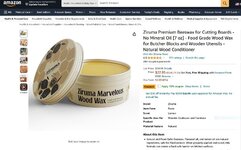
Instead of mineral oil, try this stuff, works great for kitchen stuff.


OP
M

mobiledynamics

Well-known member
Joined
Mar 14, 2010
Messages
5,045
Location
Gotham City
The goal is to use keep them from getting -dry-
Like the OP said, I have like 9 of these...
I obviously am not using all 9 of them ....it's like my hobby along with the knives and the metric boatload of cookware I have, etc.

Even just sitting soaked in mineral oil until it won't take anymore and then put on the shelf, I'm finding it's almost bone dry just from
sitting around 1 year later. Each board has literally -drank- a solid 14-20oz+ mineral oil and just -amazed- that it has dissipated all that with no usage (washing, etc) in a Years time
 
Last edited:

seber

Well-known member
Joined
May 31, 2016
Messages
4,205
Location
Deep East Tx.
As a lapidary I have wood faced stone vises that literally run in flowing mineral oil. The more oil the wood absorbs, the softer it gets until it fails altogether. I would never choose it for preserving wood.
 
OP
M

mobiledynamics

Well-known member
Joined
Mar 14, 2010
Messages
5,045
Location
Gotham City
I use Mineral Oil cause it's food safe and soaks the entire board- it's engrain,it's like a sponge.

On the boards I use daily, I will top it with Beeswax after Mineral Oil. So with that said.

For discussion sake, we're talking a 2" slab thick endgrain, 16x22 or a smidge larger....
Mineral Oil till it won't take a single drop no more and you need to wipe off the excess as it won't soak any more in
Put away (indoors climate controlled)
Come back to it a year later and the board while to bone dry, is noticeably dry.......
I suspect it's partially due to the end grain and allowing the oil to dry out. Just wasn't expecting to to dry out that much with no usage, no liquids on it, no cleaning agents --- just storage
 

Firstram

Well-known member
Joined
May 16, 2017
Messages
1,392
Instead of mineral oil, try this stuff, works great for kitchen stuff.


This is what we use, Beeswax melted into mineral oil.
 

budget76

Well-known member
Joined
Jan 19, 2016
Messages
502
This is what we use, Beeswax melted into mineral oil.
this. make your own and have enough wax for 20 more batches for what it costs to by one batch pre-made.

that being said, I don't have as many cutting boards so mine don't sit for a year without use
 

d.mcfarland

Well-known member
Joined
Jun 18, 2012
Messages
6,581
Location
Western PA
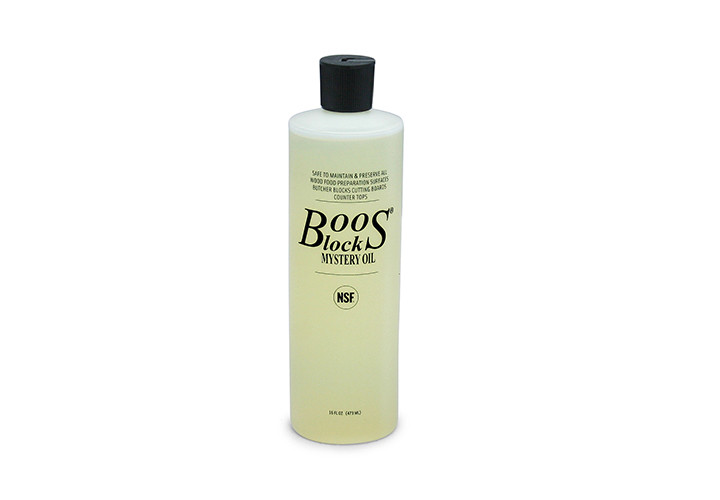
Once you use the mineral oil or whichever you pick, it needs to be sealed in with bees wax. There is a very easy to use product available from Boos Block that spreads easily by hand. You can also buy and melt your own homemade mixture.
 
OP
M

mobiledynamics

Well-known member
Joined
Mar 14, 2010
Messages
5,045
Location
Gotham City
So we are concluding the mineral oil just dissipates without (topcoating) with the wax.

I just wrap my head that even after dunking the slab in the mineral oil bath for a day, taking it out.....letting it drip clean, wiping off the excess , it just evaporates out so much. I think the last slab I just poured a solid 14oz + ontop of the board and let it sit, and it drank it all up overnight.
 

4xdog

Well-known member
Joined
Aug 18, 2012
Messages
5,624
Location
Santa Fe, NM
Each board has literally -drank- a solid 14-20oz+ mineral oil and just -amazed- that it has dissipated all that with no usage (washing, etc) in a Years time

Why wouldn't it volatilize over that time period? If the mineral oil is low viscosity (which I'm assuming) and with low wax content, it seem logical that it would have a component with enough vapor pressure to leave (mostly) over that time period.

Think about the oil molecule as beads on a string, with carbon atoms as the beads. Short chains can escape the liquid into the air (evaporation) easier. Something like hexane, with six carbons, is quite volatile. Kerosene at 9-16 carbons in its chain, isn't that volatile, but given enough time it would probably evaporate. Light mineral oils aren't a lot different in volatility from some components in gasoline or kerosene at 10-15 carbons, although other fractions can be as high as 50 carbons. Lighter oils will mean more volatility.

Try measuring the weight of a cutting board freshly oil-soaked and check it later when you think it's sufficiently dried out. See how much weight it's lost. And maybe put a few drops of your mineral oil on a (nonabsorbent) piece of glass or metal in your shop and stash it out of sight. Check on it later when you think a cutting board would be dry to see how much is gone.
 

Jeff

Well-known member
Joined
Dec 10, 2009
Messages
2,706
Location
Sonova Beach
I had to ask my wife about this. We've been married since Jesus was a baby and she hasn't killed me yet.

According to her:

  • Wash board in hot soapy water.
  • Let dry an hour or so.
  • Liberally slather in 100% mineral oil.
  • Let board sit 24 hours.

That's it.
 

TnClimber

Well-known member
Joined
Mar 22, 2023
Messages
142
Location
Middle TN
When I make cutting, charcuterie, or cheese boards I use Howard Products Butcher Block Conditioner. Mineral oil is OK to start. but you need a conditioner or wax food grade product to seal it. My 2 cents.
 

Wolley

Well-known member
Joined
Jun 24, 2022
Messages
420
Location
Maine
A lot depends on the wood species. Open pore wood like oak and walnut End grain will drink non hardening oil almost indefinitely. And any other liquid or juice. Real butcher blocks are made of sugar maple or maybe sycamore for toughness and the closed grain. I think sugar maple is the only wood cutting boards allowed in restaurants.
 

The Cobbler

Super Moderator
Staff member
Joined
Oct 24, 2013
Messages
25,962
Location
Niagara Region, Ontario, Canada
Daily washings under running water. No finish or anything. To me cutting boards are kinda disposable. They are meant to get cut up, eventually.
none of my cutting boards get treated, ever. washed, & scrubbed if needed in the sink, rinsed with hot water, set to dry .
I've sanded some over the years if they are really screwed up, and put them back into use.
 

Renegade1LI

Well-known member
Joined
Mar 11, 2018
Messages
4,992
Location
long island ny
I've been using the oil from Boos, have butcher block counter top and block, the stuff works great

 
To avoid these ads, REGISTER NOW!

dnschmidt

Well-known member
Joined
Oct 3, 2014
Messages
7,287
Location
Phoenix, AZ
I've always wondered about this "food safe" theory. If you use a 2K urethane (automotive clearcoat) or conversion varnish, which is acid catalyzed, and is used on most kitchen cabinetry (or at least should be) it should be completely inert after it has crosslinked. I don't see how these catalyzed coatings are going to poison me once the chemical reaction is completed. Isocyanate is deadly by itself, that's why we car painters use respirators during application, but once the paint is dry it's been consumed. I've painted MDF with 2K clearcoat and the MDF edges ***** up the stuff on the first two coats. After sanding smooth the final coat goes on like glass and forms a hard very tough surface that I've used for worktables. I use high density polyethylene for my cutting board which at one time during its production probably is deadly but by the time I buy it at Walmart it's apparently safe as I haven't died yet.
 

Renegade1LI

Well-known member
Joined
Mar 11, 2018
Messages
4,992
Location
long island ny
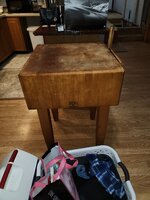
This block is from 1980 and no cracks, the boos oil works, we use it on all cutting boards and edge grain tops.
 

Attachments

  • 20231210_121836.jpg
    20231210_121836.jpg
    994.4 KB · Views: 22
  • 20231210_121825.jpg
    20231210_121825.jpg
    787.5 KB · Views: 24

budget76

Well-known member
Joined
Jan 19, 2016
Messages
502
none of my cutting boards get treated, ever. washed, & scrubbed if needed in the sink, rinsed with hot water, set to dry .
I've sanded some over the years if they are really screwed up, and put them back into use.
I don't do mine that often, but when I do it makes a world of difference (oil/beeswax mix). The oil/wax fills in all the cuts/scratches and makes water bead off, much easier to clean that way.
 

budget76

Well-known member
Joined
Jan 19, 2016
Messages
502
This block is from 1980 and no cracks, the boos oil works, we use it on all cutting boards and edge grain tops.
because you posted up and it's easy to ask - how do you clean the big blocks like this. obviously not the sink like a board. Soapy rag then one to dry after?
 

jar944

Well-known member
Joined
Jul 26, 2010
Messages
5,951
Location
Northern VA
I've always wondered about this "food safe" theory. If you use a 2K urethane (automotive clearcoat) or conversion varnish, which is acid catalyzed, and is used on most kitchen cabinetry (or at least should be) it should be completely inert after it has crosslinked. I don't see how these catalyzed coatings are going to poison me once the chemical reaction is completed. Isocyanate is deadly by itself, that's why we car painters use respirators during application, but once the paint is dry it's been consumed. I've painted MDF with 2K clearcoat and the MDF edges ***** up the stuff on the first two coats. After sanding smooth the final coat goes on like glass and forms a hard very tough surface that I've used for worktables. I use high density polyethylene for my cutting board which at one time during its production probably is deadly but by the time I buy it at Walmart it's apparently safe as I haven't died yet.
You don't want a film finish on a cutting board unless you like chips of finish in your food. Cv or 2k would be likely fine eat, but do you want to?

If it's a charcuterie board, have at it
 

jar944

Well-known member
Joined
Jul 26, 2010
Messages
5,951
Location
Northern VA
The goal is to use keep them from getting -dry-
Like the OP said, I have like 9 of these...
I obviously am not using all 9 of them ....it's like my hobby along with the knives and the metric boatload of cookware I have, etc.

Even just sitting soaked in mineral oil until it won't take anymore and then put on the shelf, I'm finding it's almost bone dry just from
sitting around 1 year later. Each board has literally -drank- a solid 14-20oz+ mineral oil and just -amazed- that it has dissipated all that with no usage (washing, etc) in a Years time
You have 2 options
Mineral oil
Beeswax

Or a mix of both.

Get a large enough tub and submerge the board for a few hours.
 

paulsomlo

Well-known member
Joined
Jul 16, 2013
Messages
3,907
Location
Northern Colorado
No, just no. Danish oil is a oil/varnish mix
From the mfg website:
A superior penetrating linseed oil finish that is polymerized for fast and easy application on interior woodwork and furniture. It is also ideal for wood paneling, cabinets, salad bowls, wood utensils, butcher blocks and surfaces that come in contact with food. This wood finish is commonly used by woodworking professionals for application to bare wood or overtop an already-stained piece. Danish Oil will darken the wood slightly and can be combined with oil-based pigments to create wood stains.
 

jar944

Well-known member
Joined
Jul 26, 2010
Messages
5,951
Location
Northern VA
From the mfg website:
A superior penetrating linseed oil finish that is polymerized for fast and easy application on interior woodwork and furniture. It is also ideal for wood paneling, cabinets, salad bowls, wood utensils, butcher blocks and surfaces that come in contact with food. This wood finish is commonly used by woodworking professionals for application to bare wood or overtop an already-stained piece. Danish Oil will darken the wood slightly and can be combined with oil-based pigments to create wood stains.
Fair enough I'll concede that tried and true is food safe. Looking at the msds its 100% linseed oil.

Bit of a marketing trick calling BLO "danish oil"
 

Firstram

Well-known member
Joined
May 16, 2017
Messages
1,392
Fair enough I'll concede that tried and true is food safe. Looking at the msds its 100% linseed oil.

Bit of a marketing trick calling BLO "danish oil"
Keep in mind Boiled Linseed Oil is not food safe, raw linseed is!
 

isb cornbinder

Well-known member
Joined
Nov 3, 2010
Messages
7,073
Location
Pacific South West, BC, Canada
I use and recommend TERRA NOVA Circa 1859 NaturOil. It is available on Amazon. This product was recommended by an old woodworker.
I surprised my wife with a solid maple chopping block. It weighs over 400#. We tried to use a motorcycle hydraulic lift jack and it needed help.
I had been actively looking for a large and heavy chopping block. This chopping block is about 36 inches square and 18 inched thick. I put four grand piano casters under the block's legs.
This came up on Craigslist. I contacted the seller immediately. He had posted the chopping block about a minute before.
It took 4 of us to load the block into my truck.
 

Attachments

  • CHOPPING BLOCK.jpg
    CHOPPING BLOCK.jpg
    21.6 KB · Views: 16

jar944

Well-known member
Joined
Jul 26, 2010
Messages
5,951
Location
Northern VA
It's actually not BLO - it's partially polymerized; there are no heavy metal dryers in it.

Which is actually heated "boiled" linseed oil, unlike the commonly available boiled linseed oil which as you point out has dryers added.
 

jar944

Well-known member
Joined
Jul 26, 2010
Messages
5,951
Location
Northern VA
I understand, I was replying to Jar pointing out the 2 linseed oils are not the same!
Keep in mind Boiled Linseed Oil is not food safe, raw linseed is!

Boiled linseed oil is food safe
"Boiled" linseed oil with dryers is not

Blame the marketing department for that

I still wouldn't want a curing oil as an end grain cutting board finish.
 

neophyte

Well-known member
Joined
Apr 23, 2012
Messages
9,760
Location
Pennsylvannia
Fair enough I'll concede that tried and true is food safe. Looking at the msds its 100% linseed oil.

Bit of a marketing trick calling BLO "danish oil"
Boiled Linseed Oil is a specific term used for linseed oil that has metallic drying agents in the oil.
The drying agents used to be lead compounds, but nowadays are based on different formulas, such as cobalt manganese salts,
 

neophyte

Well-known member
Joined
Apr 23, 2012
Messages
9,760
Location
Pennsylvannia
Which is actually heated "boiled" linseed oil, unlike the commonly available boiled linseed oil which as you point out has dryers added.
“Heated” linseed oil, is usually correctly referred to as “Stand” Linseed oil, were the Linseed oil is heated in a vacuum to promote polymerization.
 

paulsomlo

Well-known member
Joined
Jul 16, 2013
Messages
3,907
Location
Northern Colorado
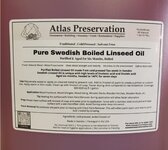
"Pure Swedish", "Purified and Aged", "high levels of linolenic acid and linoleic acid", "clean up with linseed oil soap".

Jeez, talk about marketing!
 
To avoid these ads, REGISTER NOW!
Top Bottom