To avoid these ads, REGISTER NOW!

OK - How many lights on one circuit? (long)

Cobra6

Well-known member
Joined
Oct 23, 2007
Messages
1,380
Location
Tennessee
OK - next noob question - (since I now know how I will run the wire)

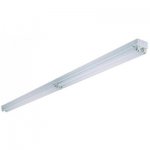
I am going to install overhead 8' tandem T8 flush fixtures on the ceiling (pic).
http://www.homedepot.com/h_d1/N-5yc...splay?langId=-1&storeId=10051&catalogId=10053

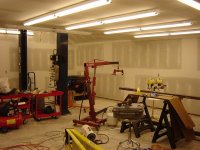
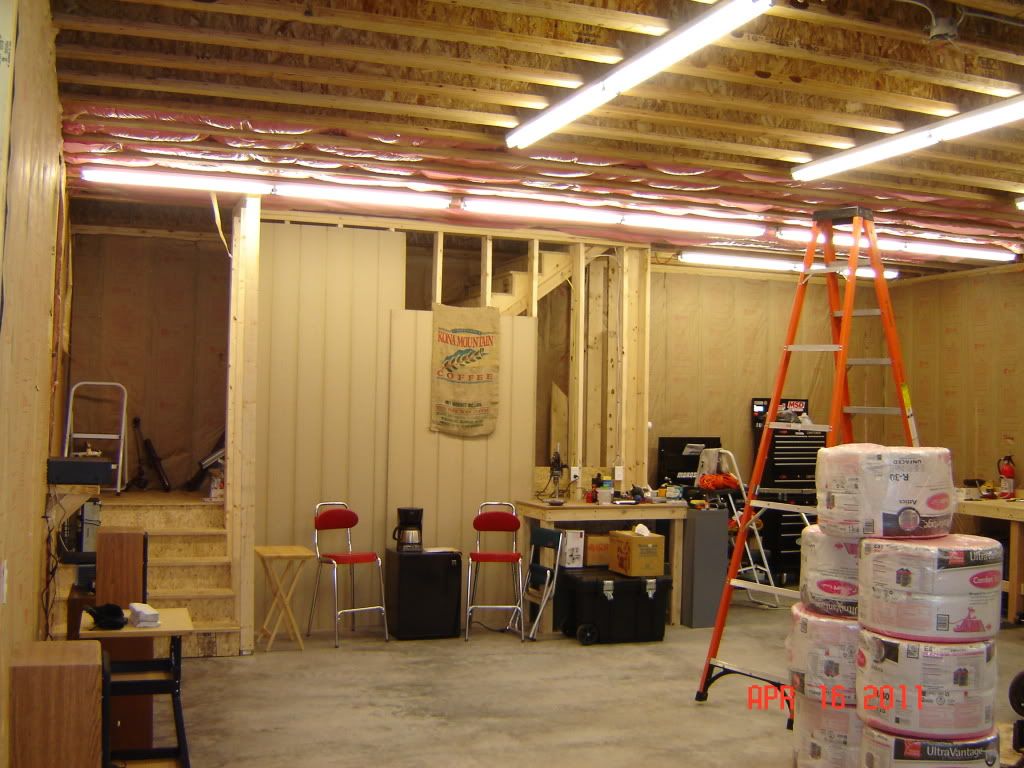
I want to put about 6 in each bay of my garage - 4 parallel down the middle and 2 along the side - similar to the second pic.

According to what I figure, I should run 14/3 NM-B w/ground wire. (or 14/2?)
And on a 15A circuit I theoretically could run 1800 watts, but probably don't want to go over 12A/1400W to be safe.

Assuming this is close, do I just need to calculate the total bulb wattage (~32W per bulb) to load the circuit? Assuming some surge, if this is true I should be able to put 10 of these fixtures on one circuit - right?
1400w/35w= 40 T8 bulbs = 10 fixtures.

Then - do I run one wire to my panel with a junction box in the middle of the ceiling with 10 lights running off of it?

Thanks again - this GJ board is saving me some headaches already. Hopefully somebody else is learning from these posts.
 

Attachments

  • lithonia tandem 8.jpg
    lithonia tandem 8.jpg
    4.2 KB · Views: 22
  • garage lights.jpg
    garage lights.jpg
    73.5 KB · Views: 71
To avoid these ads, REGISTER NOW!

bokchoy07

New member
Joined
Mar 20, 2011
Messages
2
In Canada we are only allowed to go 80% of the rating of the Breaker so we can only load a 15 amp circuit to 12 amps.
 

bochnak

Well-known member
Joined
Apr 9, 2007
Messages
1,230
Location
Mt. Prospect, IL
You have to base your fixture amperage draw by looking on the decal located on the ballast, not bulb wattage.

Also, easiest way to wire multiple fixtures on same switch is to daisy chain them. You'll save wire this way.
 
OP
C

Cobra6

Well-known member
Joined
Oct 23, 2007
Messages
1,380
Location
Tennessee
You have to base your fixture amperage draw by looking on the decal located on the ballast, not bulb wattage.

Also, easiest way to wire multiple fixtures on same switch is to daisy chain them. You'll save wire this way.

OK - thanks - I am going to pick one up today and check out the wattage requirement on the ballast.
 

Jeff Ivers

Well-known member
Joined
Apr 9, 2010
Messages
2,567
Location
Oklahoma
If it were me, I would run 12/2 with ground and 20 amp circuits. General rule of thumb is watts divided by volts is amperage load. 1800 watts on 110 exceeds the 15 amp breaker.
 

MoonRise

Well-known member
Joined
Nov 5, 2010
Messages
4,031
Location
NJ
In Canada we are only allowed to go 80% of the rating of the Breaker so we can only load a 15 amp circuit to 12 amps.

Similar in the US, but the fine-print tech detail IIRC is that a circuit breaker is supposed to be sized for 125% of the expected continuous load (amperage), with the wiring sized appropriately as well.

Which works out to be about the same thing as 'only load a circuit breaker to 80% of its rating for continuous loads', but that is not -exactly- the same thing.


You have to base your fixture amperage draw by looking on the decal located on the ballast, not bulb wattage.

Also, easiest way to wire multiple fixtures on same switch is to daisy chain them. You'll save wire this way.

You can only daisy-chain fixtures (or other devices) if they are "rated" for such a purpose (construction, wiring cavity volume, etc, etc). Most (some?) fluorescent fixtures are made for such wiring, but not necessarily all. Check first.

Otherwise, yes, do indeed 'daisy-chain' the fixtures if they are constructed/rated for such. Otherwise, run the wiring in a daisy-chain fashion but you end up with a 'trunk' line going from junction box to junction box and each fixture 'branches off' from the junction box with its own wire/whip.

As to "how many", as said you can check the nameplate rating on the fixtures which should give you the load of the ballast + the bulbs (total fixture amperage/wattage). Add that all up and get your circuit load.

Suggestion. Put more lights than (most people) think is 'enough' and you will probably come close to 'enough'. For 'precision work' (fine assembly, painting, things like that), general rule-of-thumb is 100-150 lumens/ft2 at the work area. Read the lumen output of the bulbs/tubes you are thinking of putting in (I suggest a decent 'full-spectrum' aka 'daylight' tube with a high CRI, generally 85 or better, and electronic ballasts (more efficient than the old mag ballasts and -should- eliminate or at least minimize 60 Hz flicker from the light output) and do the math to get the target lumens/ft2. Note that you'll probably only get about 80% of the 'rated' lumens from a bulb/tube (due to light losses in the fixture itself), and also that fluorescent bulbs/tubes lose lumen output as they get older (the 'rated' life-span of most fluorescent bulbs/tubes is not an 'absolute' number, but rather the time at which the light/lumen output is down to 50% of the original rated lumens), so plan/size accordingly.

In a small workshop section of my basement of ~250 ft2, I put IIRC 12 4ft T8 daylight bulbs (rated about 2000-2200 lumens each IIRC). That's three 4-bulb fixtures in that space. It's about right, although I could/should probably put in one more and spread them out a bit better.

Also, with that many lights, a suggestion is to put them on a few different light switches/banks so that you can fire them all up when you want/need BRIGHT, but only turn on some when you want/need less light or different 'directional' light (for painting/sanding for instance, you often want the light coming in at an angle so that you can see waves/dips/ripples/etc better).
 

Aceman

Well-known member
Joined
Jan 28, 2007
Messages
2,513
Location
Eastern Oregon
I believe a typical 4 lamp T8 ballast draws right around 1 amp at 120 volt. So, shooting for 10 fixtures per circuit would give you a little wiggle room.

I'd probably use 14-2 for everything. Run all the circuits to one switchbox figuring one circuit/bay. Then switch each bay individually. You'll take off from each switch with another 14-2 to feed the lights. It sounds like you'll have 3 rows of fixture per bay. So hit the first fixture in the first row, jump back out of it and hit the first fixture in the second row, then the third, etc. Then, from that first fixture in each row, chase some Romex/THHN, etc down through the fixture into the end of the other fixture butted right against it.

Piece of cake.

Don't forget outside lights, work area lighting, task lighting, etc if you need to run wire for those also.
 

dave67fd

Well-known member
Joined
Apr 25, 2011
Messages
872
Location
Southern NH
I started with two trunklines down the middle, one with three duplex outlets and another with two outlets spaced appropriately. Each duplex feeds two lights. Install short cords so they can easily be unplugged for service/clearance etc..

Seriosly consider not purchasing the Home Depot lights. They carry the China made ballasts and tend to easily fail and can blow bulbs. It doesn't pay to go cheap here.

Buy these: http://www.contractorlighting.com/8ft-lamp-watt-fluorescent-double-channel-strip-120277-p-176.html

garage048.jpg


DSC01071.jpg
 
To avoid these ads, REGISTER NOW!
OP
C

Cobra6

Well-known member
Joined
Oct 23, 2007
Messages
1,380
Location
Tennessee
I got one of the HD lights today to see how to wire it and see what the ballast wattage was - it is a China-made ballast (see pic) - I thought Lithonia was USA made.
 

Attachments

  • ballast.jpg
    ballast.jpg
    137.9 KB · Views: 117

ldim

Active member
Joined
Jul 10, 2010
Messages
33
I've found that for working on cars you don't need fixtures down the center and in fact they can be in the way. Fixtures down the sides, one across the front and one across the back and you're good to go. Nothing more painful then having an 8' bulb break onto your prize. Also consider shatterproof plastic bulb covers
 
OP
C

Cobra6

Well-known member
Joined
Oct 23, 2007
Messages
1,380
Location
Tennessee
Don't forget outside lights, work area lighting, task lighting, etc if you need to run wire for those also.

And I did - I have figured my compressor, heat/AC, lift,
water heater, and overhead lighting.
I have some lighting that will go over my workbenches along the walls, and some outside lights.

And good tips from Idim about placing the lights over the car.

I have to figure my wall outlets now...............
 

Delta74

Well-known member
Joined
May 6, 2011
Messages
320
Location
Peachland B.C. Canada
Hate to say it check the codes, not sure about the US, but here in canada, we can run flouresent lights ( there fixed loads cant unscrew and put a 500 watt in ) on a 20 amp breaker upto 100%, all other loads are 80% since they can flucuate. so read the ballast see what it lists as its amp draw, and figure out how many times it goes into 15 or 20. and there ya go, max lights. but check local codes.
 

tfi racing

Well-known member
Joined
Apr 19, 2008
Messages
2,907
Location
Cedar,BC
I got one of the HD lights today to see how to wire it and see what the ballast wattage was - it is a China-made ballast (see pic) - I thought Lithonia was USA made.

Sorry,pretty much all ballasts are Chinese or Mexican made...
Don't worry though,that GE ballast is pretty good,I install them by the truckload and have very few failures,much better than the new contractor grade Phillips that I seem to replace only after a few months...
 
OP
C

Cobra6

Well-known member
Joined
Oct 23, 2007
Messages
1,380
Location
Tennessee
I just need to get something with a ballast that won't make my favorite radio station sound "like 50 lbs of bacon frying" -
 

HoosierBuddy

Well-known member
Joined
May 9, 2006
Messages
2,935
Location
Southern Indiana
Hey Cobra,

Not exactly related to your original question...but based on my experience.

On my 3 car garage we had the same issue and had to run 2 circuits for all the overhead lights. That meant 2 switches as well.

I had my electrician hopscotch around with each circuit so that either switch turns on every other light in the garage. Often, I will only turn on 1 switch and the garage is lit up OK. If I'm working out there and need for-real light I turn on both switches. Basically, it's a dim/bright set up just like headlights.

I much prefer this over the standard "one switch" per bay approach.

Phil
 
OP
C

Cobra6

Well-known member
Joined
Oct 23, 2007
Messages
1,380
Location
Tennessee
Hey Cobra,

Not exactly related to your original question...but based on my experience.

On my 3 car garage we had the same issue and had to run 2 circuits for all the overhead lights. That meant 2 switches as well.

I had my electrician hopscotch around with each circuit so that either switch turns on every other light in the garage. Often, I will only turn on 1 switch and the garage is lit up OK. If I'm working out there and need for-real light I turn on both switches. Basically, it's a dim/bright set up just like headlights.

I much prefer this over the standard "one switch" per bay approach.

Phil

Actually - I was probably going to do something similar - especially for the two car bays - the other area will be for miscellaneous work, but probably a good way to do it - 14/2 wire is not THAT expensive. If I do this, I guess I probably also need to set this up with a two-way switch so I can access from either end of the garage -
 
To avoid these ads, REGISTER NOW!
Top Bottom