To avoid these ads, REGISTER NOW!

Old Bonney Wrenches

Harwinton

Well-known member
Joined
Apr 26, 2012
Messages
196
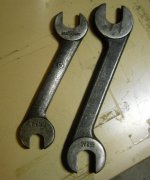
I thought you all would get a good kick out of these old Bonney wrenches I have.

attachment.php

attachment.php


The larger one has 5/8" and 11/16" openings, while the smaller one has 1/2" and 11/16" openings (Its labels use an obsolete sizing convention).

I don't know exactly how old they are, but they're definitely no spring chickens. But what's funny about them is the fact that both of them have a 11/16 opening on one end, but the heads are different sizes. I guess it's a good example on how they machined the ends into the wrenches after forging them in different sizes.

It's also interesting to look at the size of the head on the 1/2" end on the smaller wrench. I guess they didn't care too much about using extra steel back on those days...

The wrenches themselves work great and I use them on DIY projects on my vehicle and around the house and yard, although I often choose a different 1/2" wrench with a smaller head for clearance reasons.
 

Attachments

  • DSCN6270.jpg
    DSCN6270.jpg
    77.2 KB · Views: 176
  • DSCN6278.jpg
    DSCN6278.jpg
    87.4 KB · Views: 174
Last edited:
To avoid these ads, REGISTER NOW!

Private Lugnutz

Well-known member
Joined
Mar 30, 2012
Messages
30,618
Location
The Authentic Jersey Shore
Very cool. Thanks for sharing, Harwinton.

Those fractional sizes are U.S.S. convention. According to my Alloy-Artifacts derived cheat sheets, the logo on the face and the B-Shield on the shank dates these to later than 1915, no later than 1925, and the lack of a forged-in code on the shank means no later than 1921. So, sometime between 1915 and 1921.

I am personally fond of the overly large "Parabolic" heads and the classic finish style of the carbon steel era, whatever the brand, that your pair of matched wrenches represents - black japanned with polished faces. I own some parabolic Arcturus and Armstrong, and I recently re-finished a set of five (5) Williams Superior DOE wrenches that way.
 

north

Well-known member
Joined
Oct 16, 2009
Messages
1,502
Location
Norway
Awesome. I love to see old stuff and read the info that others have on it. I have spent many an hour over at Alloy Artifacts for stuff like that.
 
To avoid these ads, REGISTER NOW!
OP
H

Harwinton

Well-known member
Joined
Apr 26, 2012
Messages
196
Very cool. Thanks for sharing, Harwinton.

Those fractional sizes are U.S.S. convention. According to my Alloy-Artifacts derived cheat sheets, the logo on the face and the B-Shield on the shank dates these to later than 1915, no later than 1925, and the lack of a forged-in code on the shank means no later than 1921. So, sometime between 1915 and 1921.

I am personally fond of the overly large "Parabolic" heads and the classic finish style of the carbon steel era, whatever the brand, that your pair of matched wrenches represents - black japanned with polished faces. I own some parabolic Arcturus and Armstrong, and I recently re-finished a set of five (5) Williams Superior DOE wrenches that way.

That's an interesting idea looking these up on Alloy Artifacts. I took a look at their page on Bonney. It's a good read, lots of information!

One interesting thing I noticed with one of my wrenches is that the larger one does not have the shield logo on the shank. It does, however, have the shield logo on one of the open ends. It also lacks the date code. I wonder if this wrench is a very early one from between 1913 and 1915, the time when they first introduced the shield logo and the time when they started putting it on the shank.

Whenever they made it, though, it's still a great wrench and holds up very well. I still use it to this day!
 
To avoid these ads, REGISTER NOW!
Top Bottom