

You are using an out of date browser. It may not display this or other websites correctly.
You should upgrade or use an alternative browser.
You should upgrade or use an alternative browser.
Old Fluke 77 multimeter
- Thread starter wazzabie
- Start date
Beerhippie
Well-known member
You'd be much better off to get a clamp-on amp probe to go with it. The fuse blows if you look at it wrong. 10A just isn't much.
The fuse is inside the case and a bit of a PITA to access. If the meter is used, the fuse is probably blown already. Change the battery out while you're replacing the fuse.
The fuse is inside the case and a bit of a PITA to access. If the meter is used, the fuse is probably blown already. Change the battery out while you're replacing the fuse.
GreenIron
Well-known member
Yes. Insert the RED lead into the 10amp socket. Be aware that the max testing is for 10amp or below.to measure amps do I insert the red lead into the 10A fused and keep the black lead where shown.
Wrench97
Well-known member
Fluke is a good meter.
For amp testing with that type of meter I use a lead with a 7.5 amp fuse holder in it much easier and cheaper to change that then the one inside the meter.
For amp testing with that type of meter I use a lead with a 7.5 amp fuse holder in it much easier and cheaper to change that then the one inside the meter.
Wrench97
Well-known member
No you would need a amp clamp, is the circuit DC or AC voltage?
DCNo you would need a amp clamp, is the circuit DC or AC voltage?
Yikes $800 for the Fluke 289.I have one of those.
Decent meter. Not great. Not horrible.
I would recommend Fluke 289
I still have my Fluke 77 that I bought new in 1985/6 when I was going to a tech school. Still works fine. IIRC it was about $180 new way back then with a school discount. That was a lot of money for a VOM back in the day. I also had Realistic meters that were under $20.
Steve W.
Well-known member
I got mine from previous employer when they were upgrading to the then-new 80-series meters. That was 30 years ago.
Since changing jobs in 2008, the shops where I have been working have had all the test equipment calibrated by a third party NIST-traceable company. My 77 has passed with flying colors every single time.
Is it a good meter? Yes.
Is it the best? No.
Is it adequate for about 98% of what I need a meter for? Yes.
I have other meters, too, but if the 77 will do the job, it’s the first one I grab.
.
Since changing jobs in 2008, the shops where I have been working have had all the test equipment calibrated by a third party NIST-traceable company. My 77 has passed with flying colors every single time.
Is it a good meter? Yes.
Is it the best? No.
Is it adequate for about 98% of what I need a meter for? Yes.
I have other meters, too, but if the 77 will do the job, it’s the first one I grab.
.
Miss the Pontiacs
Well-known member
I’ve got 2 of the Fluke 77s. They work fine for what I use them for.
c39er
Well-known member
My dad worked at Fluke and gave my brother and me both Fluke 77's in the late 70's or early 80's. I still have mine...it still works fine.
I have a lot of Fluke instruments.
I have a lot of Fluke instruments.
Wrench97
Well-known member
I you look at new meters make sure they state they read DC current, most will not.
jmarkwolf
Well-known member
I have two Fluke 77's that I've owned for some decades. I use both frequently and both work perfectly.
NHtoolguy
Well-known member
That sounds like a great idea! What manufacturer makes those fused leads? I've never seen one.Fluke is a good meter.
For amp testing with that type of meter I use a lead with a 7.5 amp fuse holder in it much easier and cheaper to change that then the one inside the meter.
You can also use a shunt resistor for more than 10A if needed. A clamp meter is easier but you can usually buy a resistor for about $10. Note with a shunt resistor you measure the voltage across resistor and do the math (V/R) to calculate amperage, not the Amp measurement on meter.
Wrench97
Well-known member
Home made with a inline fuse holder crimped into a cheap lead.That sounds like a great idea! What manufacturer makes those fused leads? I've never seen one.
A 77 is a decent meter but just doesn’t have many features. I had one years ago and broke it and I got my company to replace it with something newer. The lack of capacitance is a feature many people need.
Another guy I work with had a 23 and I swear they were the same except for the color.
Another guy I work with had a 23 and I swear they were the same except for the color.
richfinn
Well-known member
Great quality meter from another era.
The lack of a backlight/capacitance/min-max and the low count make it a little old fashioned nowadays, but still very useable as a basic meter
The lack of a backlight/capacitance/min-max and the low count make it a little old fashioned nowadays, but still very useable as a basic meter
Ilikeike
ALLIANCE MEMBER
Merica 
I was issued one in January of 1990 at work. Used it for the next 25 years, almost daily, I til I retired.
I was an auto mechanic.
As others have said, it doesn’t have some features but it is still the meter I grab first for 99% of what I do in retirement.
I was an auto mechanic.
As others have said, it doesn’t have some features but it is still the meter I grab first for 99% of what I do in retirement.
tiredoldironworker
Well-known member
- Joined
- Jun 14, 2024
- Messages
- 246
I have a half dozen of them spread around from my shop to my company's shop to my brother to my niece to my nephew in law and keep one for a spare. I think it was the best basic MM of all time. I have much superior meters but only use them in the uses where they are necessary. I bought every one of them for less than 40 bux.
Are these old Fluke 77 multimeters any good? I got one at a garage sale made in USA. newbie question. to measure amps do I insert the red lead into the 10A fused and keep the black lead where shown.
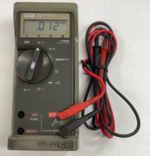
I bought a Fluke 77 around 1985. I used it for a few years, then needed an amp clamp meter and gave it to my dad. May dad passed away in 2021 and I found the 77 in his tools with a good battery in it, so he was using it yet. Today it sits on a shelf in my garage with the rest of my meters.
Fluke meters are good tough meters. I would challenge anyone to abuse a meter for forty years and still work!
To the OP, you want a clamp meter, but be aware the most of them only test AC amps. DC amps clamp meters are a bit rare. a Fluke 301D should do what you want.
KnurledNut
Well-known member
An AC/DC current transducer can be added to your 77 to take that reading through the mV/V side, but they are pricey and one really needs to be aware of the pros, cons, and how-to's of using it.
I used a 77 Series II for several years before upgrading. Very durable and reliable.
I used a 77 Series II for several years before upgrading. Very durable and reliable.
Last edited:
It may COST that much, but it’s WORTH far more. It’s a bargain at $800.Yikes $800 for the Fluke 289.
I've got 2 model 77's, one at work and one at home. Yeah they dont have a lot of features, but they are tough and reliable. One of the things I like is the stable readings it gives. I have used other cheap meters and the display rolls around like a slot machine. For basic ac and dc work I think its about bullet proof. I bought a separate capacitance meter from the jungle to test capacitors and it works great.
jayemm
Well-known member
Here's a DC amps clamp meter.
Beerhippie
Well-known member
With the resolution of the Fluke 77, you can only read to the nearest amp. You'll need another decimal place right of the decimal point to read tenths--like comparing draws across the windings of 3-phase motors.An AC/DC current transducer can be added to your 77 to take that reading through the mV/V side, but they are pricey and one really needs to be aware of the pros, cons, and how-to's of using it.
I used a 77 Series II for several years before upgrading. Very durable and reliable.
I'd say that 99.9% of the time I'm using a multimeter, the 77 would do everything I need.
Willie Makeit
Well-known member
- Joined
- Dec 30, 2013
- Messages
- 937
I have 2 of that very make and model ... been giving it their all for over 20 years. Work horses.
NHtoolguy
Well-known member
Thanks for the description. I have an inexpensive test lead set that would be a good candidate for modification. Does your inline holder use the automotive tubular glass-bodied fuses? Or, the newer flat blade type?Home made with a inline fuse holder crimped into a cheap lead.
Wrench97
Well-known member
Flat blade, easier to find these days.Thanks for the description. I have an inexpensive test lead set that would be a good candidate for modification. Does your inline holder use the automotive tubular glass-bodied fuses? Or, the newer flat blade type?