To avoid these ads, REGISTER NOW!

Old Mallet

55chevy

Well-known member
Joined
May 16, 2009
Messages
417
Location
Hendersonville, Tn.
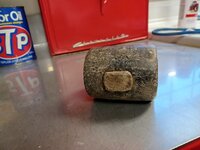
Picked up this vintage mallet at an estate sale for $1.00. Very heavy with wood surrounded by steel. Anybody know about these? There is one online for $100. Can't be worth much, but very different.
 

Attachments

  • 20230119_141227.jpg
    20230119_141227.jpg
    621 KB · Views: 75
  • 20230119_141236.jpg
    20230119_141236.jpg
    83.7 KB · Views: 75
  • 20230119_141219.jpg
    20230119_141219.jpg
    546.1 KB · Views: 74
To avoid these ads, REGISTER NOW!

four.cycle

Well-known member
Joined
Oct 19, 2015
Messages
28,458
Location
Tacoma, Washington
hammers.jpg
Both of my wood mallets were custom turned by Dave Feist (of Lincoln Hardware) who was also a member of the local "Wood Turners Group". The large one is turned from a piece of English Laurel - he made it for me to hit my shake froe, but it was so pretty I didn't want to bang it all up.
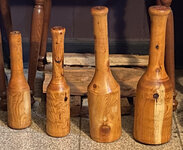
Some older mallets with metal-wrapped heads fetch respectable prices in the second-hand market.
 

2oolhound

Well-known member
Joined
Dec 18, 2010
Messages
5,918
Location
BC Canada
English Laurel - he made it for me to hit my shake froe, but it was so pretty I didn't want to bang it all up.
I know what you mean. I turned these ones out of yew starting with the larger one, about 4.25" just for use with my froe but now I'm having 2nd thoughts. Most froe mallets seem to be hacked out with a hatchet and get chewed up pretty fast.
I turned these out on my atlas 10" metal lathe just because I've never owned this type of mallet and was curious about them. You see them often enough. I want to make 2 more even smaller ones like this over the weekend. I'm working on 2 regular type mallets that will have steel ferrules at the ends of the striking surfaces and compliment the one posted above with the steel sleeve.

Mallets_1246.jpg.
Striking surface diameters are aprox: 4.25", 3.33", 3" and 3".
 

four.cycle

Well-known member
Joined
Oct 19, 2015
Messages
28,458
Location
Tacoma, Washington
^ indeed.
I made my first mallet for my froe out of a piece of pear. about 5 inch diameter. I just chopped it off with a chainsaw, bored a hole through it with an auger, and inserted (believe it or not) a piece of old broom handle for a handle. left the bark on it. It worked well enough to finish that job but it was fairly tattered by the time I got done. ;)
 
To avoid these ads, REGISTER NOW!

RTM

Well-known member
Joined
May 13, 2019
Messages
13,058
Location
SF Bay Area
The many (5 or 6) people I know who use a froe regularly use a chunk of a branch to hit it. The back edge of a froe is just too abusive to a nice mallet in their opinion.

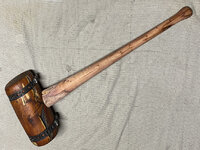
One guy had a 4-6" diameter tree branch, turned about 6" of it down to a grip. Wood with an interlocking grain, like elm, or eucalyptus, seem to stand up to the abuse better.

I tried a dead blow mallet, it was effective, but the face showed signs of abuse quickly .

One of the two mallets I turned
DSC08996-X2.jpg
 

2oolhound

Well-known member
Joined
Dec 18, 2010
Messages
5,918
Location
BC Canada
Yes, I figured a mallet would get beat to heck if it was used for banging on a froe so I only used a naughty piece of yew that will deserve being beaten.

Nice work RTM! What is the tool laying down? Is that awl looking tool some kind of stitching awl?

And Mintgrun, it's funny to see your post because that's the picture I had in my mind when I was turning my mallets thinking they would work great and wondering what type of wood they're mostly made from.

I'd planned to leave the bark on the 2 larger ones I'm working on too so they would look like pieces of log but then I decided to put a steel furrule on each end and needed to turn them down for those so off came most of the bark. I guess the other reason for removing the bark is because I haven't turned much wood before so am enjoying doing so on my atlas metal lathe just for the experience. I get that to carpenters and other wood workers mallets were commonly after thoughts or spin off jobs required to complete the main job at hand. I can respect those tools but I also like tools that have a bit of design flare as well as function built in.

This one's almost done but the handle is a length of limb with a lot of the outer sap ring showing which is white but in this case, kinda grey and I'm not happy with the look next to the BLO finished head so I'm going to stain a few spots before the BLO treatment this weekend (workin today so weekends start sundays).

YewMallet9Sm_1286.jpg
 

RTM

Well-known member
Joined
May 13, 2019
Messages
13,058
Location
SF Bay Area
Nice work RTM! What is the tool laying down? Is that awl looking tool some kind of stitching awl
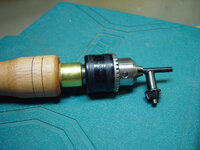
The one with it's **** towards the camera is a drill chuck on a handle. Very useful for center drilling an item on a wood lathe, it self centers very quickly. It was part of a class, making the handle, drill the center, cut the tenon to fit the ferrule, etc.


DSC09007-X2.jpg


The awl is a marking awl, again part of the class. The tip was made by spinning some drill rod down on a grinder, while spinning it in a drill. Great for marking stuff on the lathe while spinning, to get your contour lines. No better picture.
 
To avoid these ads, REGISTER NOW!
Top Bottom