To avoid these ads, REGISTER NOW!

Old Rockwell Drill Press - Opinions?

rrgg654

Member
Joined
Jan 2, 2017
Messages
8
Location
Alberta, Canada
My current Delta drill press (17-965) has a certain amount of lateral movement in the quill, especially at full extension. This is a common issue on modern drill presses as there is no way to compensate for wear in the head where the quill slides up and down. This is not a problem on most drilling tasks, especially when the starter hole has been counterpunched, but it is a pain when drilling overlapped holes or partial holes on the edge of something, like with a Forstner bit.

Older presses had a split casting with a bolt for snuggling up to the quill as the hole in the head became worn. This is not found on any modern drill presses that I can find.

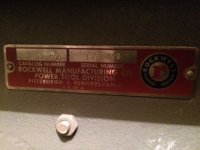
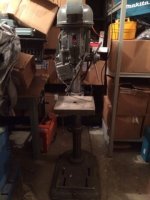
I have a chance to purchase the drill press shown. It is a 17" Rockwell 17-600 from the 1960's I think. Note the bolt through the head casting as described above.

Has anyone used such a press? Does the split head really remove lateral play in the quill at full stroke? I'd hate to go to all the trouble of changing presses only to find out that the adjustment provides only marginal improvement.

Anything I should watch out for on this press when I inspect it? Has anyone changed the bearings on a press like this? Are they readily available and easy to install?

Any comments are welcomed.
 

Attachments

  • $_27.jpg
    $_27.jpg
    25.4 KB · Views: 165
  • $_217.jpg
    $_217.jpg
    37.7 KB · Views: 129
  • $_247.jpg
    $_247.jpg
    24.5 KB · Views: 163
  • $_272.jpg
    $_272.jpg
    22.4 KB · Views: 140
  • $_273.jpg
    $_273.jpg
    27.2 KB · Views: 133
To avoid these ads, REGISTER NOW!

454ragtop

Well-known member
Joined
Mar 24, 2008
Messages
5,011
Location
Carver, MA
That's a 17" Delta Rockwell with slow speed pulleys, a very good light industrial drill press. I've changed bearings in the motors, never actually had to replace any in the machine itself. Suspect you would be very happy with it, is quite the step up from the import Delta you have now quality wise. Also note they are heavier than they look, probably weighs about double, which in machine tools is always a good thing. Make sure the gears in the table raiser are good, others have had problems with them, but I've never seen it. Have 4 of them now, and have had 4 or 5 others in the past.
 
Last edited:

rsanter

Well-known member
Joined
Dec 22, 2007
Messages
18,552
Location
visalia ca
It does and doesn't.
That feature is to lock or clamp the quill in the down position so it can be used with a drum sander or such.
People have discovered that if they tighten it slightly it will reduce some of the play or movement you have described. Keep in mind that tightening it will reduce the clearance mostly in the X axis ( side to side) but not do as much in the Y axis ( for and aft).
Generally when a drill press has play like described between the quill and head casting, it is either from use/wear, poor machining tolerance, or is just the manufacturing spec on that machine.
You are supposed to move the table up and down between jobs such that the drilling operation starts with the quill mostly retracted and then finishes extended. The hole will do a lot of its own self guiding as you make it.

If you need a greater precision than this then what you need is a higher precision drill press or a milling machine.
Often drill presses made for metal will have a tighter tolerance than the standard homeowner or woodworking drill press

Bob
 

GLTHFJ60

Well-known member
Joined
Oct 31, 2013
Messages
821
Location
Durham, NC
rrgg654, I own a 1960s vintage Rockwell 17-600 drill press that is nearly identical to the one pictured above.

The split head does a pretty good job of eliminating x/y axis play in my experience. The quill is pretty stout, although it is a drill press, not a mill.

I find that even with a stout drill press, the drill bit will deflect more than anything when drilling into curved surfaces or when overlapping another hole. Pre-drilling is the best way to ensure your hole starts straight, in addition to starting the hole with the work raised to the bit as far as you can so that the quill is retracted.

Would you like me to take some measurements on my drill press to see what play is? I've got a dial indicator and can provide measurements.
 

Packard V8

Well-known member
Joined
Mar 16, 2009
Messages
7,381
Location
Spokane, WA
The Delta/Rockwell 17" is about the best commonly available light industrial DP. You will like most everything about it, other than the cost of parts. Buy a good, complete working machine. A bargain, missing only a few parts, gets expensive, as every small part on eBay is $25 and any larger part is $50 - 75 plus shipping.

One positive feature is on th 17",all the bearings are standard P/Ns, unlike its 14" brother, which has proprietary NLA bearings. That's a really good thing, as the 17" is a precision unit and has bearings out the wazoo, all up and down inside the spindle, which also prevents the side play you describe.

jack vines
 
To avoid these ads, REGISTER NOW!

GLTHFJ60

Well-known member
Joined
Oct 31, 2013
Messages
821
Location
Durham, NC
Sorry this took a while (myriad of excuses) but I got your numbers.

Model and serial number below. I believe that what I have is a 1963 completely original drill press, except a 1.5hp motor that someone added along the line.

X and Y both have .010" of play measured at the collar at the bottom of the quill, when the quill is fully extended. When the split casting is tightened up where the quill exists the head casting, the quill play is 100% removed, aka I measured .000" of play at the bottom of the quill, fully extended.

ZZfLrkNRk830epmfArfi69TROG_ZMKMGL04YO5srEMnweYsVzSZmwEQnCNQqPM7IOiUvby408xO9oMQjZl8_JhQfG89Evaaj38wza4nejwyhFQQU7z9tTQX_f9Al-p4w2MeRkE-hmNnA3bs2jGxcUp2bNAMjIp3435mNJnHEq9LSNVNv6oyxxKX5KsjenW09A3NR8Aya1xTdQr-y-5oqkH5kh2_ppmJKm7EOU0mY4MOI3MTGDU6CQLmcNIu9-kmAr-Lj65d7yy3LFKAvKe-et3k10iPu2WtUl8ScAspN_iy0JAu88HFiNuq7M3Sb7uedn9gSbxj1U_D1KPqyCVwlDGjlh1hRc60vEjeXeiXrhe7QJhxdDyhx-3aNj_V0mmJ3pWAUNgpBobLYdKrD1U-AgmdcrR1WXLxXSW5IjcZsxwr_0HvVgTiJCFKVOKCcsC9Zzgt595ou3t6wiKZ-hbjYRVwJzI-KyVPkT-mSoRuW6aLThYNpGEQqE50eNtAfK9zfCziCgFGihWJoj8Xc3UvDT4DjEQVup84MO3KnKbv3PmGiUzkzJFW1_LtXptxJRw5wp0dEib6VaYXoswhcBvT1p2LsBjd6IEnHpzz9JRYPBCPeajeyG0C6lS-G8zidTxDdXA0EADoMU2rzTOMvuQpvPGQeubiBe0t2z1B-HXJ929A=w2530-h1898-no
 
OP
R

rrgg654

Member
Joined
Jan 2, 2017
Messages
8
Location
Alberta, Canada
Thanks to all that replied so far.

I got everything assembled with new bearings and had 3 thou runout at the spindle (a JT33 male stub, not the MT2 female snout spindle).

Took the spindle shaft to a machine shop and they say it is straight (< 1/10th of a thou 0.0001")

Perplexed for a while.

One thing that bothers me is that the bearings just drop right onto the shaft. Virtually zero interference. I'm thinking that this should be a press fit. If they are not the shaft could be cocked within the inner races, producing wobble. Even a tiny bit of clearance can result in 3 thou runout. My newer press has zero, as does my lathe, as does the shaft on the upper spindle where the pulley goes on.

To get the shaft ground down, chromed up, reground will cost more that I paid for the press.

Any comments before I decide if I am going to proceed with this step?

Thanks again everyone.
 

crguy

Well-known member
Joined
Jan 24, 2016
Messages
2,681
Location
SW Washington
First all, a little runout in a drill press is no big deal. Drill presses are nothing like lathes, and not expected to be. If the bearing fits are loose, you could knurl them a little and/or use loctite which should center the bearing by itself if there is minimal clearance.
 

GLTHFJ60

Well-known member
Joined
Oct 31, 2013
Messages
821
Location
Durham, NC
I haven't had my drill press apart yet, but I would expect bearings to be a press fit on the spindle. Were there any visual defects in the bearing journals on the spindle, maybe from a bearing spinning on the spindle causing material to wear away?

At the end of the day it is a drill press, not a mill.
 
To avoid these ads, REGISTER NOW!
Top Bottom