
You are using an out of date browser. It may not display this or other websites correctly.
You should upgrade or use an alternative browser.
You should upgrade or use an alternative browser.
Old Stahlwille set
- Thread starter Stewie 83
- Start date

Private Lugnutz
Well-known member
If it's for use, any round bar of suitable diameter for the cross-drilled holes will suffice.Have to buy the stahlwille Bar handle to use it tho.
The Stahlwille junkies on the 'Stahlwille, Belzer etc' thread will probably know. Click on the German Tools link in the Index in the Sticky at the top of the forum.Any idea of the year it was made?
Oldtuleguy
Well-known member
- Joined
- Nov 4, 2017
- Messages
- 10,486
Looks older to me, but I don't really follow the euro stuff. Made in Germany on the label implies prewar
Last edited:
Welcome to the forum, where are you in this wide World?
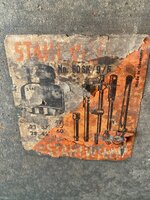
1” drive set as listed in the 1955 Catalog. Sockets lock on and have push buttons to release.
As the part number decodes, 60= 1” , 9= socket quantity, 5= accessory qty.
I don’t know what the SK refers to and the socket sequence is unusual.
The set above it it in the image is appropriate sizes for ISO metric tooling.
Snap-On loxocket tools will work with these.

1” drive set as listed in the 1955 Catalog. Sockets lock on and have push buttons to release.
As the part number decodes, 60= 1” , 9= socket quantity, 5= accessory qty.
I don’t know what the SK refers to and the socket sequence is unusual.
The set above it it in the image is appropriate sizes for ISO metric tooling.
Snap-On loxocket tools will work with these.
Last edited:
Im from Finland. Many thanks to you about this infoWelcome to the forum, where are you in this wide World?
1” drive set as listed in the 1955 Catalog. Sockets lock on and have push buttons to release.
As the part number decodes, 60= 1” , 9= socket quantity, 5= accessory qty.
I don’t know what the SK refers to and the socket sequence is unusual.
The set above it it in the image is appropriate sizes for ISO metric tooling.
Snap-On loxocket tools will work with these.

-S-
Or early postwar. Not exactly sure when the W. Germany markings became common, but my sister has a globe dated ‘47 or so that still just described the whole area as ‘occupied Germany’ or something like that, without clear east/west border.Looks older to me, but I don't really follow the euro stuff. Made in Germany on the label implies prewar
Dave455
Well-known member
The socket size sequence is the old Swedish standard SMS 1413 / 1415.Welcome to the forum, where are you in this wide World?
1” drive set as listed in the 1955 Catalog. Sockets lock on and have push buttons to release.
As the part number decodes, 60= 1” , 9= socket quantity, 5= accessory qty.
I don’t know what the SK refers to and the socket sequence is unusual.
The set above it it in the image is appropriate sizes for ISO metric tooling.
Snap-On loxocket tools will work with these.
These are Whitworth or BSF threads with metric bolt heads.
The sizes 21, 23, 28, 33, 37 etc correspond to bolts of 7/16, 1/2, 5/8, 3/4, 7/8 etc with Whitworth (coarse) threads. BSF (fine) threads use one size smaller.
Some of the sizes are shared by the old French standard, but that exact sequence is unique to the Swedish.
These sizes are common on older (sometimes not so old) Swedish machine tools. Probably many other applications too, but machine tools are where I commonly find them.