To avoid these ads, REGISTER NOW!

Old Taps and Dies

donthelegend

Well-known member
Joined
Nov 7, 2011
Messages
203
Location
St. Louis, MO
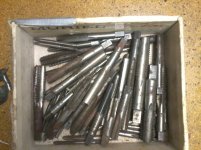
I've been going through my parents garage and sorting/organizing/claiming some tools recently. I've known some of what was there but I've found things both I and my dad had forgotten about and brought them over to my garage to be cleaned/sorted/used as appropriate. This includes a decent collection of taps and dies. Some of these were purchased by me, some by my dad, some by his dad, and some by his grandpa. Some current chinese stuff from various names, some older USA Craftsman, and several other brands I don't recognize. Anyone know anything about the "Card" brand?

Any way, my main question is how should I clean these up? Some of the taps are completely covered in rust, and I don't really know if I can do anything with them. Lots of them have rust spots over the size of the tap that seems like it would be easy enough to clean up, but I'm not sure if I should wire wheel them or use electrolysis? Is there a coating that electrolysis will hurt?

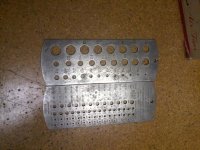
Also included a pic of an old drill bit chart that I cleaned up with electrolysis because I thought it was cool and someone here would appreciate it. It says Copyright 1898 at the bottom, not sure if it's actually that old or not though.

Thanks guys!
 

Attachments

  • Photo634.jpg
    Photo634.jpg
    137 KB · Views: 87
  • Photo635.jpg
    Photo635.jpg
    139.2 KB · Views: 80
  • Photo636.jpg
    Photo636.jpg
    128.7 KB · Views: 67
  • Photo640.jpg
    Photo640.jpg
    142.3 KB · Views: 90
  • Photo639.jpg
    Photo639.jpg
    141.5 KB · Views: 77
  • Photo638.jpg
    Photo638.jpg
    139.3 KB · Views: 89
  • Photo637.jpg
    Photo637.jpg
    129.8 KB · Views: 94
To avoid these ads, REGISTER NOW!

Zeke

Well-known member
Joined
Aug 13, 2009
Messages
17,176
Location
Long Beach CA, the sewer by the sea.
I've got lots of old taps. Many never used since they came to me. When I need one I just take some of the cutting oil and a small wire brush, clean them up a bit and go to work. Don't use a bench mounted grinder with a wire wheel. That will just dull the points.

I suppose you could degrease and clean them and then do the molasses soak. But they aren't going to get any sharper or duller by making them pretty.

I like the old Athol gauges. Yes, they are probably that old because Athol was acquired by Starrett, I believe, somewhere around 1905.
 
Last edited:
OP
D

donthelegend

Well-known member
Joined
Nov 7, 2011
Messages
203
Location
St. Louis, MO
I've got lots of old taps. Many never used since they came to me. When I need one I just take some of the cutting oil and a small wire brush, clean them up a bit and go to work.

I suppose you could degrease and clean them and then do the molasses soak. But they aren't going to get any sharper or duller by making them pretty.

I like the old Athol gauges. Yes, they are probably that old because Athol was acquired by Starrett, I believe, somewhere around 1905.


I'm less concerned about making them pretty just for the sake of pretty and more concerned about making them readable/ stopping the rust spots where they're at now. Right now only about half the taps can be read, and while I can probably figure out the size of them by matching them to fasteners or other readable taps, it'd be nice to be able to just pick it up and read what it says.


As far as I know, these were all used in a home garage setting (so not very often) so they should still have plenty of life left
 

454ragtop

Well-known member
Joined
Mar 24, 2008
Messages
5,011
Location
Carver, MA
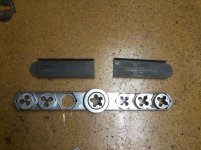
Card is/was a machinist grade manufacturer of taps and dies, good stuff. That die set with the storage in the stock handles looks pretty unique, probably should be in the "Tools only YOU have" thread, never seen anything like it before. As far as the thread gauge, it is a Starrett, Athol in this case being the town in MA where they are located. Rust wise, the taps don't look to bad, I think I'd spray them with oil to prevent further rust, and just use them. Not the best way to store them, rubbing against each other, try to limit the rubbing movement.
Jim
 
OP
D

donthelegend

Well-known member
Joined
Nov 7, 2011
Messages
203
Location
St. Louis, MO
The dies with the storage in the handle is old craftsman, so I figured it wasn't that rare... I'll post it over in that thread though and see if anyone else has seen one. I can just make out the old crown logo on the left handle, unfortunately any other information has been worn away.

I'm going to try to come up with a better way to store them, but want to clean them up some in that process so I just sorted them into "pipe taps" and "everything else" for now.

Thanks all for the suggestions and info so far!
 

Outlawmws

Well-known member
Joined
Aug 9, 2011
Messages
39,313
Location
The Badlands
I've been using a vinegar soak for old taps dies and drills I accumulate. I don't like them rusty either. After cleaning and drying, oil them with gun oil. Made for the job of preventing rust...

For the parts that are stubborn, use a tooth brush, and if it's really stubborn, a brass/bronze brush the size of a tooth brush.
 
Last edited:

Kevin54

MEMBER EMERITUS
Joined
Jan 12, 2005
Messages
29,341
Location
Urbana, Ohio
One thing that you have to watch with old tap and dies is how much they may have been used. A tap that is really rusty, it may be better to toss it and replace it with a new one. I'm talking about ones that are solid rust. All it takes is using it one time and chipping a piece of tooth off, and your part that you are tapping may be screwed. Larger taps, not as much worry, but smaller taps could be a problem. So it's up to you to decide. If you give the edges the thumb test, you can tell whether they are sharp or not. Plus look at them closely to make sure that there are no chipped teeth on them. Taps especially over the dies. A die has protected teeth, but a tap may be banged around against other taps.
 

cheechi

Well-known member
Joined
Feb 29, 2012
Messages
4,384
Location
Triad, NC
you can use a file brush on taps, and depending on the size maybe also some of the dies. Just don't be too aggressive. If it's just surface rust it won't take much effort.
 

JoeFin

Well-known member
Joined
Sep 13, 2013
Messages
717
Location
NorCal - where the Rednecks Race
You mean you can use the same Tap more then twice in Stainless Steel

A lot of guys don't even know the difference in quality of these old taps that were made when the "Queen's Steel" was still the benchmark standard. Butterfield, Morse, Greenfield, even American Tool Co. were all extremely well made cutting tools then

You can wire wheel or emery the shanks just fine so you can read the stamped sizes, but I wouldn't let the wheel get any where near the cutting edges. Also try running a round or half-round polishing stone up through the flutes. That will clean it up and help keep your cutting edge bright and sharp too

000_0006-1.jpg
 

Steinmetz

Well-known member
Joined
Oct 11, 2012
Messages
2,274
Location
Washington State
"...Also try running a round or half-round polishing stone up through the flutes. That will clean it up and help keep your cutting edge bright and sharp too...".

That's what I do.
 
To avoid these ads, REGISTER NOW!
OP
D

donthelegend

Well-known member
Joined
Nov 7, 2011
Messages
203
Location
St. Louis, MO
Well, I'm going with a vingear soak on a few taps right now to see how I like the results. If the come out well, I'll probably stick with that, if not, I'll just wire wheel the shanks and be done with it (I'll stay away from the cutting edges). In either case, I'm going to figure out a slightly better way to store them and give them all a coat of oil to prevent any future rust.

As I've been looking more closely at these, there are definitely some that have been well used and aren't worth keeping, but most seem to have lots of life left in them.
 

Kevin54

MEMBER EMERITUS
Joined
Jan 12, 2005
Messages
29,341
Location
Urbana, Ohio
Well, I'm going with a vingear soak on a few taps right now to see how I like the results. If the come out well, I'll probably stick with that, if not, I'll just wire wheel the shanks and be done with it (I'll stay away from the cutting edges). In either case, I'm going to figure out a slightly better way to store them and give them all a coat of oil to prevent any future rust.

As I've been looking more closely at these, there are definitely some that have been well used and aren't worth keeping, but most seem to have lots of life left in them.

If you have a mill or a router table and router, pick up some PVC sheet or pick up some nice Poplar wood from your local boxstore, and make a nice holder for your taps and dies.

When I get some free time, I have the same thing to do. I had bought some 4x8 sheets if 1/2" white PVC from a lumberyard that was clearing out some areas. I laid out a pattern on paper what I need to put in a drawer. One sheet will hole my taps, and one will hold all of my button dies.

I'll post up the item when I get started, which will hopefully be in a couple of days.
 

JoeFin

Well-known member
Joined
Sep 13, 2013
Messages
717
Location
NorCal - where the Rednecks Race
If you have a mill or a router table and router, pick up some PVC sheet or pick up some nice Poplar wood from your local boxstore, and make a nice holder for your taps and dies.

The little wood box was initially what I did with them until my collection kinda out grew the box


This is what my taps and dies look like now


DSCF1284_zps8a81ffeb.jpg


I don't expect most garage guys to need as extensive a collection of taps and dies as I do. You need to remember I have a descent CNC machine shop doing mostly prototype work. Not everyone needs 10 or 12 minimum of each size


and then a little more space for some odds and ends bearings, small screws and nuts, ect. ect.

DSCF1283_zps3458e59c.jpg
 
OP
D

donthelegend

Well-known member
Joined
Nov 7, 2011
Messages
203
Location
St. Louis, MO
Well the vinegar soak has been giving the exact results I was looking for so I'm sticking with it. Doing about 7-10 taps at a time, letting them soak for about 4-6 hours, then rinsing, hitting them with a scotchbrite pad, and then oiling. Still haven't figured out how I'm going to store them, but there have been some good ideas posted already.

Thanks everyone for the suggestions!
 

Kevin54

MEMBER EMERITUS
Joined
Jan 12, 2005
Messages
29,341
Location
Urbana, Ohio
Quote:
Originally Posted by Steinmetz View Post
"...Also try running a round or half-round polishing stone up through the flutes. That will clean it up and help keep your cutting edge bright and sharp too...".

That's what I do.


Please elaborate.

If you run a round stone up through the thread relief, it will sharpen the edges of the cutting edges of the teeth or thread, making it cut better.

One other thing when it comes to taps, if at all possible, steer away from 4 flute taps, and try to stick with 2 flute taps. A lot of 4 flute taps, just don't seem to have enough chip clearance and do not cut as well as a 2 flute spiral point tap, or a two flute gun tap.

If you have a tap and find that it is taking a lot of horsing to get it to cut, try stepping up one size in your tap drill. Easier to do with a number drill that a fractional drill though. By just opening the hole up a few thousandths can make a world of difference.

Another thing to remember....don't try to tap a hole using a bottom tap. Use a pointed tap until it bottoms out, then switch over to your bottom tap to finish the threading process up.

Never wire brush a tap to get rust out of the threads. It will do nothing more than shine it up, but more importantly, it will dull the teeth or threads of the tap. If you have taps that are rusty and/or pitted, shitcan them. I don't care whether it is a generic offbrand tap, or if it a tap out of a Snap-On set, a rusty pitted tap is not a good tap. It is better all the way around to replace it with a new tap.

If you find that you are tapping some material, say aluminum, and the tap is proving hard to get it to thread, and you have the right size of tap drill, shitcan the tap and buy a new one. For most materials, not counting the exotic materials, a tap should go through relatively easy. Make sure you use a good lube. For most tapped holes, I use just plain motor oil. One can also use something like Tap Magic, one can use lard mixed with a little kerosene, or there is about a dozen other lubes out there that you can use. But for general tapping on common materials, any 10W-30W oil will work just fine.

Do not try to tap the hole all at once. Back the tap out, clean it off, and clean the hole out, then go at it again. I have always made up special air guns using a 1/8" diameter steel tube. You can get one off of something like a windshield washer fluid tube. This allows you to get the tube down into the hole to clear it out. When doing so though, wrap a shoprag around the nozzle so you don't get chips into your eyes.

And remember....taps are fairly cheap. For most taps, you can get decent taps for $3.00 each and up for 2 flutes. Once you get to the 5/16" or 3/8" size, the taps then step up to 3 flute. And remember, it is way cheaper to spend a few dollars on a new tap than it is to snap an old tap off in a part, then have to work like heck to get it out or to have to pay someone to remove it for you. It's also not a crime to have mismatched sets of different brands.

And for some that may not know, BEWARE of 6-32 taps. You will snap one of those off before you will snap taps of smaller sizes. For some reason a 6-32 is the odd tap that will normally break. If you find yourself having to order taps top fill a set, order two or three of a 6-32.

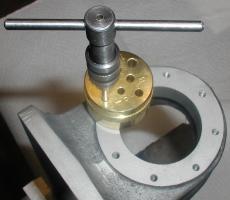
One other little tidbit about tapping.....Either make or buy a "Tap Guide". A tap guide is nothing more than a round piece of barstock, with both ends parallel to one another and the clearance size of hole for the tap drilled through the piece. This lets you start your tap exactly perpendicular to the hole. This will aid in keeping the tap from binding and possibly snapping. To clarify, some tap guides are round, and some may be elongated. Both are a valuable asset to any toolbox though. :thumbup:

tap_guides_2.jpg


tap1.jpg
 

george4

Well-known member
Joined
Feb 18, 2006
Messages
773
Location
N California
If you run a round stone up through the thread relief, it will sharpen the edges of the cutting edges of the teeth or thread, making it cut better.

One other thing when it comes to taps, if at all possible, steer away from 4 flute taps, and try to stick with 2 flute taps. A lot of 4 flute taps, just don't seem to have enough chip clearance and do not cut as well as a 2 flute spiral point tap, or a two flute gun tap.

If you have a tap and find that it is taking a lot of horsing to get it to cut, try stepping up one size in your tap drill. Easier to do with a number drill that a fractional drill though. By just opening the hole up a few thousandths can make a world of difference.

Another thing to remember....don't try to tap a hole using a bottom tap. Use a pointed tap until it bottoms out, then switch over to your bottom tap to finish the threading process up.

Never wire brush a tap to get rust out of the threads. It will do nothing more than shine it up, but more importantly, it will dull the teeth or threads of the tap. If you have taps that are rusty and/or pitted, shitcan them. I don't care whether it is a generic offbrand tap, or if it a tap out of a Snap-On set, a rusty pitted tap is not a good tap. It is better all the way around to replace it with a new tap.

If you find that you are tapping some material, say aluminum, and the tap is proving hard to get it to thread, and you have the right size of tap drill, shitcan the tap and buy a new one. For most materials, not counting the exotic materials, a tap should go through relatively easy. Make sure you use a good lube. For most tapped holes, I use just plain motor oil. One can also use something like Tap Magic, one can use lard mixed with a little kerosene, or there is about a dozen other lubes out there that you can use. But for general tapping on common materials, any 10W-30W oil will work just fine.

Do not try to tap the hole all at once. Back the tap out, clean it off, and clean the hole out, then go at it again. I have always made up special air guns using a 1/8" diameter steel tube. You can get one off of something like a windshield washer fluid tube. This allows you to get the tube down into the hole to clear it out. When doing so though, wrap a shoprag around the nozzle so you don't get chips into your eyes.

And remember....taps are fairly cheap. For most taps, you can get decent taps for $3.00 each and up for 2 flutes. Once you get to the 5/16" or 3/8" size, the taps then step up to 3 flute. And remember, it is way cheaper to spend a few dollars on a new tap than it is to snap an old tap off in a part, then have to work like heck to get it out or to have to pay someone to remove it for you. It's also not a crime to have mismatched sets of different brands.

And for some that may not know, BEWARE of 6-32 taps. You will snap one of those off before you will snap taps of smaller sizes. For some reason a 6-32 is the odd tap that will normally break. If you find yourself having to order taps top fill a set, order two or three of a 6-32.

One other little tidbit about tapping.....Either make or buy a "Tap Guide". A tap guide is nothing more than a round piece of barstock, with both ends parallel to one another and the clearance size of hole for the tap drilled through the piece. This lets you start your tap exactly perpendicular to the hole. This will aid in keeping the tap from binding and possibly snapping. To clarify, some tap guides are round, and some may be elongated. Both are a valuable asset to any toolbox though. :thumbup:

tap_guides_2.jpg


tap1.jpg

Thoughtfull post, thanks. Been meaning to get tap guides, added them to my list on amazon.
 

Steinmetz

Well-known member
Joined
Oct 11, 2012
Messages
2,274
Location
Washington State
If you run a round stone up through the thread relief, it will sharpen the edges of the cutting edges of the teeth or thread, making it cut better.

One other thing when it comes to taps, if at all possible, steer away from 4 flute taps, and try to stick with 2 flute taps. A lot of 4 flute taps, just don't seem to have enough chip clearance and do not cut as well as a 2 flute spiral point tap, or a two flute gun tap.

If you have a tap and find that it is taking a lot of horsing to get it to cut, try stepping up one size in your tap drill. Easier to do with a number drill that a fractional drill though. By just opening the hole up a few thousandths can make a world of difference.

Another thing to remember....don't try to tap a hole using a bottom tap. Use a pointed tap until it bottoms out, then switch over to your bottom tap to finish the threading process up.

Never wire brush a tap to get rust out of the threads. It will do nothing more than shine it up, but more importantly, it will dull the teeth or threads of the tap. If you have taps that are rusty and/or pitted, shitcan them. I don't care whether it is a generic offbrand tap, or if it a tap out of a Snap-On set, a rusty pitted tap is not a good tap. It is better all the way around to replace it with a new tap.

If you find that you are tapping some material, say aluminum, and the tap is proving hard to get it to thread, and you have the right size of tap drill, shitcan the tap and buy a new one. For most materials, not counting the exotic materials, a tap should go through relatively easy. Make sure you use a good lube. For most tapped holes, I use just plain motor oil. One can also use something like Tap Magic, one can use lard mixed with a little kerosene, or there is about a dozen other lubes out there that you can use. But for general tapping on common materials, any 10W-30W oil will work just fine.

Do not try to tap the hole all at once. Back the tap out, clean it off, and clean the hole out, then go at it again. I have always made up special air guns using a 1/8" diameter steel tube. You can get one off of something like a windshield washer fluid tube. This allows you to get the tube down into the hole to clear it out. When doing so though, wrap a shoprag around the nozzle so you don't get chips into your eyes.

And remember....taps are fairly cheap. For most taps, you can get decent taps for $3.00 each and up for 2 flutes. Once you get to the 5/16" or 3/8" size, the taps then step up to 3 flute. And remember, it is way cheaper to spend a few dollars on a new tap than it is to snap an old tap off in a part, then have to work like heck to get it out or to have to pay someone to remove it for you. It's also not a crime to have mismatched sets of different brands.

And for some that may not know, BEWARE of 6-32 taps. You will snap one of those off before you will snap taps of smaller sizes. For some reason a 6-32 is the odd tap that will normally break. If you find yourself having to order taps top fill a set, order two or three of a 6-32.

One other little tidbit about tapping.....Either make or buy a "Tap Guide". A tap guide is nothing more than a round piece of barstock, with both ends parallel to one another and the clearance size of hole for the tap drilled through the piece. This lets you start your tap exactly perpendicular to the hole. This will aid in keeping the tap from binding and possibly snapping. To clarify, some tap guides are round, and some may be elongated. Both are a valuable asset to any toolbox though. :thumbup:

tap_guides_2.jpg


tap1.jpg

Thanks for handling that. I didn't want to educate this morning, for some reason.

Those tap guides work well, particularly since there is a v-groove on the underside that allows them to be positioned on curved surfaces. They work best when clamped. Although I own them, I most often thread at the lathe or milling machine, so I don't use them very often at all.
 
To avoid these ads, REGISTER NOW!
Top Bottom