Oldtuleguy
Well-known member
- Joined
- Nov 4, 2017
- Messages
- 10,486
Patd 1925 pats pend I think


Your tools are early to mid 20's, so it's possible, and would surely explain some of the differences between yours, mine, and the 1928 catalog.Just earlier version.
 ), shows the built-in socket and small parts tray going wide to narrow left to right and the hasp clearly pinned on the top of the lid. And the BX- boxes (and model numbering scheme) are identified as Stevens products. Which would mean they couldn't be older than 1927, after the merger.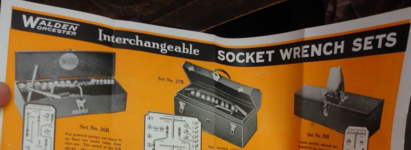
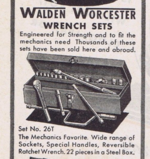
I have a small pile of stuff that may go with it. Here's a few things I had handy^ Your box is not the same as mine. Not just the clasp, but the reinforced lid, and the socket tray. Look at my photos, look at the catalogs, then look at your box. I don't know if that means we have two different model numbers or different generations of the BX-20. Something to figure out at some point.
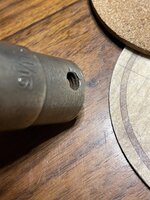
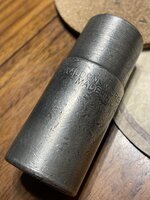
11/16 7322. oval drive socketwith set screw hole.Ok Walden fans here is some more cool stuff. Never shown in a catalog, apparently in the late 20s they made an entire oval drive set. Look close to what I’m describing as the first thumb ratchet




I'm still wanting to give this away.I've got this 1/4" drive WW 3117 if someone needs it to complete a set. It's in good shape.


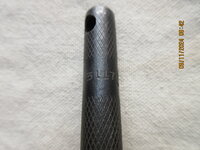

I'll let it go for basically the cost of postage... $6 shipped.
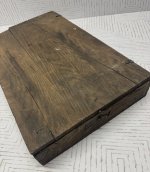
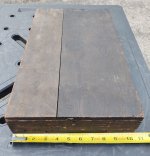
Looks pretty good nice find!I was out at an antique store today & saw a Walden no. 12 pressed steel socket set. I took a pic so I could do some research. I have a lot of early socket sets, but I don't have a Walden set. The set I saw today appears to be complete. The no. 12 had 27 hex sockets, 11 square sockets & the spark plug socket for a total of 39 sockets. This set has all 39. It also has the 5 wrenches & all the extensions and other pieces. I've never seen one so complete in the original wooden box...with the original lid!! I called them back & negotiated a better price. I payed less than $100. Below is the pic I took while I was there. I'll go pic it up tomorrow. I haven't been through this whole thread, but is the Walden no. 12 set difficult to find?
Thanks. I got lucky. Now I'm curious if the top of the lid might have any markings. It would be nice...but I doubt it.Looks pretty good nice find!
Nice find.I was out at an antique store today & saw a Walden no. 12 pressed steel socket set.
These kinds of questions are almost impossible to answer, Ben. They're not common, but they're not unicorns, either. There's one on AA and there's one posted upthread somewhere. That one is older than yours as I recall, with the loop handle ratchet.I haven't been through this whole thread, but is the Walden no. 12 set difficult to find?



It was their largest set in the pressed-steel era. When they progressed to the bulky machined sockets they changed their numbering system to match the number of sockets. I have a No. 8 and a No. 16 set in their original wooden boxes, for example, and they have eight (8) and twelve (12) sockets, respectively. The largest set in that era was a No. 27. (There was a No. 26 as well.)I guess I didn't realize Walden made a large set like the no. 12.
It presents fantastically well!I picked up the Walden set this afternoon.
That circle is just begging to be filled! The question is, with what?Also, on the outside of the lid, you can still see No. 12 Set with a round circle where the Walden logo used to be.

We must be birds of the same feather Lugz. The empty circle has bugged me since I've brought it home. I was researching this just a few minutes ago to make sense of what would have been there. The pic you posted above is the same logo that was on the original label that was on the inside of the lid based on the 1918 catalog pic of the set. My guess would be the logo on the outside probably matched the logo on the inner label. I posted a closer pic below of the circle. It doesn't have any evidence of anything burnt in the wood inside the circle. I'm also tempted to make a proper copy of the inside label to put on the inside of the lid. Why not at this point. I could play around with printing the right size logo on paper to fit the circle.It was their largest set in the pressed-steel era. When they progressed to the bulky machined sockets they changed their numbering system to match the number of sockets. I have a No. 8 and a No. 16 set in their original wooden boxes, for example, and they have eight (8) and twelve (12) sockets, respectively. The largest set in that era was a No. 27. (There was a No. 26 as well.)
It presents fantastically well!
That circle is just begging to be filled! The question is, with what?
The smaller sets in the fiberboard cases had a paper label on the inside of the lid and a lightly embossed branding and set number on the top of the lid. Marketing in the machined era indicates that the set number and logo were wood-burned on the lid, but mine are a little later, with brass tags there. It's too bad @coolford did not post a photo of the top of his early No. 12 set lid. He hasn't been here since 2021. AA's lid is missing. I'm wondering if it was wood-burned to match the "No. 12" and "Set" markings and has just faded. There is some indication that it might have been. Did you try lightly cleaning that area with Murphy's or something like that? I know it sounds outlandish, but if we could verify the method, I would see if I could hire a sign shop to burn it in. You're already in for $100, might as well go all in.
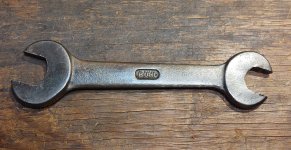
I'll definitely do something. I want to make it look as original as possible. I found one wrench inside that doesn't belong to the set & it bares the name Nash (pic below). I suppose for Nash cars? The Nash came out in 1917, so it kinda goes along with the time frame of the socket set. It's cool to think of what vehicles this set was possibly used on for repairs.^ I wonder if you could have a letter press like stamp made with a CNC machine. There's gotta be a way to do it. Blot the stamp in a black ink pad and hammer it. Test it on a similar piece of wood first.
I'm extremely tempted to give it a light coat of Linseed Oil...or should I just leave the original grunge look? We know what the Linseed Oil will do...It presents fantastically well!
Personally, I would give it the light coat of BLO.I'm extremely tempted to give it a light coat of Linseed Oil...or should I just leave the original grunge look? We know what the Linseed Oil will do...
If you're referring to the wooden box, I would not hesitate to treat it. I rub all my boxes down to clean, preserve, refresh the grain and make them shine again. My preference is Murphy's, but I've also used and like Orange Glo, believe it or not.I'm extremely tempted to give it a light coat of Linseed Oil...or should I just leave the original grunge look?
Or go over to the wood fabrication section of the forum, see who has a laser engraved, and con them into doing it. I suspect the existing dark color might put most of them off tho.I know it sounds outlandish, but if we could verify the method, I would see if I could hire a sign shop ti burn it in.
I wouldn't be overly concerned about trying to date or even sequence it inside the Pressed-Steel era based on the box. With the 1918 Bellows ratchet, it's near the end and moving into the Machined era. My take-away from that box not having anything on the lid would be confident carte blanche to emboss the logo in that circle to match the way the "No. 12" and "Set" are applied, which has plenty of evidence in period marketing. Just my $.02.No circle where a logo once was or anything. So I guess, some they marked & some they didn't? Or maybe this is a clue to a earlier made set to a later one? Not sure yet.
Oh...I'm not going down that rabbit hole. I was just pointing out some differences. The steel socket era only lasted around 15 yrs anyways. I'm working on the logo for the circle. I already have the inner label ready for print.I wouldn't be overly concerned about trying to date or even sequence it inside the Pressed-Steel era based on the box.
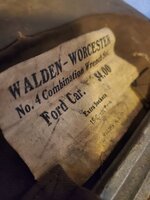
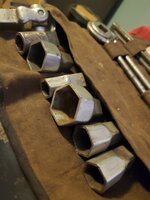
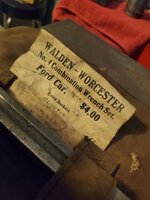
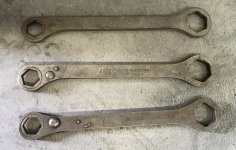
Ford brake and reverse band adjustment wrenches are littered all over this forum, from Mossberg, Bog, Hinsdale, even Packer Auto ("Ray"), and of course Walden. But I think this is the first Walden 4564 I have seen with the warning on the flip side about not using it as a ratchet for anything else.


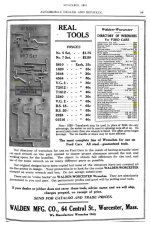



I bet you do!(I have a more documentation that I did not post if anyone ever needs it.)
The next version added an unexplained (to me) opening on the other end. I don’t have one of these, but I have looked at multiple online photos and that additional end does not look hex shaped. I’ve not been able to find a description of the purpose of the second end.
Oval Drive tool? (Kidding..., I know you have some.) No idea.Anyone know what this non hex opening would be used for?
Did you show him a photo of wrench C and D (i.e., commonly found and seen and described in most trade mags and catalogs)? Or wrench B (with the funky oval end), Don? If B, I'd be curious to see what that "adjustment bolt" looks like.Here is the answer I got from my Model T expert.

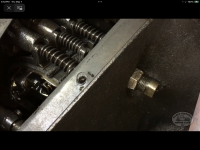

Thank you very much for finding the answer, and thanks also for the screen shot of adjustment bolt it goes on!Here is the answer I got from my Model T expert.
-Don
”It is a transmission low band adjuster . The hex end is for the locknut , the other end turns the adjustment bolt that tightens the band . It comes out of the “hogs head “ on the passenger side.”
Thanks. So that's the oval area machined into the end of that bolt just waiting for @Leviton 's example of the special version of the transmission band wrench? Pretty cool. That's a big bolt. EDIT: There are numerous Ford manuals, spanning a decade or more, on Google Books. They don't illustrate this.I grabbed a couple of screenshots