To avoid these ads, REGISTER NOW!

Oops I bought a Hyper-heat

Iron Beaver

Well-known member
Joined
May 3, 2020
Messages
684
I thought I would come document my adventures using a mini-split heat pump for home heating in a reasonably chilly climate.

Long story short, my parents decided to install a new heating system in their house.

First we looked at propane. It is expensive, not getting any cheaper, and hard to store safely in fire-prone areas.
Electricity is also expensive.

Then I heard about a thing called a high-efficiency air source heat pump. And a thing called Manual J. Does Manual J understand half-underground basements? Not that I found. Does it understand strawbale houses? Probably. Does it understand that WY has a thing called wind that overwhelms insulation with air infiltration? Maybe.... What assumptions does it make? Who knows. Am I smart enough to explain to manual J my design of a hybrid system with a heat pump for all but the coldest days and resistive heat for the one or two really cold days (<-15F or so) a year? Nope.

So I did the normal, logical thing and forgot about about standard manuals and tables, started with the known R values of walls, roof, and floor, and began calculating thermal load myself. Fujitsu provides a handy chart of COP vs temperature for their Halcyon models so I could calculate the total cost of heat given the last 10 years of temperature data from the local airport. With a hydrologic modeler and a programmer in the family, you can guess how deep the rabbit hole went.

Several hundred lines of code and two model reviews later, we decided to get a heat pump.

Many, many $USD later, we have a Mitsubishi hyper-heat heat pump coming soon to a place near us. Will it heat the house, or will it be a hugely expensive disaster? Stay tuned...
 
To avoid these ads, REGISTER NOW!

dsimatt

Well-known member
Joined
Dec 9, 2012
Messages
6,454
Mine pumps out plenty of heat below 0 so i doubt you will be disappointed.
 

yeldogt

Well-known member
Joined
Jan 2, 2012
Messages
18,184
hp is all about matching the output to the load. They publish the output at a given temp and if the load on the house is the same or lower you are fine.

it's hard to get good calculations for anything out of the ordinary .... even spray foam that been common for 30+ years.

leaks are the big factor ...
 

fitter30

Well-known member
Joined
Jun 23, 2019
Messages
2,967
Location
Peace Valley,mo
How many head unit if so how is it divided? Have a modified A frame 8' walls 3 bed. two bath ,loft has master bed & bath main level two bed & bath with utility rm open kitchen and living area .1900 sq ft. Installed two condensers both three head two ton.
Put in two systems and a lp stove for emergency heat for if one system fail or no power have heat and don't have to be concerned with getting parts for a repair. Parts for minis might take a few days being in a rural setting. Minis have been working out ok brand is Gibson by nordyne. Like the zoning.
 

danski0224

Well-known member
Joined
Jan 29, 2005
Messages
13,376
Location
Near Naperville, IL
Yes, Manual J can do half basements. Manual J, by hand, is quite involved.

Even HVAC-Calc will figure above ground basement walls.

Manual J just gives the load (heat loss and gain).

Manual S is about equipment selection.

BTU output of your chosen equipment would need to align with the load calculation.

Economic balance point tells you when to switch from heat pump to "backup" heat.
 
OP
I

Iron Beaver

Well-known member
Joined
May 3, 2020
Messages
684
How many head unit if so how is it divided? Have a modified A frame 8' walls 3 bed. two bath ,loft has master bed & bath main level two bed & bath with utility rm open kitchen and living area .1900 sq ft. Installed two condensers both three head two ton.
Put in two systems and a lp stove for emergency heat for if one system fail or no power have heat and don't have to be concerned with getting parts for a repair. Parts for minis might take a few days being in a rural setting. Minis have been working out ok brand is Gibson by nordyne. Like the zoning.
It is a single head unit.
 
OP
I

Iron Beaver

Well-known member
Joined
May 3, 2020
Messages
684
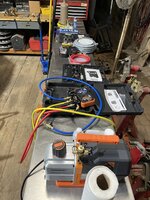
After a bunch of hard work, this happened:

WhatsApp Image 2022-07-24 at 8.46.55 AM.jpeg

Unfortunately, it was all downhill from there. I carefully tightened every junction to about the middle of the torque range Mitsubishi specifies. I vacuumed down the lineset and did the recommended double Nitrogen flush. Then vacuumed down the lineset to 484 microns for the 1 hour rise test. After 50 minutes, the vacuum was at (*drum roll please*)

522 microns.

So I thought maybe there was a bit of moisture left in the system; I vaccumed down the lineset again to 482 and after 50 minutes, vacuum was at 505 microns.

Now I know 14PSI holding the joint closed is way different than 600 PSI trying to blow it open. I can only conclude given the failure of the vacuum rise test that I have a truly massive leak. Probably massive enough to suggest the pre-flared lineset had a burr or something. A burr that, now that I have tightened the joints, will almost certainly have scratched its mating surface on the mini split

I feel like today's stupid tax bill is gonna be large
 

Wiz02

Well-known member
Joined
Jul 13, 2007
Messages
2,399
Location
Southeastern PA
Ugh sounds like something that will happen to me when I get the time to put a mini split in my garage. Time to step back, analyze the situation and take corrective action. Easier said than done, I know. Best of luck and keep us posted.
 
OP
I

Iron Beaver

Well-known member
Joined
May 3, 2020
Messages
684
Yeah. On the HP side for the outdoor unit I thought I saw a burr in part of the flare but then second-guessed myself and decided I saw wrong because this was a professionally flared lineset and there was a nice smooth ring near the center anyway. That fitting seemed like it never tightened the way I expected; the torque stayed constant throughout about 1/4 turn instead of spiking when the flare seated like all the other connections.

Unfortunately, I'm guessing this means the fitting on the HP side of the pump is damaged beyond repair. So I probably just threw away a $3000 mini split because I trusted a factory flare...
 
Last edited:

danski0224

Well-known member
Joined
Jan 29, 2005
Messages
13,376
Location
Near Naperville, IL
In just about everything I've read about those OEM flared linesets, the general guidance is to cut the flared ends off and make new ones.

And don't forget to put the nut on first.

There's a proliferation of mini split lineset torquing tools, too.

I'd also assume that the connection point on the equipment is pretty durable and not easily damaged.
 

Yankeefarmer

Well-known member
Joined
Jul 25, 2011
Messages
1,174
Location
Connecticut
If you are set up to do a “nitrogen flush,” why don’t you pressurize to say, 300 psig or so and see if it leaks down? Shouldn’t cost you anything.
 
OP
I

Iron Beaver

Well-known member
Joined
May 3, 2020
Messages
684
In just about everything I've read about those OEM flared linesets, the general guidance is to cut the flared ends off and make new ones.

And don't forget to put the nut on first.

There's a proliferation of mini split lineset torquing tools, too.

I'd also assume that the connection point on the equipment is pretty durable and not easily damaged.
This wasn't a Mitsubishi OEM lineset; it was a seperate pre-flared lineset that was supposed to be ready to plug, evacuate, and play. Apparently the guidelines to redo flares applies to those, too.

I would like to think the connection point on the equipment is durable, but it's just made of brass. Not that much harder than the copper of the linesets. When you take into account that even a scratch on mating surfaces can cause a leak, I really doubt the connection point survived.
 
OP
I

Iron Beaver

Well-known member
Joined
May 3, 2020
Messages
684
If you are set up to do a “nitrogen flush,” why don’t you pressurize to say, 300 psig or so and see if it leaks down? Shouldn’t cost you anything.

That is the next step. Unfortunately I ran out of time on Saturday and had to postpone further work until next weekend
 
OP
I

Iron Beaver

Well-known member
Joined
May 3, 2020
Messages
684
Overthinking things is basically my personal brand :p

Note that I didn't say overthinking things in a productive way lol
 

danski0224

Well-known member
Joined
Jan 29, 2005
Messages
13,376
Location
Near Naperville, IL
This wasn't a Mitsubishi OEM lineset; it was a seperate pre-flared lineset that was supposed to be ready to plug, evacuate, and play. Apparently the guidelines to redo flares applies to those, too.

I would like to think the connection point on the equipment is durable, but it's just made of brass. Not that much harder than the copper of the linesets. When you take into account that even a scratch on mating surfaces can cause a leak, I really doubt the connection point survived.
Probably doesn't matter what manufacturer made the lineset flares.

When in doubt, cut it out.

From what I understand, the common failure point is on the circumference of the tubing, where it is bent by the flare.
 

American Locomotive

Well-known member
Joined
Jan 8, 2017
Messages
10,945
Location
Rhode Island
482 > 505 after an hour isn't much decay at all. Really I'd call that a passing decay test. I'm guessing you're a little stuck on the "500" number. A small rise is perfectly normal, and not indicative of a leak. Remember, a micron is a very, very small unit of pressure. 1 micron is 0.000019 PSI. So a 23 micron rise is a 0.000437 PSI change.

You just didn't pull a very deep vacuum. Change the oil in your vacuum pump, make sure all of your fittings are tight, and pull down to ~400 microns, then start your decay test. If your vacuum pump is having trouble pulling down that low, change your vacuum pump oil. You might also want to invest in a schrader core removal tool - it makes the vacuum process go much faster. Also make sure you close your valves after you turn the vacuum pump off.

But really, you don't check leaks with vacuum. You check for leaks with a pressure test using an inert gas (nitrogen, argon, whatever). I just installed 3 Mitsubishi 6000 btu hyper heat units (Yours looks to be about the same size as the ones I installed?). The first two units I pressurized to 350 PSI (really you'd probably want a little more, but my setup was a little sketchy and didn't feel comfortable going any higher), and made sure they held 24 hours. Both systems didn't lose any pressure. The last system we got a little impatient and only pressure tested for about 2 hours. But after 2 hours at 350 PSI - it also gained a few PSI, so we called it good.

Basically the process should be:
- Assemble line set, and torque to spec. Use oil or your favorite assembly goop (I used Nylog Blue)
- Pull quick vacuum (maybe 1000-1500 microns or so) to evacuate most of the air
- Pressure test to 300+ PSI (preferably around 500) for at least an hour. 24 hours is better.
- Change vacuum pump oil
- Vent your pressure test gas
- Vacuum to at least 500 microns (I usually pull down to <400, and as long as it stays below 500 during decay I call it good)
- Disconnect vacuum
- Release charge.
 
Last edited:
To avoid these ads, REGISTER NOW!

mbunimog

Well-known member
Joined
Feb 27, 2013
Messages
124
Location
Frederick, Maryland
Test your vacuum pump with the VCRT to see how low it will go. Mine tested 8 to 9 microns at the fitting at the pump.
 

Attachments

  • IMG_0886.jpeg
    IMG_0886.jpeg
    441.8 KB · Views: 50

PoorUB

Well-known member
Joined
Mar 29, 2021
Messages
11,622
Location
Fargo, ND
I did HVAC service for 12 years. Your micron readings look fine to me, they will mover around some. I would gas it up and go. If you are really having doubts pressure test with nitrogen and soak the connections and see if you get any bubbles. No leaks, vac it again and run it.
 
OP
I

Iron Beaver

Well-known member
Joined
May 3, 2020
Messages
684
Thanks for the vote of confidence! I am trying hard to vent zero refrigerant so I will probably pressure test. Nitrogen is cheap and harmless when vented; refrigerant is anything but.
 

danski0224

Well-known member
Joined
Jan 29, 2005
Messages
13,376
Location
Near Naperville, IL
If you only knew how much refrigerant is vented...

I worked for a residential HVAC shop where it was common for a system being replaced to develop a "leak" the day before, to save time by not using the reclaim machine.

Another one didn't use vacuum pumps. They purged the lineset with refrigerant. Open one side, when it came out the other, it was good to go.

All of the equipment out there being hobbled along with a "gas n go"...

I am doubtful that stuff like this isn't widespread.

Then there are the refrigerant recovery programs at the supply houses that are mostly a joke. You end up having to buy a new reclaim cylinder all of the time, they don't take the old one if it's out of date, no one wants to re-certify them, you have to wait for whatever they decide to pay you, and that never covers the cost of the cylinder. It might be a better deal for much larger scale recovery operations. Maybe.
 
Last edited:

yeldogt

Well-known member
Joined
Jan 2, 2012
Messages
18,184
If you only knew how much refrigerant is vented...

I worked for a residential HVAC shop where it was common for a system being replaced to develop a "leak" the day before, to save time by not using the reclaim machine.

Another one didn't use vacuum pumps. They purged the lineset with refrigerant. Open one side, when it came out the other, it was good to go.

All of the equipment out there being hobbled along with a "gas n go"...

I am doubtful that stuff like this isn't widespread.

Then there are the refrigerant recovery programs at the supply houses that are mostly a joke. You end up having to buy a new reclaim cylinder all of the time, they don't take the old one if it's out of date, no one wants to re-certify them, you have to wait for whatever they decide to pay you, and that never covers the cost of the cylinder. It might be a better deal for much larger scale recovery operations. Maybe.
Knowing there is no way for this to happen in an official way ...... wonder what is the contaminate danger of not doing pump downs and all the other items that are part of a "proper" install. Have heard about the 'acid' issues -- my memory --- it is from moisture. So what is the r/d's job? ,,, can't they make one that does a better job and neutralizes any low ph? When you do a service on an older system (open it up) the r/d needed is typically a larger unit vs what is installed at the factory on a new system (or provided in the box to be installed)

Years ago when I first saw mini splits they had hoses like an auto ac --- these were ac only and not inverter. Would have been 1970 in Japan when I was a kid living there. later in the 70's in other parts of Asia I would see copper and they never pumped them down .... again later in south africa --- no pump downs.

the guy that did my unit in cape town did have all the equipment --- cape town is like being on another continent and it was a better unit. some of the units in africa are only a couple hundred dollars

Pioneer sells a install kit that is basically a purge/ pressure gas ... I want to try it just to try it
 
Last edited:

danski0224

Well-known member
Joined
Jan 29, 2005
Messages
13,376
Location
Near Naperville, IL
knowing there is no way for this to happen in an official way ...... really wonder what is the contaminate danger of not doing pump downs and all the other items that are part of a "proper" install.
It isn't done, because it "saves time".

Most of the time, the system still appears to work, and it may continue to do so for the duration of the warranty.

Much older, low efficiency stuff also tolerated ****** installation more than the new stuff.
 

yeldogt

Well-known member
Joined
Jan 2, 2012
Messages
18,184
It isn't done, because it "saves time".

Most of the time, the system still appears to work, and it may continue to do so for the duration of the warranty.

Much older, low efficiency stuff also tolerated ****** installation more than the new stuff.
That could be some of it -- the new inverter heat pump units w/ newer refrigerant work at higher pressures.

It seems leaking is the problem .. most times from the flares. i do remember some comment about acid hurting compressors .... but. the compressors seem to run forever. leaks kill all the systems.

does high acid kill the copper and have it leak ..... one would think this would be an easy fix.
 

danski0224

Well-known member
Joined
Jan 29, 2005
Messages
13,376
Location
Near Naperville, IL
I have been sent pictures of the copper lineset itself leaking. Didn't show up until a pressure test at 500 psi. These were on mini splits, new equipment, new copper.

Most mini splits are also a heat pump, so the pressure test at 500 psi (or whatever the manufacturer recommends) is important.

Not sure if acid is an issue unless the last piece of equipment was a run and burn. There are clean up driers, if the lineset is inaccessible.
 

pcmeiners

Well-known member
Joined
Aug 13, 2009
Messages
7,874
Location
In the only town in Pennsylvania, Bloomsburg.
If you are worried about leaks.....


As others have pointed out, you your gas vacumn will vary over time, every time, as through out your sysytem your line temperatures vary constantly, as does the temperature of your test gas tank. Test with high pressure, again pressure will vary with temperature if using a very precise gauge. With high pressure you can find leaks fairly easily.
 
OP
I

Iron Beaver

Well-known member
Joined
May 3, 2020
Messages
684
I did a pressure test last weekend. Held pressure flawlessly and leak detector found nothing at any of the flares. So with that, we released the charge and fired it up

First impressions:

This thing is well engineered. It's quiet and modern. Per the manual I ran a test of heating and cooling and it promptly roasted us all and then cooled the house back down. As expected when the outside temperature is 90 and the unit is on the south side of a building in the hot summer sun, heating works much better than cooling
 
OP
I

Iron Beaver

Well-known member
Joined
May 3, 2020
Messages
684
Update: As the first nippy fall days roll in, the heat pump continues to work just fine. Seems to heat the house with no trouble at temperatures in the low 30s; time will tell how it does as fall and winter advance.

I'll try to post more updates as noteworthy things happen
 

walrus

Well-known member
Joined
Nov 12, 2008
Messages
11,675
Location
Maine
Hyper heats are all over Maine heating and cooling homes, if its sized right and your home is an open floor plan, it will work. I have 2 12k mini splits, Fujitsu and Daiken, both work well but I only use them until my woodstove can be fired 24/7. 20 degrees is that point.
 
OP
I

Iron Beaver

Well-known member
Joined
May 3, 2020
Messages
684
I've been meaning to post an update!

It has been working just fine. Temperatures hit -40ish where we were at and we didn't even try to run it for a bit less than a week. The thing plus the resistive backup used around $60/month of electricity in Nov. and Dec.. We are trying to optimize the heating program to use less electricity in peak times, that might reduce the bill somewhat
 

thammel

Well-known member
Joined
Oct 3, 2005
Messages
2,243
Location
Maryland
I've got Mitsubishi Mr Slim heat pumps and they are amazing. When it was super cold recently (10F) they were pumping out really warm air. And this is not electric resistive heat either. Just wow!
 

Bolson32

Well-known member
Joined
Dec 6, 2016
Messages
541
Location
Lake Elmo, MN
I've been meaning to post an update!

It has been working just fine. Temperatures hit -40ish where we were at and we didn't even try to run it for a bit less than a week. The thing plus the resistive backup used around $60/month of electricity in Nov. and Dec.. We are trying to optimize the heating program to use less electricity in peak times, that might reduce the bill somewhat
Assuming you have a dual fuel setup then?
 
OP
I

Iron Beaver

Well-known member
Joined
May 3, 2020
Messages
684
Actually triple fuel, but it's designed to be all-electric. There is the heat pump for all but a few days per year, and resistive backup to take on those few days. There is also firewood but we're trying to phase that out
 
To avoid these ads, REGISTER NOW!
Top Bottom