To avoid these ads, REGISTER NOW!

Open vs Closed Radiant Floor Heating

FastKat

Well-known member
Joined
Jan 4, 2010
Messages
553
I am designing a 32x28 garage and I am trying to decide if I should put PEX in the slab for radiant floor heat. I already have a 95% efficient 50/100k BTU hot water tank so I'm halfway there without even trying. It can heat water up to 167*F.

The closed system is like a cooling system in a car. It uses a closed loop of water (or water+ something) and interfaces with the heat source through a heat exchanger. This also requires two pumps and some other parts.

The open system... well I am going to butcher it. Best look at the pic and read the site for more info. This involves pulling water from the street, through your PEX floor, through the hot water tank, and then to your faucets, etc. When heating the floor, it will simply circulate water between the tank and the PEX floor without drawing water from the street. This only uses a pump and a one way check valve. It is cheaper, simpler, and easier to install than a closed system.
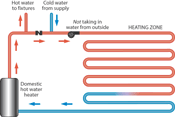
open-direct-system-schematic.gif


https://www.radiantec.com/about-radiant-heating/the-best-systems/

The concern with the open system is Legionella and other microbes, however, I'm not sure that this is a legitimate concern... not that Legionella isn't dangerous, but I'm not sure that these systems actually causes Legionella to come out of the faucet, shower head, etc. All water goes through the hot water tank before going to the faucets.

I had an open system in my condo (conventional gas hot water tank running to a furnace heat exchanger, not a PEX floor system) and it seemed to work fine.

Any thoughts? Any real world cases of a properly installed open hydronic system causing Legionella infection?
 
To avoid these ads, REGISTER NOW!

KenB

Well-known member
Joined
Dec 8, 2008
Messages
334
Location
Pittsburgh, PA
Can’t say either is a clear winner. One advantage to a closed system (which I have in my garage) is that you can have an antifreeze solution in the subfloor loop, so it doesn’t freeze if you lose hot water in the winter. Btw, does the legionella form in the open loop system because the subfloor loop can lay stagnant for long periods of time?

Ken
 

The Cobbler

Super Moderator
Staff member
Joined
Oct 24, 2013
Messages
25,828
Location
Niagara Region, Ontario, Canada
I'm interested in this too. I "don't think" an open system would be a cause for legionaella or other bacteria issues as long as you have the HW heater high enough temp, which is the case anyway.
how is this system any different than water comming thru a several hundred feet waterline buried underground?
as long as there's flow of freshwater through the lines I can't see an issue. tho, I admit by no means am I an authority. I am truly interested in this thread and the comments
I think by setting the water heater higher & installing a mixing valve to the faucet side would be good idea tho
 
OP
F

FastKat

Well-known member
Joined
Jan 4, 2010
Messages
553
Yea, that is a pro for the closed system. Does that antifreeze have a service interval like it does in a car?

I think it's a combination of stagnation and temperature. Legionella's ideal growth range is about 90*-115*F. I think the fear is that water in the floor will cool to that temperature and grow Legionella. However, every time the pump turns on the water in the floor will circulate back to the hot water tank which is hot enough to kill the bacteria. Every time a faucet is opened water from the street will purge the water in the floor through the hot water tank... even in the summer when the pump isn't running to heat the floor.

Where are you in Pittsburgh Ken? I am just north of Pittsburgh.
 

ard

Well-known member
Joined
Feb 16, 2015
Messages
4,391
Location
Sierra Foothills... California
IMO you can treat the water in your closed system so nothing grows. antifreeze, chlorine, etc. fill it with DI water to begin.

Id never do an open system. Be like running the car's cooling system with water from the hose every day.

;)
 

u3b3rg33k

Well-known member
Joined
Dec 18, 2017
Messages
4,047
are you sure your heater will do 167F at 95% efficient? many of the condensing systems stop condensing once they get close to those temps. I'd say go closed. then you can put some anti-freeze in your heating system. what state are you in?
 

ard

Well-known member
Joined
Feb 16, 2015
Messages
4,391
Location
Sierra Foothills... California
they show it in the diagrams / instructions.

to the previous poster, to me it's 's not really like running car with water from the hose everyday . to me it is an economical approach that makes sense. but I guess i've already implied that LOL

How do you maintain a balanced and stable chemistry in the heating loop if it is constantly changed?

It isnt even a close call-OP go survey the top 100 sites on hydroponic heating- see how many recommend the open loop.
 

yeldogt

Well-known member
Joined
Jan 2, 2012
Messages
18,184
I would never do an open system -- there is no way to keep the system fresh in the off season. Even with reverse piping where you feed the DHW through the floor in the off season is a bad idea if you have humidity.

The heating system is also taking heat form the DHW at the very time you need the most recovery.

Bradford white makes a DHW heater (tank) with a coil for supplemental heat -- I have used them for kitchen and bathroom floor warming/heating
 

Jackfre

Well-known member
Joined
Dec 26, 2010
Messages
4,406
Location
N CA
Open loop is cheaper. Closed loop is better and especially safer. There are many thousands of open loop systems that are running successfully but things must be just right. Your circulator must run at least daily to keep the water in the loops from stagnating. I think you would need a rigorous maintenance schedule to flush the tank to keep the organics from building up in the bottom. Keeping the tank temp high to kill/prevent the bugs. means you need at least a tempering valve on the slab piping to prevent overheating of the slab. Open loop says "I should be safe." Closed loop says, "I am safe."
 

The Cobbler

Super Moderator
Staff member
Joined
Oct 24, 2013
Messages
25,828
Location
Niagara Region, Ontario, Canada
How do you maintain a balanced and stable chemistry in the heating loop if it is constantly changed?

It isnt even a close call-OP go survey the top 100 sites on hydroponic heating- see how many recommend the open loop.
the water is freshend whenever you use DHW , it's no different than a 100' run to your water tank, the way I see it

I would never do an open system -- there is no way to keep the system fresh in the off season. Even with reverse piping where you feed the DHW through the floor in the off season is a bad idea if you have humidity.

The heating system is also taking heat form the DHW at the very time you need the most recovery.

Bradford white makes a DHW heater (tank) with a coil for supplemental heat -- I have used them for kitchen and bathroom floor warming/heating

the system remains fresh in off season by running water through the system every time you use DHW
as far as feeding DHW through the floor a bad ieda in off season because of humidity, I don't think that would cause a temp change enough to cool the floor to condense
just my $0.02
 

yeldogt

Well-known member
Joined
Jan 2, 2012
Messages
18,184
the water is freshend whenever you use DHW , it's no different than a 100' run to your water tank, the way I see it


the system remains fresh in off season by running water through the system every time you use DHW
as far as feeding DHW through the floor a bad ieda in off season because of humidity, I don't think that would cause a temp change enough to cool the floor to condense
just my $0.02

There can be a large amount of water in the systems -- 100' of PEX is not very much area to cover. They end up being much more. You also can't be throwing 130 degree water into the slab .. all the parts have to be for potable water. The open systems require more than what's shown in the diagram. They can cause condensation is the summer with cold well water -- it's no different vs typical dripping pipes in a humid environment.

Will it work to transfer the heat -- it will .. is it a good idea .. IMO no.
 
OP
F

FastKat

Well-known member
Joined
Jan 4, 2010
Messages
553
Having the anti freezing and anti corrosive properties is a plus... though I don't plan on letting the water freeze and I think PEX is resistant to corrosion. I am sure there is a service interval associated with the coolant, too, just like on a car.

IMO you can treat the water in your closed system so nothing grows. antifreeze, chlorine, etc. fill it with DI water to begin.

Id never do an open system. Be like running the car's cooling system with water from the hose every day.

I'm not a boat guy but don't some boats pull in water from the lake/ocean to cool their engines?
 
OP
F

FastKat

Well-known member
Joined
Jan 4, 2010
Messages
553
There can be a large amount of water in the systems -- 100' of PEX is not very much area to cover. They end up being much more. You also can't be throwing 130 degree water into the slab .. all the parts have to be for potable water. The open systems require more than what's shown in the diagram. They can cause condensation is the summer with cold well water -- it's no different vs typical dripping pipes in a humid environment.

Will it work to transfer the heat -- it will .. is it a good idea .. IMO no.

I think 1/2" PEX has about 1.6 gallons of water per 100 feet. I would probably be using about 700 feet of tubing so the volume would be about 11 gallons + a small manifold + 3/4" look going between the manifold and the tank... so we're looking at less than 10 gallons in the system. A single shower would purge that daily.

I was wondering about the water temp going into the slab... how do you manage that on an open system? Would there be a mixing valve in the heating loop that diverts cooled floor return water back to the pump rather than cycling it through the water tank?
 
OP
F

FastKat

Well-known member
Joined
Jan 4, 2010
Messages
553
How do you maintain a balanced and stable chemistry in the heating loop if it is constantly changed?

It isnt even a close call-OP go survey the top 100 sites on hydroponic heating- see how many recommend the open loop.

My neighbor at the condo also had an open hydronic system. He needed a new hot water tank and also changed the circulation pump while he was at it. The only thing in the recirculation line was rust and sediment which he suspects was from iron pipe and maybe sediment from the hot water tank. It was not slimey, smelly, etc. Keep in mind that rust was likely through the whole system and unrelated to the hydronic loop.

People keep saying it's unsafe but I cannot find any hard evidence to support the claim.
 
To avoid these ads, REGISTER NOW!

yeldogt

Well-known member
Joined
Jan 2, 2012
Messages
18,184
You will not purge equally with a manifold ...

Sorry ... it's a dumb idea and so easy to do a closed.

Good luck.
 

The Cobbler

Super Moderator
Staff member
Joined
Oct 24, 2013
Messages
25,828
Location
Niagara Region, Ontario, Canada
My neighbor at the condo also had an open hydronic system. He needed a new hot water tank and also changed the circulation pump while he was at it. The only thing in the recirculation line was rust and sediment which he suspects was from iron pipe and maybe sediment from the hot water tank. It was not slimey, smelly, etc. Keep in mind that rust was likely through the whole system and unrelated to the hydronic loop.

People keep saying it's unsafe but I cannot find any hard evidence to support the claim.

I concur on all your points .
I just cannot see the issues. to me it's totally sensible for small systems. for large or whole house , it may be a different story. to heat a bathroom floor , a closed system would be a lot more expensive . again, my $0.02
 

ard

Well-known member
Joined
Feb 16, 2015
Messages
4,391
Location
Sierra Foothills... California
the water is freshend whenever you use DHW , it's no different than a 100' run to your water tank, the way I see it


the system remains fresh in off season by running water through the system every time you use DHW
as far as feeding DHW through the floor a bad ieda in off season because of humidity, I don't think that would cause a temp change enough to cool the floor to condense
just my $0.02

Why do you think 'fresh' water is the best for a hydronic loop plumbing system???

(It may not be....)
 

Randy in Maine

Well-known member
Joined
Nov 21, 2010
Messages
2,176
Location
The Beach
Do what?

Also, FWIW, every closed loop system has an open loop component to it... though it can be quite short if you want it to be.

That would like getting my drinking water after it runs through the water heater and then 300' of garden hose. No one does that either although it probably would not kill you.

Those lines are separate at my house. The radiant O2 barrier heat line is just for heat. The other one is for "drinking water" and/or domestic hot water.
 

The Cobbler

Super Moderator
Staff member
Joined
Oct 24, 2013
Messages
25,828
Location
Niagara Region, Ontario, Canada
Why do you think 'fresh' water is the best for a hydronic loop plumbing system???

(It may not be....)

the fresh water aspect is to keep the DHW fresh only.

That would like getting my drinking water after it runs through the water heater and then 300' of garden hose. No one does that either although it probably would not kill you.

Those lines are separate at my house. The radiant O2 barrier heat line is just for heat. The other one is for "drinking water" and/or domestic hot water.

no, you don't currently drink water out of your hot water tank now, do you? the setup supplies fresh water to the DHW when a hot tap is opened and thererfore fresh water to infloor heat setup
 

bzinsky

Well-known member
Joined
Oct 27, 2014
Messages
5,565
I don't understand why you would input the cold water at the beginning of the loop. All it's going to do is rapidly cool down the floor whenever you run water in the house.

Do it like a hot water loop in a large building. They have a circulating pump circulating a big loop around the building. The purpose is to T off individual fixtures from the loop so that they can receive hot water quickly.

The city water input to those systems is always right at the water heater, right next to the exit for the loop.
 

lowrider2

Well-known member
Joined
May 26, 2016
Messages
48
Location
Idaho Panhandle
Does anyone have a simple (read not a funnel and hose) way to get the hydronics charged with antifreeze? It's a new system which is pressure tested but has no water yet. Holding a 5 gal bucket of antifreeze and pouring into a funnel doesn't appeal to me. Also, should there be formula for mixing water with antifreeze? System is 2700' of 1/2" PEX in 8 zones.
 

Miss the Pontiacs

Well-known member
Joined
Nov 7, 2016
Messages
16,416
Location
Saskatchewan Canada
Would condensing boilers and non-condensing boilers have a part in this open/closed loop systems. In our area hot water heaters are not allowed for heating purposes. Boilers are the standard and from what I understand is that a non condensing boiler is what I should be looking at. Or should a totally new thread be started for this discussion.
 

Firebrick43

Well-known member
Joined
May 12, 2015
Messages
13,998
Location
West central Indiana
Does anyone have a simple (read not a funnel and hose) way to get the hydronics charged with antifreeze? It's a new system which is pressure tested but has no water yet. Holding a 5 gal bucket of antifreeze and pouring into a funnel doesn't appeal to me. Also, should there be formula for mixing water with antifreeze? System is 2700' of 1/2" PEX in 8 zones.
A cheap pump powered by a drill. https://www.amazon.com/WAYNE-WDP21S-Light-Suction-Discharge/dp/B000CMFZY2

Would condensing boilers and non-condensing boilers have a part in this open/closed loop systems. In our area hot water heaters are not allowed for heating purposes. Boilers are the standard and from what I understand is that a non condensing boiler is what I should be looking at. Or should a totally new thread be started for this discussion.

Two big points about not doing an open system.

1, oxygen . A closed system, even using tap water, quickly eleminate's oxygen and therefore corrosion. This is why many cast iron boilers last for 50 years even with iron piping. If one has leaks and has to constantly add makeup water or runs an open system equipment life drops really fast. Most dhw heaters have a life span under 8 years.

Second, precipitating solids. A lot of water has desolved solids and heating it precipitates them out. Again plugging valve and lowering the heating equipment life and especially effecientcy.

As far as a standard gas dhw heater being used, they shouldnt as it as return water of in floor heat is below 120 degrees and therefore in the condensing range resulting in much lower life as the equipment can handle the acids the condensing the flue gases precipitates out. Condensing water heaters and boilers are typically made of SS.

Valving schemes and heat exchangers can be used to prevent problems but then you start approaching the cost of purpose made condensing boilers and don't get the efficiency gains. Down side is condensing boilers are complicated in controlls and heat exchangers and expensive to maintain. (Some situations the energy savings wont cover the equipment cost/maintance cost) A non condensing boiler can be very durable and reliable in a closed system, but efficentcy will rarely be abovery 80 percent.

IMHO the only place a dhw heater should be used with in floor heat is an electric tank unit with small floors. But then you are tied to the high operating cost of electric resistant heat.
 
Last edited:

Miss the Pontiacs

Well-known member
Joined
Nov 7, 2016
Messages
16,416
Location
Saskatchewan Canada
So what I am getting out of this as my system will be closed. No way of eliminating the condensate, so a non condensing boiler is required. Glycol based fluid, cheaper to install and maintain (less peripheral equipment required). More expensive to operate by approx, 10%.
Now what is the name of a good noncondensating boiler?
 

Firebrick43

Well-known member
Joined
May 12, 2015
Messages
13,998
Location
West central Indiana
Condensate can be delt with a pump. Don't take that as a push towards them however.

Weil McLain is the defacto standard for us made cast iron boilers. There are other European brands as well

Warning about antifreeze in your boiler. While a good idea in a garage against freezing its not a free lunch. It can turn acidic over time or if it's overheated. Therefore it needs at least yearly checks for ph and adding corrosion preventative additives. It's not car antifreeze(ethelyne glycol) but propylene glycol. Ethylene glycol will clog everything with silicates over time.

It also pumps harder and carries less heat so if your tubing size is marginal it may struggle or have to upsize the pump.
 
To avoid these ads, REGISTER NOW!
Top Bottom