minute_basset
Member
This is a little long with a few moving parts to be tuned... Anyone with a similar configuration?
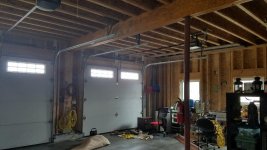
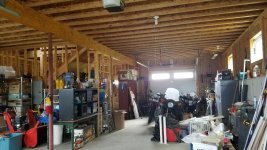
We built our engineered pre-fabricated garage-mahal a few years ago with the intention of insulating, heating and finishing the 2nd floor studio "some day". We have an immediate need to get the garage insulated and heated now - partly to protect a newly repaired slab. However, we want to optimize the work and cost on any construction/hvac - and hopefully avoid rework or a big mistake.. Oh and minimizing ongoing operation costs is up there too.
The Garage:
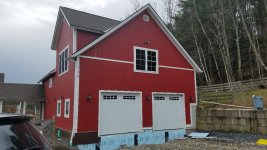
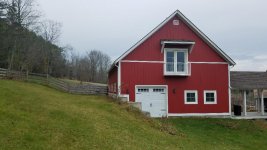
Standalone New Englander story and a half barn in Central VT
30' x 40' with one long wall partially built into hillside (5' foundation); the other 5' is above grade. Insulated slab on 4' frost wall w 2" exterior foam.
2x6 construction with advantech exterior sheathing, tyvek, and vertical shiplap siding, 10' ceilings in garage; 3 9'x9' insulated garage doors and 1 man door,
4' wide stair well with one turn to 2nd floor.
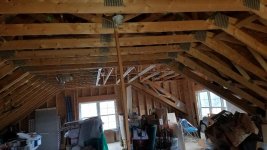
3' knee wall on second floor with trusses set on top giving a 9' ceiling at the center flat area under peak. 13' gabled dormer with 9' ceiling space, 10/12 pitch, architectural shingles.
Garage is multi-use - storage, working on vehicles, servicing tractor and mower, carpentry/woodworking, some finishing. Mostly weekend warriors and sometimes during the week.
2nd floor can be a 1000 sq ft apartment/studio. When we built the garage, we pulled water lines and septic line to be able to put in a bath/kitchenette upstairs and slop sink in the garage. Garage has separate panel pulled off the 200 amp house service (might be 50 amps)
Existing 300# propane tank currently supplying supplemental gas stoves and gas range. No line to the garage.
During the winter, we need to keep the garage above freezing with the ability to warm it up to work.
And we'd like studio to be able to accommodate airbnb or short-term rentals.
Initially the plan was to insulate with spray foam (did the house with Icynene), but now open to more options. I have a buddy that does dense pack and he'd give me a break. And we hadn't thought through the best way to heat the 2 spaces.
Been pouring over the forum researching options, but the studio complicates things.
Questions:
What's the best approach for getting the garage up and running? R20 batts in walls and ceiling covered with vapor barrier and wall finish? Then later dense pack the 2nd floor slopes and loose cellulose in attic? Foam the whole envelope - walls, slopes, under side of roof, plus batts in the garage ceiling?
Do we try to heat the 2 floors off one system? We've been looking at everything from heating the garage with a pellet stove, rinnai, or mini-split. But would then need to choose heating and hot water system (on demand?) the for apartment and will also need a backup source if using electric heat due to power losses in winter.
Will most likely need an HRV in the living space.
Foam guys are giving a quote next week. Vermont Energy Code is being updated this year to R20 to R32 in Walls; R60 in sloped roof.
Downloaded a couple or Manual J spreadsheets to do a rough heat load calc, but will depend on insulation and sealing effectiveness.
Thoughts ? Options? Recommendations?
Many thanks!
We built our engineered pre-fabricated garage-mahal a few years ago with the intention of insulating, heating and finishing the 2nd floor studio "some day". We have an immediate need to get the garage insulated and heated now - partly to protect a newly repaired slab. However, we want to optimize the work and cost on any construction/hvac - and hopefully avoid rework or a big mistake.. Oh and minimizing ongoing operation costs is up there too.
The Garage:
Standalone New Englander story and a half barn in Central VT
30' x 40' with one long wall partially built into hillside (5' foundation); the other 5' is above grade. Insulated slab on 4' frost wall w 2" exterior foam.
2x6 construction with advantech exterior sheathing, tyvek, and vertical shiplap siding, 10' ceilings in garage; 3 9'x9' insulated garage doors and 1 man door,
4' wide stair well with one turn to 2nd floor.
3' knee wall on second floor with trusses set on top giving a 9' ceiling at the center flat area under peak. 13' gabled dormer with 9' ceiling space, 10/12 pitch, architectural shingles.
Garage is multi-use - storage, working on vehicles, servicing tractor and mower, carpentry/woodworking, some finishing. Mostly weekend warriors and sometimes during the week.
2nd floor can be a 1000 sq ft apartment/studio. When we built the garage, we pulled water lines and septic line to be able to put in a bath/kitchenette upstairs and slop sink in the garage. Garage has separate panel pulled off the 200 amp house service (might be 50 amps)
Existing 300# propane tank currently supplying supplemental gas stoves and gas range. No line to the garage.
During the winter, we need to keep the garage above freezing with the ability to warm it up to work.
And we'd like studio to be able to accommodate airbnb or short-term rentals.
Initially the plan was to insulate with spray foam (did the house with Icynene), but now open to more options. I have a buddy that does dense pack and he'd give me a break. And we hadn't thought through the best way to heat the 2 spaces.
Been pouring over the forum researching options, but the studio complicates things.
Questions:
What's the best approach for getting the garage up and running? R20 batts in walls and ceiling covered with vapor barrier and wall finish? Then later dense pack the 2nd floor slopes and loose cellulose in attic? Foam the whole envelope - walls, slopes, under side of roof, plus batts in the garage ceiling?
Do we try to heat the 2 floors off one system? We've been looking at everything from heating the garage with a pellet stove, rinnai, or mini-split. But would then need to choose heating and hot water system (on demand?) the for apartment and will also need a backup source if using electric heat due to power losses in winter.
Will most likely need an HRV in the living space.
Foam guys are giving a quote next week. Vermont Energy Code is being updated this year to R20 to R32 in Walls; R60 in sloped roof.
Downloaded a couple or Manual J spreadsheets to do a rough heat load calc, but will depend on insulation and sealing effectiveness.
Thoughts ? Options? Recommendations?
Many thanks!