To avoid these ads, REGISTER NOW!

Options for supplying detached garage with natural gas

Mark100

Active member
Joined
Sep 24, 2019
Messages
40
Location
South East Michigan
Hello All,

I have three options (that I know of) to run natural gas to my new detached garage. The meter size was increase 5 years ago to allow for a standby NG generator. According to my gas load calculation, there is more than enough capacity with this meter. The regulator is installed at the meter and rated for 6-8 IWC. I will be adding a 45k to 60k BTU unit heater or tube heater to the garage. The line run for both options would be about the same at 150 feet. The gas meter is on the opposite side of the house from the garage.

Option 1: Run 1" direct bury from the meter around the house to the garage. This would be about 150 feet of direct bury poly tube.

Option 2: The inlet into the house is 1" black pipe and runs about 50 feet before it branches off for all of the gas utilities. I could tap into the 1" line before the appliances and run that to the outside of the basement and then use direct bury for 50' to get to the garage. Basement utilities are all accessible at this time, no ceiling.

Option 3: Branch off of the 1" inlet directly inside of the house and then run a parallel 1" through the basement to outside and then direct bury to the garage 50'.

I always get some good info from the board and I am hoping these pictures will help.
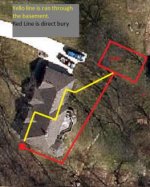
Garage Gas.jpg
MEter.jpg
 
Last edited:
To avoid these ads, REGISTER NOW!

HoosierBuddy

Well-known member
Joined
May 9, 2006
Messages
2,936
Location
Southern Indiana
Just based on eyeballing a picture from a zillion miles away, that does not look like 1" pipe going into the house. It looks like 3/4" to me.

If you measure the OD of that vertical ******, does it measure a hair over 1". If so, that's 3/4". If it measures 1.3" then my eyesight has failed me.

Depending on which it is will change my answer.

Phil
 
OP
M

Mark100

Active member
Joined
Sep 24, 2019
Messages
40
Location
South East Michigan
Phil,

I did measure and I got just over 1.25 inches diameter or 4.25 circumference. Pipe inside is labeled 1". I believe the pipes on the meter are 1.25"
Just based on eyeballing a picture from a zillion miles away, that does not look like 1" pipe going into the house. It looks like 3/4" to me.

If you measure the OD of that vertical ******, does it measure a hair over 1". If so, that's 3/4". If it measures 1.3" then my eyesight has failed me.

Depending on which it is will change my answer.

Phil

Sent from my SM-G960U using The Garage Journal mobile app
 

BD1

Well-known member
Joined
Mar 18, 2007
Messages
4,602
Location
north side
Photos did not show up.
You have to trench either way. Are you hand digging OR trenching ?
A outside meter tie in will be easier then the inside and you'll use less pipefittings.
The leaving side of meter should have a union. IF there's a elbow there, you only need to remove elbow and replace with tee. Then ******, elbow, ******, and valve to connect to tubing.
Inside you have to cut into existing main, add tee, *******, and union. Then pipe from tee through wall to tubing for garage.
Is existing landscaping a issue with trenching ?
I think for a do it yourselfer, a tie in at meter would be the easiest. The exposed piping would be more accessible and easier to test.


Sent from my iPhone using Tapatalk
 

acmikee

Well-known member
Joined
Feb 2, 2005
Messages
301
Location
olympia, wa
pics would help if you can thread pipe I would do #2 if not do #1. I would also run a PVC pipe for future use--internet, cable, alarm does it have water if not now is the time to install a waterline just cap both ends
 

BD1

Well-known member
Joined
Mar 18, 2007
Messages
4,602
Location
north side
I uploaded the pictures a different way. I think they are visible now.

Yes pictures show up. Do you know the route of the underground existing line ?
That maybe a issue trenching from meter.

Meter tie in is easy. Loosen union and remove existing elbow that goes into center tee ( the bull) and replace with tee ****** and valve.


Sent from my iPhone using Tapatalk
 
OP
M

Mark100

Active member
Joined
Sep 24, 2019
Messages
40
Location
South East Michigan
Yes. The meter supply comes from a different area. There are no utilities in the back of the house.
Yes pictures show up. Do you know the route of the underground existing line ?
That maybe a issue trenching from meter.

Meter tie in is easy. Loosen union and remove existing elbow that goes into center tee ( the bull) and replace with tee ****** and valve.


Sent from my iPhone using Tapatalk

Sent from my SM-G960U using The Garage Journal mobile app
 

HoosierBuddy

Well-known member
Joined
May 9, 2006
Messages
2,936
Location
Southern Indiana
Yes pictures show up. Do you know the route of the underground existing line ?
That maybe a issue trenching from meter.

Meter tie in is easy. Loosen union and remove existing elbow that goes into center tee ( the bull) and replace with tee ****** and valve.


Sent from my iPhone using Tapatalk

This may be a problem. If done by the homeowner, the connection might have to be made downstream of the existing homeowner owned shutoff valve. The valve upstream of the meter is a portion of the gas company's distribution system and should not be turned (off or on) by the homeowner. To allow that valve to be turned by an "non-qualified" person would be a violation of 49 CFR 192.801 and related sections of federal code.

It IS possible to tie in where you suggest, but it would involve two service calls by the local gas company, one to turn off and one to turn on.

Also...don't forget to call 811 and get locates.

Phil
 
To avoid these ads, REGISTER NOW!

BD1

Well-known member
Joined
Mar 18, 2007
Messages
4,602
Location
north side
This may be a problem. If done by the homeowner, the connection might have to be made downstream of the existing homeowner owned shutoff valve. The valve upstream of the meter is a portion of the gas company's distribution system and should not be turned (off or on) by the homeowner. To allow that valve to be turned by an "non-qualified" person would be a violation of 49 CFR 192.801 and related sections of federal code.

It IS possible to tie in where you suggest, but it would involve two service calls by the local gas company, one to turn off and one to turn on.

Also...don't forget to call 811 and get locates.

Phil


Say what ? I never heard of calling the gas company to shutdown gas service to work on your piping. There is not any locking device at gas service main shutoff. It's a quarter turn valve. Homeowner could call gas company to verify, but I've been doing gas piping for 40 years in Illinois. We've shutsdown residential and commercial all the time.
The holes are provided to add a locking device if needed by gas company. Example would be if utilities were not paid .
A gas meter does not have a seal like a electric meter.
Just imagine breaking a gas line when connecting say a new stove. By the time the gas company got there your house may have blown up. That's why there is no locking device.


Sent from my iPhone using Tapatalk
 

HoosierBuddy

Well-known member
Joined
May 9, 2006
Messages
2,936
Location
Southern Indiana
Say what ? I never heard of calling the gas company to shutdown gas service to work on your piping. There is not any locking device at gas service main shutoff. It's a quarter turn valve. Homeowner could call gas company to verify, but I've been doing gas piping for 40 years in Illinois. We've shutsdown residential and commercial all the time.
The holes are provided to add a locking device if needed by gas company. Example would be if utilities were not paid .
A gas meter does not have a seal like a electric meter.
Just imagine breaking a gas line when connecting say a new stove. By the time the gas company got there your house may have blown up. That's why there is no locking device.


Sent from my iPhone using Tapatalk

I didn't write the code. I'm just telling you what it says. This change is about 15 years old. Emergency Responders do what they have to do to save lives and no one is going to get too bent out of shape about that.

However the valve you are so keen to turn is an emergency valve as defined by code...and regardless if you like it, I like it, or anyone else likes it, turning distribution valves is a "covered task" for each distribution operator and anyone that does that task has to be trained in how to do it properly and what to do if something goes wrong. That training has to be documented by the gas company for each covered individual and repeated at regular intervals. Those individuals also have to be in the company's drug and alcohol testing pool.

I have seen homeowners (obviously with a lot less skill that you have in the trade) on at least two occasions, break these valves during unauthorized operation and then you have to get specialized equipment or dig up the service line to shut it down, to safely change the valve. When you call the gas company to check on this, ask to speak to their "operator qualification" manager.

If he says I'm wrong...I'll eat my hat. The key difference here between the valve to the left of the meter and the one to the right of the meter is one belongs to the gas company and is therefore covered under PHMSA rules and the other (the customer valve) does not and is not.

Phil
 
Last edited:

BD1

Well-known member
Joined
Mar 18, 2007
Messages
4,602
Location
north side

jlv03

Well-known member
Joined
Jan 19, 2020
Messages
349
Location
SE IA
Is that an attached garage on the top side of your picture (near where there are vehicles parked)? If so, I'd say run a gas line to the attached garage for a heater there and then do the 50' run to the detached.

If not, I'd lean towards option 1 (bury from meter to garage).
 

D45

Well-known member
Joined
Mar 21, 2014
Messages
4,836
Location
NW INDIANA
I would tee off at the meter, valve with metal riser and direct bury yellow plastic pipe.

Direct route to the garage, less joints, and a direct supply.

Rather than do half black pipe throughout the house and then adding in yellow...…..just my opinion

150 foot roll of 1" yellow pipe is under $300 and if you make the trench curve smooth and radius enough it can be one solid line with no splicing or couplers to leak

If not, a 1" Constab 90 degree fitting is $35

Good black iron pipe isn't cheap...….it will likely be $300 just for the pipe to run inside your house
 
Last edited:
OP
M

Mark100

Active member
Joined
Sep 24, 2019
Messages
40
Location
South East Michigan
With the option of running from the meter directly to the garage with direct bury poly, do I need to be concerned with elevation change? My house is a walk out basement style. The meter is at 1st floor level. When I run from the meter, down about a 10 foot elevation change to the back of the house and then up about 14 feet in elevation to the garage. I assume that the line would just need to be say 24 inches below grass the entire way. Not 24 inches from lowest point.

If I run from inside the house, I could tee in to the 1 inch pipe and then run 12 feet to the exterior where it would transition to direct bury poly. How would I calculate BTU load capacity for all of the loads in line before the split?

Sent from my SM-G960U using The Garage Journal mobile app
 

Attachments

  • Gas inside.jpg
    Gas inside.jpg
    17.6 KB · Views: 26
  • Gas outside.jpg
    Gas outside.jpg
    17.7 KB · Views: 22
Last edited:

BD1

Well-known member
Joined
Mar 18, 2007
Messages
4,602
Location
north side
After studying the info on this link, I think I would be fine to run with the current 1" pipe and tee off after my stove/dryer branch. Thank you for the link.


You're welcome. If you take a photo of the tentative tie in point we can help out.
Hopefully you can make a cut between fittings ,add tee, union , and two *******.


Sent from my iPhone using Tapatalk
 
To avoid these ads, REGISTER NOW!
Top Bottom