To avoid these ads, REGISTER NOW!

Options to remove 10x12 pitch joists?

andrew978

Member
Joined
Sep 18, 2015
Messages
14
Final stages of getting the roof squared away for my new shed. Overall its 14x20 and here is what the current plan calls for on the truss design:

KING_truss.png


What I would like to do is maximize storage and open space. I know I know. A contradiction. Storage is only boxes, light things and XMAS decorations.

Would it be possible to just skip the King post and rely on the collar tie 1/3 of the way down from the top for the areas I want to keep as open as possible?

I figure maybe I design the way they show it for 1/3 of the shed in the front, and then 1/3 in the back, and then leave the middle 1/3 wide open with maybe a small collar tie but that is about it.

I plan on having most of my workshop in the center of the shed so having a high roof with lots of open space for moving around boards is key.
 
To avoid these ads, REGISTER NOW!

theoldwizard1

Well-known member
Joined
Feb 22, 2011
Messages
43,191
Location
SE MI
Go back to the truss designer. Ask about a roof system without a King Post, utilizing a a rafter tie. Likely the rafter and joists will have to be upgraded (2x8 ?, 2x10 ?).

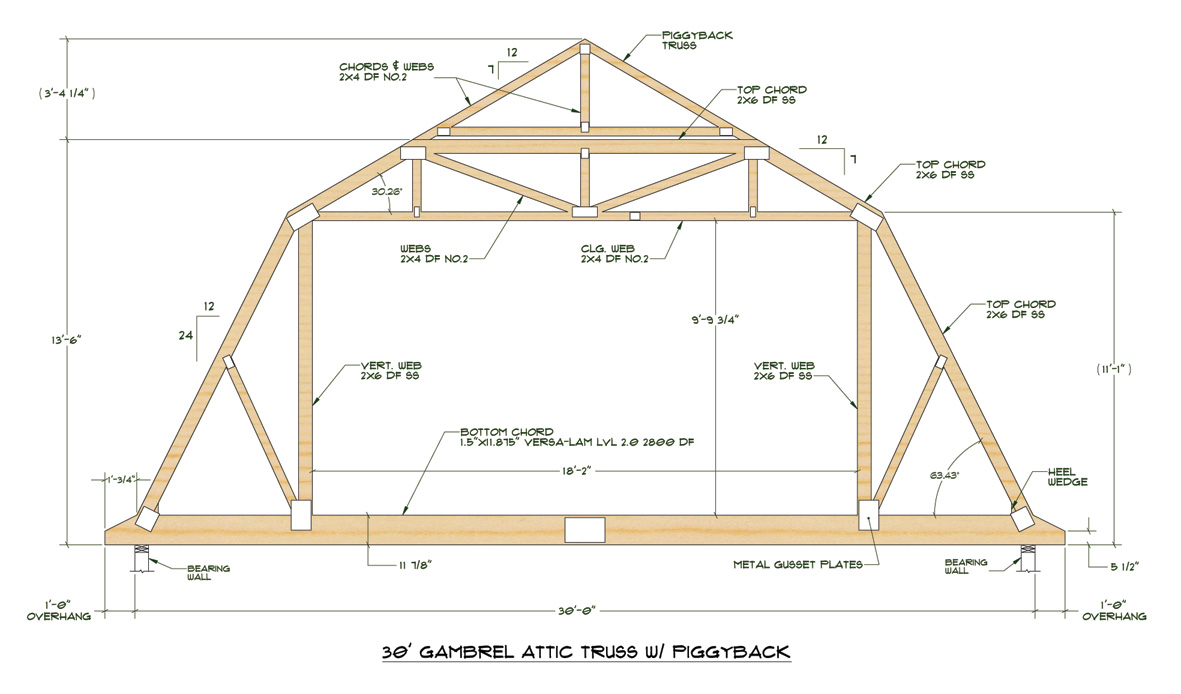
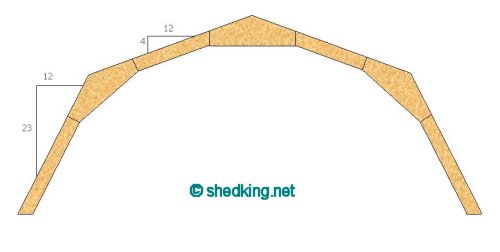
Bill is correct. The maximum storage space is with a gambrel roof. For a span of 14' you may not need any webbing. Basic gambrel truss design.

Adding floor joist will add a lot of strength to you structure and prevent the roof system from pushing the walls out.
 

matt_i

Well-known member
Joined
Mar 14, 2008
Messages
10,728
Location
SE Michigan
They are called a "storage truss" around here. I have them in my original shop from the previous owner. Expect the cost to go up and lumber to get more beefy. A "normal" truss would typically be built from 2x4s whereas the storage trusses are 2x6s and 2x8s. I have not priced them myself.
 

Evilunclegrimace

Well-known member
Joined
Sep 24, 2015
Messages
868
Location
Erie Pa
The building code calls for the collar ties to be in the botton1/3 of the rafter height so moving them to the top 1/3 is not a good idea. Have your truss designer spec out storage trusses for part of your build and scissor trusses for the area that you would like to have extra head room.
 

MushCreek

Well-known member
Joined
Jan 14, 2015
Messages
9,782
Location
Upstate South Carolina
I'm not sure what that king post is doing. With the rafter tie shown, the walls can't bow outward. The gusset at the top prevents the top of the rafters from opening up in high lift wind conditions. The rafters and rafters ties look a bit light, though.

I also like gambrel roofs. My barn design came from barnplans.com, a cool place to look at ideas, even if you don't buy their plans. I have a huge, open loft.
 

bczygan

Well-known member
Joined
Nov 4, 2009
Messages
22,002
Location
DETROIT! Arsenal of Scrappers
A truss can be designed that avoids any intermediate members, especially for that small span.

Members will be deep and connections will be critical.

Cost will be higher.

Never remove truss members without knowing what you are doing.

Bill
 

Kevin54

MEMBER EMERITUS
Joined
Jan 12, 2005
Messages
29,341
Location
Urbana, Ohio
I'm not sure what that king post is doing. With the rafter tie shown, the walls can't bow outward. The gusset at the top prevents the top of the rafters from opening up in high lift wind conditions. The rafters and rafters ties look a bit light, though.

I also like gambrel roofs. My barn design came from barnplans.com, a cool place to look at ideas, even if you don't buy their plans. I have a huge, open loft.

This^^^^

If you are really concerned, sister up your trusses, and run a ridge beam between each truss. But for that small of section, I think I would just build rafters instead of buying trusses.
 

theoldwizard1

Well-known member
Joined
Feb 22, 2011
Messages
43,191
Location
SE MI
The building code calls for the collar ties to be in the botton1/3 of the rafter height so moving them to the top 1/3 is not a good idea.
Local codes are just that. Local.

If the tie is 1/3 from the top it usually called a "collar" tie. It is is 2/3 from the top it is usually call a rafter tie.

17229d1199668602-high-do-collar-ties-need-collar_raftertie.jpg
 

theoldwizard1

Well-known member
Joined
Feb 22, 2011
Messages
43,191
Location
SE MI
A truss can be designed that avoids any intermediate members, especially for that small span.

Members will be deep and connections will be critical.

Cost will be higher.

Never remove truss members without knowing what you are doing.

Bill

Bill, I don't know your education/background but YOU ARE RIGHT ON !
 
To avoid these ads, REGISTER NOW!

Norcal

Well-known member
Joined
Mar 16, 2008
Messages
13,758
A truss can be designed that avoids any intermediate members, especially for that small span.

Members will be deep and connections will be critical.

Cost will be higher.

Never remove truss members without knowing what you are doing.Bill

Modification of trusses should not be done without consulting a engineer to add to the above comment.
 

T_R

Well-known member
Joined
Jul 2, 2015
Messages
902
Location
Maine
For only a 14 foot span, just forget the trusses and cut rafters. You'd have to look at span tables but it probably could be done with 2x8x12 and would be cheaper than trusses.
 

Kevin54

MEMBER EMERITUS
Joined
Jan 12, 2005
Messages
29,341
Location
Urbana, Ohio
I'd still just build a standard truss in the 10/12 pitch. Easy enough to do and you can have open span. It's only 14 foot wide, so that is 7' on a side. The hardest part of the whole job is just getting your ridge beam in center and level. :rolleyes: No rocket science or multi angles involved like in a Gambrel roof.
 

theoldwizard1

Well-known member
Joined
Feb 22, 2011
Messages
43,191
Location
SE MI
A couple things you will notice about a gambrel roof that is "pleasing to the eye" :


  • The peak is very close to 1/2 of the span.
  • Each roof section has the same span.

What is underneath is up to the engineers and Bill has shown a few designs that I have not seen !
 

theoldwizard1

Well-known member
Joined
Feb 22, 2011
Messages
43,191
Location
SE MI
I'd still just build a standard truss in the 10/12 pitch. Easy enough to do and you can have open span. It's only 14 foot wide, so that is 7' on a side. The hardest part of the whole job is just getting your ridge beam in center and level. :rolleyes: No rocket science or multi angles involved like in a Gambrel roof.
Yep !

Build each end wall with a pocket for the beam (2x10 ?). Make sure the end with no opening has posts (doubled or tripled 2x4s) that transfer the load to the bottom plate and foundation. If you have an opening, you will likely have to make a bigger header (2 - 2x12 with spacer ?) and 2 (3?) jack studs on each side.
 

bczygan

Well-known member
Joined
Nov 4, 2009
Messages
22,002
Location
DETROIT! Arsenal of Scrappers
Yep !

Build each end wall with a pocket for the beam (2x10 ?). Make sure the end with no opening has posts (doubled or tripled 2x4s) that transfer the load to the bottom plate and foundation. If you have an opening, you will likely have to make a bigger header (2 - 2x12 with spacer ?) and 2 (3?) jack studs on each side.

Good points about needing a header that will support the load transferred from a ridge beam, and then to the ground.

But with a small span like this, a ridge beam may not be the most economical way to frame it. A ridge beam allows you to have smaller rafters, since it takes half the load from each rafter.

With this small span, a ridge board is all that's needed. Properly sized, located and fastened collar ties then help triangulate the structure and resist outward pressure of the rafters. This is for stick built rafters and ceiling joists. Since the rafters push out on the side walls, the ceiling joists and their connection to the exterior walls is critical, and must resist this outward pressure.

But you can also get triangulation in the depth of the members themselves. Whether shop built or site built, if the members of the truss, and the plates fastening the members together are engineered properly, for the imposed loads, they alone can be adequate. And I am just talking about the two top chord members and the bottom chord of the truss. No king post included!

Ask the truss company to engineer these trusses for you with that configuration. And specify the live load capability and deflection limit you want for the bottom chord. Decide if you are going to finish the ceiling, if you will have a floor in the attic, and how you want to access it. Also determine how you will insulate.

Those things will determine the parameters of the design.

Bill
 

theoldwizard1

Well-known member
Joined
Feb 22, 2011
Messages
43,191
Location
SE MI
Good points about needing a header that will support the load transferred from a ridge beam, and then to the ground.

But with a small span like this, a ridge beam may not be the most economical way to frame it. A ridge beam allows you to have smaller rafters, since it takes half the load from each rafter.
I forgot that this is just a shed ! I was thinking a 2 car garage !!
 
To avoid these ads, REGISTER NOW!
Top Bottom