To avoid these ads, REGISTER NOW!

Organizing breakers

engineer2

Well-known member
Joined
Dec 13, 2009
Messages
11,793
Location
Chicago burbs
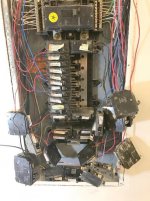
Over the years with various projects, our house breaker panel has sort of become randomized. I believe location doesn't much a difference from a technical standpoint.

I was thinking about trying to group breakers by location and then put the 220V breakers near the top. Most have enough wire slack to do this. Worth the trouble or don't worry about it? Probably a 30 minute project, except the wife will be calling down the stair when the cable box shuts off.

Square D QO series 200 amp, 34 out of 40 used.
 
To avoid these ads, REGISTER NOW!

Bert_

Well-known member
Joined
Dec 24, 2016
Messages
9,690
Location
NW Iowa
I wouldn't even think about doing it. If stuff isn't labeled I might do that.
 

Zeke

Well-known member
Joined
Aug 13, 2009
Messages
17,176
Location
Long Beach CA, the sewer by the sea.
The only thing you might be able to achieve is balancing the load some. The 240v breakers take care of themselves but having all your 20 A circuits that are more or less in continuing use on one leg is not the most efficient. But, you'd need a sensitive amp meter to know.

Let's just say that your household does a lot of laundry. You have 2 circuits to the laundry room (other than lighting), or you should. This, of course, assumes you have a gas dryer. One 20 A breaker above the other, each going to the laundry are on different legs. Another: all the circuits to the kitchen should be distributed equally as much as you can. So, IOW, the 2 counter circuits are on one side next to each other. Both scenarios are easy to label and the power to the laundry and kit counter are using both legs. You would naturally have the dishwasher and GD next to each other too. For the same labeling and distribution reasons.

Can't help you if everything is plugged into one outlet. :D

As a reference and there are many more articles on the subject.
 

Stuart in MN

Well-known member
Joined
Sep 8, 2005
Messages
22,977
Location
Minneapolis
It's nice to have things arranged in a way that makes logical sense, but unless you're very OCD I wouldn't worry about it.
 
OP
E

engineer2

Well-known member
Joined
Dec 13, 2009
Messages
11,793
Location
Chicago burbs
Creating labels is easy. Excel works very well for that. Just paste the final version to the inside of the cover. Easy to balance the breaker ratings, but harder to predict what will be in use. Agree laundry is a frequently used appliance. Kitchen is all A-B. Kitchen lights get used a lot. Most are LED, cutting down on the current. AC during the summer. Air compressor once in a while.

Panels alternate the legs so every other breaker is on the same leg anyway, at least with Square D.

Organizing is more for the benefit of the casual user, like the wife resetting a tripped breaker. Of course she would call me before touching anything and I'd be asking why did the breaker trip.
 
Last edited:

Zeke

Well-known member
Joined
Aug 13, 2009
Messages
17,176
Location
Long Beach CA, the sewer by the sea.
Creating labels is easy. Excel works very well for that. Just paste the final version to the inside of the cover. Easy to balance the breaker ratings, but harder to predict what will be in use. Agree laundry is a frequently used appliance. Kitchen is all A-B. Kitchen lights get used a lot. Most are LED, cutting down on the current. AC during the summer. Air compressor once in a while.

Panels alternate the legs so every other breaker is on the same leg anyway, at least with Square D.


Organizing is more for the benefit of the casual user, like the wife resetting a tripped breaker. Of course she would call me before touching anything and I'd be asking why did the breaker trip.
When you say that I tend to agree with the other comments of 'why bother?'
 

Kevin Essiambre

Well-known member
Joined
May 1, 2014
Messages
208
Location
Ottawa, Ontario, Canada
I only reorganize breakers when replacing the panel. I try to group the circuits by room... mainly trying to keep all the kitchen circuits in one area.

On an existing panel, I would only do this if the panel isn't balanced for every day loads.

Sent from my new phone. Autocorrect may have changed stuff.
 

coleman10

Well-known member
Joined
Nov 12, 2012
Messages
871
Location
Fort Lauderdale, FL
Watch out for multi-wire branch circuits. They need to be on opposite legs. Putting both breakers on the same leg can potentially overload the common. They should be on adjacent breakers and the handles should be tied. Just something to watch out for.
 

Bert_

Well-known member
Joined
Dec 24, 2016
Messages
9,690
Location
NW Iowa
Watch out for multi-wire branch circuits. They need to be on opposite legs. Putting both breakers on the same leg can potentially overload the common. They should be on adjacent breakers and the handles should be tied. Just something to watch out for.

This is another good reason to leave it alone. Even just a few years ago a multi wire circuits were allowed to be on individual single pole breakers.
 
OP
E

engineer2

Well-known member
Joined
Dec 13, 2009
Messages
11,793
Location
Chicago burbs
Did it last night and it didn't take long. Much more organized now and easier to find a particular breaker.
Even just a few years ago a multi wire circuits were allowed to be on individual single pole breakers.
Our 1992 house was full of randomly networked neutrals and none of them were tied. Nothing like unexpectedly getting tingled by a neutral. I've separated a few and also installed some 2 pole breakers that I got cheap.
 

Attachments

  • IMG_2648.jpg
    IMG_2648.jpg
    57.9 KB · Views: 138

fasteddie

Well-known member
Joined
May 25, 2018
Messages
697
Location
NJ
I drew up simple floor plans of each floor and put the breaker numbers in their respective locations on the maps. Drawings in plastic sleeves are held inside the panel doors with magnets.
 
To avoid these ads, REGISTER NOW!
OP
E

engineer2

Well-known member
Joined
Dec 13, 2009
Messages
11,793
Location
Chicago burbs
I should mention houses are difficult to sell around here and any inexpensive thing you can do to give you a leg up on the competition helps.
 

ddawg16

Well-known member
Joined
Jul 11, 2008
Messages
21,005
Location
S. California
OCD much...?

I was thinking the same thing......

And then I pulled up some pics of my panel and started thinking how I might better organize it.

Damn the OP................

Actually, I did pull up picks....and my ckt list (Excel spreadsheet)
I'm in good shape. The garage and oven are the only 240V breakers...they are at the top.

Next is all the kitchen stuff.

Then it's by room...

Since I had an original part of the house and then added on, I've got the original ckts together.

Lights are in a row....(Pretty obvious, all 15A breakers)

At the bottom is the AFCI breakers.

I still need to get back in and finish dressing up the other side and adding printed heat shrink wire labels.

Here is an old old pic before I started dressing the wires
 

Attachments

  • IMG-20120722-00170.jpg
    IMG-20120722-00170.jpg
    144.2 KB · Views: 96

coleman10

Well-known member
Joined
Nov 12, 2012
Messages
871
Location
Fort Lauderdale, FL
I wish my breakers were by room. Perhaps an electrician could explain why this was done this way, but breaker 1 will be for room 1 and one outlet in room 2, and adjacent room. Breaker 2 is for room 2 and one outlet in room 3, and adjacent room. WTH. I don’t get it. Not sure why you’d want to purposely bring one circuit through the wall into the next room. It was definitely planned that way. Perhaps, so you could purposely put something on a different circuit in another room. I had an issue where my laser printer was pulling in so much juice when it was warming up that it caused a blip in my network equipment and threw everything off line. I put the printer on the secret outlet that’s on another breaker and solved that problem.

The rest of the house is wired so strangely that I had to draw a floor plan of the entire house and mark every outlet and switch on the drawing, then create a legend to show which outlet/switch went to which breaker. I had MWBCs on the same leg (not adjacent) and none tied. Had to fix all that. You’d think the wiring was designed by a monkey, and it’s not an old house. Drives me nuts.
 

ddawg16

Well-known member
Joined
Jul 11, 2008
Messages
21,005
Location
S. California
I wish my breakers were by room. Perhaps an electrician could explain why this was done this way, but breaker 1 will be for room 1 and one outlet in room 2, and adjacent room. Breaker 2 is for room 2 and one outlet in room 3, and adjacent room. WTH. I don’t get it. Not sure why you’d want to purposely bring one circuit through the wall into the next room. It was definitely planned that way. Perhaps, so you could purposely put something on a different circuit in another room. I had an issue where my laser printer was pulling in so much juice when it was warming up that it caused a blip in my network equipment and threw everything off line. I put the printer on the secret outlet that’s on another breaker and solved that problem.

The rest of the house is wired so strangely that I had to draw a floor plan of the entire house and mark every outlet and switch on the drawing, then create a legend to show which outlet/switch went to which breaker. I had MWBCs on the same leg (not adjacent) and none tied. Had to fix all that. You’d think the wiring was designed by a monkey, and it’s not an old house. Drives me nuts.

Nothing wrong with that....everyone should do it.


I have a floor plan that shows the breaker # of each outlet/switch.

One of these days I'll print it out, have it laminated and hang it on the door of my load center.

It's also a good idea to write the breaker # with a Sharpie on the inside of the outlet/switch cover.
 

coleman10

Well-known member
Joined
Nov 12, 2012
Messages
871
Location
Fort Lauderdale, FL
One of these days I'll print it out, have it laminated and hang it on the door of my load center.


It's also a good idea to write the breaker # with a Sharpie on the inside of the outlet/switch cover.


Mine are hand drawn. Once I clean them up a bit, I’ll scan them and then stick them on the inside of the panel cover.

Adding the breaker number to the inside is the outlet or switch cover is an excellent suggestion.
 
OP
E

engineer2

Well-known member
Joined
Dec 13, 2009
Messages
11,793
Location
Chicago burbs
I wish my breakers were by room. Perhaps an electrician could explain why this was done this way
One theory is if you pop a breaker, you don't lose power to the entire room. Inconvenient if it is night time and the entire room goes black.
It's also done to save a bunch of time and money when they build the house.
 

Bert_

Well-known member
Joined
Dec 24, 2016
Messages
9,690
Location
NW Iowa
I wish my breakers were by room. Perhaps an electrician could explain why this was done this way, but breaker 1 will be for room 1 and one outlet in room 2, and adjacent room. Breaker 2 is for room 2 and one outlet in room 3, and adjacent room. WTH. I don’t get it. Not sure why you’d want to purposely bring one circuit through the wall into the next room. It was definitely planned that way. Perhaps, so you could purposely put something on a different circuit in another room. I had an issue where my laser printer was pulling in so much juice when it was warming up that it caused a blip in my network equipment and threw everything off line. I put the printer on the secret outlet that’s on another breaker and solved that problem.

The rest of the house is wired so strangely that I had to draw a floor plan of the entire house and mark every outlet and switch on the drawing, then create a legend to show which outlet/switch went to which breaker. I had MWBCs on the same leg (not adjacent) and none tied. Had to fix all that. You’d think the wiring was designed by a monkey, and it’s not an old house. Drives me nuts.

Less wire if the outlets on both sides of a wall are all on the same circuit.
 

ddawg16

Well-known member
Joined
Jul 11, 2008
Messages
21,005
Location
S. California
One theory is if you pop a breaker, you don't lose power to the entire room. Inconvenient if it is night time and the entire room goes black.
It's also done to save a bunch of time and money when they build the house.

Less wire if the outlets on both sides of a wall are all on the same circuit.

My house was built in 52....some walls were like that....same ckt powered outlets in both rooms.

Because I had to use AFCI breakers for my addition, all the outlets in a room are on the same ckt.

But, lights are on a different ckt....hence, I can kill power to a room and still have light. Or kill the lights and use a floor lamp.
 

Falcon67

Well-known member
Joined
Jun 11, 2009
Messages
18,371
Location
Merkel, TX
My shop panel is like that - 120v runs on the left, 240v runs on the right. Except for one 240V on the left run because I ran out of space LOL. But I planned it like that from the get-go. The house panel - just use labels when we figure out what one of the breakers really does.
 

hop up

Well-known member
Joined
Sep 22, 2010
Messages
121
OMG Please dont start organizing the panel and mix and matching the breakers. The breakers share a Neutral or white and breakers will be set up using 110 off of each pole. So in other words they are phasing the panel and balancing the load on . If you start moving breakers to Your Pleasure you have a good chance to over load the neutral and start blowing the breakers or worse..
The reason for the unorganized way the panel set up might be the way the home was built. In the 1950s when you ran the conduit on the floor before the hardwood floors installed you would pick up a outlet closest to you. A example would be a wall that has a outlet on a wall and opposite to that wall is another outlet and thats callled a back to back. On balloon built homes we would pick up outlets on the same wall 1st floor and second floor to save time ,material and share the neutral.
So if you choose to unphase the panel you may open a can of worms and may have a chance of overheating the neutral or white or even a fire depending on the condition of quality of work and load on the phase of the breakers 110/110/N. Now do this on a 3 phase 480v and your not going to have a number of items that work for very long or more then a few seconds. Please read up on what you are doing and its called phasing
 
OP
E

engineer2

Well-known member
Joined
Dec 13, 2009
Messages
11,793
Location
Chicago burbs
^^True. When you start looking at your panel you need to look at all the home runs and count neutrals vs hots. Electricians sometimes "network" neutrals at outlying J-boxes too. Circuits with shared neutrals need to be on opposite phases AND be handle-tied or on a 2-pole breaker. Alternate is to pull another neutral and convert the Edison circuit into a conventional circuit, but there is nothing wrong with an Edison circuit.

When I bought my house it was full of networked neutrals, Edison circuits and nothing was handle-tied. Made for a tingly experience.
 

egdede

ALLIANCE MEMBER
Joined
Dec 20, 2009
Messages
2,063
Electricians sometimes "network" neutrals at outlying J-boxes too. Circuits with shared neutrals need to be on opposite phases AND be handle-tied or on a 2-pole breaker.


My panel is above 12" crawl-space. Kitchen cabinets are anchored to wall behind panel. Very poor access. Because of this, I ran 12/3 NM-B to BIG boxes and split off 12/2 NM-B circuits. I use these boxes in the crawl space to split the MWBC:

https://www.amazon.com/dp/B005UP9M3G/?tag=atomicindus08-20

The inspector likes my boxes.

I'm going to label every cover-plate as per Deputy Dawgs suggestion above.
 
Last edited:
To avoid these ads, REGISTER NOW!
Top Bottom