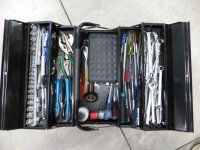
You have to be selective about what you put in it, otherwise the weight goes thru the roof and you can't find anything quickly.
Depends on the relative numbers of different types of tools e.g. wrenches, screwdrivers, sockets etc. you want/need to carry.
What I used to do :-
Only put in what I needed to work on a particular make of vehicle e.g. Ford.
and leave out the sizes of wrenches/sockets I didn't need.
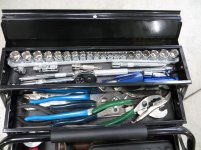
Sockets went in the smallest compartment on top tier, ratchet, extensions etc were beside sockets.
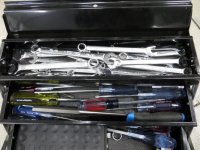
Other side, top tier were wrenches.
Middle tier, screwdrivers on one side, pliers on other side.
Bottom compartment was used for hammers,speedbrace, hacksaw,heavy items, items too large to fit in upper compartments.
------------------------
You vary this to suit what tools you have/need to carry.
e.g. you might use a drive handle and bit selection instead of seperate screwdrivers, you might not need many pliers thus freeing up space for other small tools. Many small tools sets come in storage boxes which are too wide to fit in an upper compartment, so will have to be placed in the bottom tray etc.
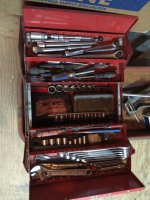
When I worked as a professional auto mechanic many years ago, I used 2 cantilever (3 tier/5tray) toolboxes. In one I kept the tools I used frequently, as in every day. Following the above advice, kept it reasonably easy to carry around the workshop.
The other box I used for infrequently used items, e.g. broken stud extractors, files, taps/dies,pullers and the other wrench/socket sizes I might need occasionally e.g if a different make of vehicle came in.
The 2 boxes ended up roughly equal in weight which meant I was balanced rather than lop-sided if I needed to carry the boxes out to my car.
It's surprising just how much can be fitted into the above two inexpensive boxes and that individual items can still be found easily.
Al.