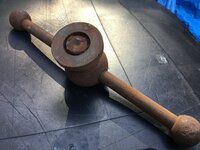
Anyone know which vise mfg. this handle might belong to? I do not have the vise, just the handle. My main question though is there a thread on the end of the screw shaft where it enters the handle. Looks like it 'snapped" off. Not a clean cut with a cutting tool or any flame cut marks. Any ideas on the best way to get it out? Would it be a thread or a press fit. Thanks in advance.


You are using an out of date browser. It may not display this or other websites correctly.
You should upgrade or use an alternative browser.
You should upgrade or use an alternative browser.
Orphan Vise Handle
- Thread starter amunner
- Start date


Death Row Dave
Well-known member
It’s cool as cool can get . I would suspect some type of left hand threads .
RoninB4
Well-known member
Looks like a job (bore it out) for a mill if you can't get the cross handle off to put in a lathe. Could be a spline, left hand threads, or even pinned. Report back, I'm curious about it.
Packard V8
Well-known member
The flattened meatball head is unusual; most often they're either spherical or cylindrical.
To break the screw there is uncommon. Usually, a cheater bar is required to put enough force to break the screw and usually bends the handle in the process. For the handle to be stronger than the screw is not best science design. Bending the handle should occur before the screw or the casting breaks, signalling to the numbnuts operator to cease and desist.
jack vines
To break the screw there is uncommon. Usually, a cheater bar is required to put enough force to break the screw and usually bends the handle in the process. For the handle to be stronger than the screw is not best science design. Bending the handle should occur before the screw or the casting breaks, signalling to the numbnuts operator to cease and desist.
jack vines
I'm tending to agree with the above. Shrink fit could also make the connection. I would also examine the the neck on the ball for a tapered pin.I've never seen a threaded knob on a vise. I would guess it was pressed on while very hot.
lg
no neat sig line
TailGunner3000
Well-known member
The shape of the meatball looks very much like that found on various Reed vises.
Shiftless
Well-known member
I think those were assembled using friction welding.
I am wondering why you want to go to the trouble of removing that stub from the handle if you don’t have any use for the handle. If you just want an industrial artifact for display, you could grind it flat and smooth and call it a day. If you like, you could remove the rust or Even polish it up if that’s your thing.
I am wondering why you want to go to the trouble of removing that stub from the handle if you don’t have any use for the handle. If you just want an industrial artifact for display, you could grind it flat and smooth and call it a day. If you like, you could remove the rust or Even polish it up if that’s your thing.
TailGunner3000
Well-known member
It's also possible that may not be an original factory connection. The original screw may have been damaged and a previous owner may have attempted to replace it with a piece of threaded rod.
TailGunner3000
Well-known member
Friction welding makes sense.
freudianfloyd
Well-known member
I stopped at a yard sale a few weeks ago and sitting on the table was the handle and screw of what had to be an 8" vise. The main screw was around 1 1/2" in diameter and about 3 feet long. I thought about getting it, but just could not think of what to do with it. I would love to have the vise it came off of.
Packard V8
Well-known member
Most likely was a woodworking vise. I have one of those kicking around under the workbench. Although, the 3' long is a bit much for a bench vise. Could also be from a cider press.
jack vines
jack vines
It's from a Reed R series with the split collar to adjust for lash. That's why it has the flattened hockey puck spindle, large recessed area for the split collar and a handle with round ball ends. Many spindles had the threaded portion friction welded in place. That's so they didn't have to turn a piece of steel that was around 2" in diameter (the spindle) down to an inch or less...lots of wasted steel that way.
It was almost certainly being pushed far beyond its limits and simply snapped. I'm in the middle of making an entirely new screw for the spindle/screw on a Parker 975 that belongs to a friend...he put a cheater pipe on the handle and the screw snapped in half, much like this one, just farther from the spindle.
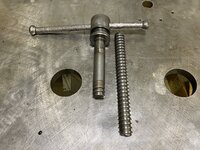
It was almost certainly being pushed far beyond its limits and simply snapped. I'm in the middle of making an entirely new screw for the spindle/screw on a Parker 975 that belongs to a friend...he put a cheater pipe on the handle and the screw snapped in half, much like this one, just farther from the spindle.
Last edited:
I went back through my photos and found a picture of an R Series Reed all disassembled before I started the restoration process. I cropped it a bit and you can see the spindle shape as well as the split collar parts. This was a smaller swivel jaw model, but the spindle shape/style was the same as on the bigger vises.

MWitte
Well-known member
The screw on my Rock Island vise was broken about like yours. On that one the meatball was cast iron. When I bored the broken shaft out of it, it looked like a couple scallops were cut in the sides of the screw shaft before the meatball was cast around it. I simply cross drilled & pinned mine back together.
matt_i
Well-known member
Sounds like something to hang on the wall.
If you had to repair it, it would require a lot of heat and some thought about how to hold it concentric, but if you can silver-braze (56% silver solder) the connection and get a good result of the entire joint being wetted, I think it would be very strong going forward. The silver brazing should wick into the joint and fill it up if the flux is working correctly.
The downside is the high heat can screw (ha ha) up the rest of the metallurgy.
If you had to repair it, it would require a lot of heat and some thought about how to hold it concentric, but if you can silver-braze (56% silver solder) the connection and get a good result of the entire joint being wetted, I think it would be very strong going forward. The silver brazing should wick into the joint and fill it up if the flux is working correctly.
The downside is the high heat can screw (ha ha) up the rest of the metallurgy.