To avoid these ads, REGISTER NOW!

Oscilloscope...

OP
S

SuzukiGS750EZ

Well-known member
Joined
Apr 26, 2012
Messages
3,273
Close:


Remember 4 cylinder engine, so only 1 bank.


All cylinders share a power feed, Orange. The vast majority of things the engine computer controls are ground side switched. Meaning they always have power, ECU supplies ground to turn things on.


That means the other 2 colors are the controls: But look at the pairing, 1 and 4 share a common control wire, as do 2 and 3. On a standard layout 4cylinder engine, what do 1/4 and 2/3 have in common?


They're companion, or sister, cylinders. Meaning when 1 is at TDC compression, 4 is at TDC exhaust. Same for 2 and 3.


Now, this isn't an uncommon setup for ignition systems, it's called waste spark. 1 and 4 are fired at the same time, regardless of which is at TDC compression and which is at TDC exhaust. This allows for "dumber" computers and lower resolution cam/crank inputs. All the ECU needs to know is when the cylinder is at TDC. If it's TDC compression, great, power stroke is created. If it's TDC exhaust, it's a "waste spark".


Thus 1/4 and 2/3 can share an ignition coil each. Instead of 4 individual coils, we have 2 coils, on for cylinders 1/4, and another for 2/3.


__________________________________________________


So, if Orange is the power input, and Green and Purple are switched grounds to control the injectors - What happens when the green wire is provided a ground path?
It fires the injector because it's ground side switched and completes the circuit?
 
To avoid these ads, REGISTER NOW!

2ndGearRubber

Well-known member
Joined
Mar 24, 2014
Messages
14,185
Location
Pittsburgh
It fires the injector because it's ground side switched and completes the circuit?

Correct: But consider how it's wired.


Green is the control for cylinders 2 and 3. Meaning when #2 injector is fired, #3 is also fired.

This is called "batch firing". Meaning 1 and 4 always are sprayed together, and 2 and 3 are always sprayed as a pair.

Yes, this leads to less than ideal fuel distribution, as one of the two cylinders is no where near being ready to open its intake valves and take in the fuel spray.


However, when it's the 90s, and you have primitive computers and triggering devices - it works pretty well. Basically everything post 2005 was all sequential injection. So a 4cylinder engine would have 5 wire colors to the injectors. A shared power, and 4 individually colored control wires for ground.

But back in the day, we paired up the cylinders. So all 4 injectors share a common power. Cylinders 1 and 4 share a common control, and 2 and 3 share a common control. 3 wire colors total for a batch fired 4cylinder engine.


Meaning, just by counting the wire colors, we can determine whether the engine is sequentially or batch fired. :)

__________________________________

Same deal for spark.

You have a V6 ignition coil pack sitting on top of the intake with 6 plug wires coming off of it. - 4 wires going into the electrical connector. One is almost always bigger, that's the main power feed. So we have 1 main power, and 3 remaining wires for control. 3 controls, 6 cylinders - each wire controls 2 cylinders. Meaning it HAS to be waste spark.
 

2ndGearRubber

Well-known member
Joined
Mar 24, 2014
Messages
14,185
Location
Pittsburgh
Sticking with the 6cylinder coil pack.


Amp clamp on our larger power wire will produce the current pattern for all 3 ignition coils. Each of the 3 coils has two outputs to the plug wires of two paired cylinders. If the above coil pack has a weak coil, one will see 2 weak current ramps.

Why? Through one full rotation of the engine (720 degrees) each cylinder will fire once. Being that we have 6 cylinders, we will have 6 current ramps shaped like a right triangle, with the 90* angle facing to the right.

But remember, 2 of those cylinders are sharing each coil. So the coil pack assembly will discharge each coil TWICE during 720*. Because our coil pack is made up of 3 coils, and each is fired twice for one engine rotation, two of the current ramps will be "weak" or low or whatever if a single coil has an issue. IF we had a car with individual coil on plugs, and we probed the main power wire looking for a weak coil - we would see a single coil with an issue.

Again, it's a function of how the system works. Each cylinder has its own coil. So if there's one coil with an issue, only one ramp will look funky per engine cycle (720 degrees). With our coil-pack assembly using waste spark, we will see 2 funky ramps if one of the coils is bad. The coil pack is made of 3 coils, feeding 6 cylinders. A bit of multiplication shows each coil will need fired twice per full engine cycle to provide spark to each cylinder at the correct time. The extra spark events when the companion cylinder is on TDC exhaust, is the "waste".


I promise, it becomes abundantly clear as you see the diagrams, see the patterns, and create the faults.
 

theoldwizard1

Well-known member
Joined
Feb 22, 2011
Messages
43,077
Location
SE MI
All cylinders share a power feed, Orange. The vast majority of things the engine computer controls are ground side switched. Meaning they always have power, ECU supplies ground to turn things on.

This is a KEY CONCEPT !

Anything that a computer has to "turn on", it is likely (99.999% of the time) going to do it by completing the circuit to ground ! (Primarily do to the cost of the type of transistor used.)

Power (12V) is almost always supplied from a fuse or a fuse and a relay. The computer may turn on the relay (by completing the circuit to ground).
 
Last edited:

theoldwizard1

Well-known member
Joined
Feb 22, 2011
Messages
43,077
Location
SE MI
Green is the control for cylinders 2 and 3. Meaning when #2 injector is fired, #3 is also fired.

This is called "batch firing". Meaning 1 and 4 always are sprayed together, and 2 and 3 are always sprayed as a pair.

Yes, this leads to less than ideal fuel distribution, ...

As stated, I have not seen that since the early 90s ! Look carefully at the wires again. One of the same colored wires might have a stripe on it. BIG DIFFERENCE !
 
Last edited:

theoldwizard1

Well-known member
Joined
Feb 22, 2011
Messages
43,077
Location
SE MI
One of the "odd" things you will encounter are speed sensor, like crankshaft sensor, camshaft sensor and wheel speed sensor.

There are two or three different "technologies" used to created that signal.

I am familiar with Ford product and they typically use a "variable reluctance" speed sensor. It is cheap and dependable (if manufactured correctly). This is a true alternating current (AC) signal (the voltage goes above and below zero volts). Do not use a "bench 'scope" to look at it (unless it has differential inputs, which most do not). If could damage the 'scope.

The output will look just like the output from a AC outlet, a nice continuous sine wave (or a sine wave, a space and another sine wave for crank and cam). This is a two wire sensor. For best viewing, hook your battery powered 'scope lead to one wire and the ground to the other. On a this type of sensor, the peak voltage changes as the speed of the wheel increases. Bad ABS wheel sensor "tone" rings/sensor stick out like a sore thumb !

I'll let 2ndGear explain the other technologies of speed sensor.
 

2ndGearRubber

Well-known member
Joined
Mar 24, 2014
Messages
14,185
Location
Pittsburgh
This is a KEY CONCEPT !

Anything that a computer has to "turn on", it is likely (99.999% of the time) going to do it by completing the circuit to ground ! (Primarily do to the cost of the type of transistor used.)

Power (12V) is almost always supplied from a fuse or a fuse and a relay. The computer may turn on the relay (by completing the circuit to ground).

Also a hidden benefit to ground side switching- open circuit detection.

Send out 12 volts to component, 11.something will be on the control wire until ground is applied. This is how the computer knows if something is unplugged.
 
OP
S

SuzukiGS750EZ

Well-known member
Joined
Apr 26, 2012
Messages
3,273
This is a KEY CONCEPT !

Anything that a computer has to "turn on", it is likely (99.999% of the time) going to do it by completing the circuit to ground ! (Primarily do to the cost of the type of transistor used.)

Power (12V) is almost always supplied from a fuse or a fuse and a relay. The computer may turn on the relay (by completing the circuit to ground).
Ok, so if most everything is ground side switched, without a diagram, how do you determine if it isn't?
 

2ndGearRubber

Well-known member
Joined
Mar 24, 2014
Messages
14,185
Location
Pittsburgh
Ok, so if most everything is ground side switched, without a diagram, how do you determine if it isn't?

That would be a matter of having to test the circuit.

If one where to probe into an injector circuit, and see 0v everywhere with the engine running, we would need to assume the component isnt functioning.

Then power/ground tests need performed. If no power is present, one could also command on the component and see if power arrives.
 

theoldwizard1

Well-known member
Joined
Feb 22, 2011
Messages
43,077
Location
SE MI
Ok, so if most everything is ground side switched, without a diagram, how do you determine if it isn't?

So you are looking for the 0.001 % case ?

Use an incandescent test light. Hook the pig tail to ground. If on side lights (typically requires key on) but goes out when you turn the key off, it is probably ground side switched.
 
OP
S

SuzukiGS750EZ

Well-known member
Joined
Apr 26, 2012
Messages
3,273
So you are looking for the 0.001 % case ?


Use an incandescent test light. Hook the pig tail to ground. If on side lights (typically requires key on) but goes out when you turn the key off, it is probably ground side switched.
Oh, I knew that then lol. Thanks!
 
OP
S

SuzukiGS750EZ

Well-known member
Joined
Apr 26, 2012
Messages
3,273
Well, i've almost bought a scope 3 times today lol. I keep holding back because i'm afraid i'll not know how to incorporate it into my routine when working on vehicles.
 

2ndGearRubber

Well-known member
Joined
Mar 24, 2014
Messages
14,185
Location
Pittsburgh
Well, i've almost bought a scope 3 times today lol. I keep holding back because i'm afraid i'll not know how to incorporate it into my routine when working on vehicles.

I would highly suggest playing with what you have a such as possible to understand what some of the patterns are.

One of the biggest things is looking at good, so you know bad when you see it. I'll also use a scope or scantool to confirm what the other tool showed me.

Right up there with the lab scope, a series of test lights with know current draws. 250mv for safety, 2 and 5 amp for substituting a load to condemn a non functioning component


Fuel pump inop? Substitute a 5 amp test light, and voltage drop the circuit. Done, needs a pump. If you have voltage drop or the light simply doesn't light, you have an input issue.
 

richfinn

Well-known member
Joined
Jan 29, 2011
Messages
4,809
Location
Leeds, Yorkshire, England
I would highly suggest playing with what you have a such as possible to understand what some of the patterns are.

One of the biggest things is looking at good, so you know bad when you see it. I'll also use a scope or scantool to confirm what the other tool showed me.

Right up there with the lab scope, a series of test lights with know current draws. 250mv for safety, 2 and 5 amp for substituting a load to condemn a non functioning component


Fuel pump inop? Substitute a 5 amp test light, and voltage drop the circuit. Done, needs a pump. If you have voltage drop or the light simply doesn't light, you have an input issue.

Amen to that, spend some $$$ on a textbook and use what you have, then decide if you need a better scope
 
OP
S

SuzukiGS750EZ

Well-known member
Joined
Apr 26, 2012
Messages
3,273
Ok so skip scope for now.

I'm interested in the scanner danner book. I may pick it up. $50 is doable.

I will take my current scope out to the car but I need some direction. I don't know what's "interesting" or important to look at and learn. I was just thinking today, I diagnosed bad knock sensors & harness with my DMM last month. Would have been perfect for scope...

What to do... what to do... I feel as if learning an o-scope would bring my game up a ton. Someone at work asked me to look at their car. CEL wouldn't show, but I could communicate. Was a bad cluster. Stuff like that... I just don't know I guess the steps to take to start diagnosis. I need to "relearn" my diagnostic approach. I've always been multimeter, live data and codes which has gotten me ok results with some educated guesses but I don't like guessing and the feeling of knowing and proving why something isn't working is a rewarding feeling.

I however am not a parts changer and if I can't prove the root cause, I will direct them to somebody who can. But I'd like to be able to do the proving every time myself.
 

2ndGearRubber

Well-known member
Joined
Mar 24, 2014
Messages
14,185
Location
Pittsburgh
For simple issues when learning - diagnose it first as normal, then use your scope to confirm what you're seeing. I would just diagnose things, then check the same issue with the scope. I have a misfire - swap the coil, problem moves. So the coil is at fault.

What does the current ramp look like? Can you see a primary/secondary pattern? What's that look like? Lift the plug boot off the plug, creating an extra air gap. What happens to the trace?


As you gain confidence and understanding of what you're measuring, you will find yourself going to the scope more often. If you're a "root cause" kinda guy, you'll find yourself enjoying it. Very satisfying tool to use IMO.
 

richfinn

Well-known member
Joined
Jan 29, 2011
Messages
4,809
Location
Leeds, Yorkshire, England
Start with the coolant temp sensor, hook positive lead into the 5v ref and negative to battery ground

Select a long timebase like 1 min per division and 2v per division on the voltage scale

Start the engine and watch the voltage change as the engine warms up and the resistance of the sensor changes

Thats the easiest circuit to start with and will help you figure out the scaling etc.

You could even graph the live data on your scan tool and see the difference between raw data on your scope and the processed data on your scan tool, that would give you some insight to what the PCM is doing

When you figure that out you can move onto some faster signals!!!
 

2ndGearRubber

Well-known member
Joined
Mar 24, 2014
Messages
14,185
Location
Pittsburgh
Start with the coolant temp sensor, hook positive lead into the 5v ref and negative to battery ground

Select a long timebase like 1 min per division and 2v per division on the voltage scale

Start the engine and watch the voltage change as the engine warms up and the resistance of the sensor changes

Thats the easiest circuit to start with and will help you figure out the scaling etc.

You could even graph the live data on your scan tool and see the difference between raw data on your scope and the processed data on your scan tool, that would give you some insight to what the PCM is doing

When you figure that out you can move onto some faster signals!!!


Another valuable thing - is purposely messing up your scales.

Take that signal wayyyy out and wayyyy in on the timebase. Learn how to fix your scope. The picoscope rule of 20V per screen and 20ms/div works well as a starting point. But playing with things teaches you how to fix your own issues.
 
To avoid these ads, REGISTER NOW!

leadfoot415

Well-known member
Joined
Nov 28, 2012
Messages
1,251
Location
Livonia, MI
Ford hasn't used this style of a sensor across the board in at least 10+ years. You are speaking of a passive style sensor. Everything nowadays is what the blue potato considers an active style senor which produces a square wave instead of a sine.

One of the "odd" things you will encounter are speed sensor, like crankshaft sensor, camshaft sensor and wheel speed sensor.

There are two or three different "technologies" used to created that signal.

I am familiar with Ford product and they typically use a "variable reluctance" speed sensor. It is cheap and dependable (if manufactured correctly). This is a true alternating current (AC) signal (the voltage goes above and below zero volts). Do not use a "bench 'scope" to look at it (unless it has differential inputs, which most do not). If could damage the 'scope.

The output will look just like the output from a AC outlet, a nice continuous sine wave (or a sine wave, a space and another sine wave for crank and cam). This is a two wire sensor. For best viewing, hook your battery powered 'scope lead to one wire and the ground to the other. On a this type of sensor, the peak voltage changes as the speed of the wheel increases. Bad ABS wheel sensor "tone" rings/sensor stick out like a sore thumb !

I'll let 2ndGear explain the other technologies of speed sensor.
 

2ndGearRubber

Well-known member
Joined
Mar 24, 2014
Messages
14,185
Location
Pittsburgh
You think you have a misfire on cylinder one. Swap the coils between cylinder 1 and cylinder 2. If the misfire moves to cylinder 2, the coil is bad.

That's what I've always done. Ohm out wires. Ohm the coil.

Arrives with a misfire on cylinder 1: Move coil to cylinder 2, no misfire. Move it back to cylinder 1, no misfire. Drive it around, still zero misfires.

Car returns a week later, misfire on #1 again. ;)


I stick a scope on 'em first if I can. Depends on the fault. I really prefer to touch nothing if I can help it. Outside of terminal fit issues, back probes are pretty non invasive. I also enjoy using my scope. Often if I can feel a severe miss is the problem I'll try to identify before getting the codes out of it. Some brands **** at picking the correct cylinder as well, or just spit out P0300.


Learning to use the scope for fault finding is SO much easier, if you already know the fault. Learning curve and whatnot.
 
OP
S

SuzukiGS750EZ

Well-known member
Joined
Apr 26, 2012
Messages
3,273
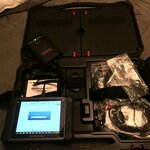
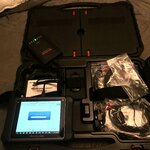
Well, i couldn't help myself. I bought the book AND the Autel unit. It was affordable and if i can start learning on it with not a lot of money invested, it comes with probes and such and i can use it along side a tool i already have (my 3k gaming laptop makes me uncomfortable sitting anywhere near my car to use my OWON), i'll be happy. I wish i could convert the e-book to PDF though...
 

2ndGearRubber

Well-known member
Joined
Mar 24, 2014
Messages
14,185
Location
Pittsburgh
Well, i couldn't help myself. I bought the book AND the Autel unit. It was affordable and if i can start learning on it with not a lot of money invested, it comes with probes and such and i can use it along side a tool i already have (my 3k gaming laptop makes me uncomfortable sitting anywhere near my car to use my OWON), i'll be happy. I wish i could convert the e-book to PDF though...

Can one toggle between the scope screen, and the scanner?

That would be pretty convenient to command something on, then swap to the scope to watch it happen.

I actually found I like the spiral bound format, rugged for reference when working if needed.


https://www.aeswave.com/Current-Probe-Low-range-with-BNC-p9500.html

That will be a solid future purchase as well. Amazing what current can show you, from shorted motors to implicit confirmations of good power/ground.

https://www.amazon.com/dp/B0787JKMTH/?tag=atomicindus08-20

These and a fused jumper wire will let you into any fused circuit. Grab a fuse holder and crimp on some female spade connectors.
 
Last edited:
OP
S

SuzukiGS750EZ

Well-known member
Joined
Apr 26, 2012
Messages
3,273
I have a couple of grandkids that are midly interested in science. It we get through magnetism and simple DC circuits, I am going to buy


Capture.jpg


Typical Chinese, it is sold under multiple brand names, at different price points, but the model number always seems to contain "1013".


YEAPOOK ADS1013D Handheld, 2 Channel, Storage Oscilloscope, 7" touch screen display - Amazon $150.
Teach em young, they'll appreciate it! I wish my school offered an electronics class. I feel I'm late to the party for many things that should have been offered in school lol
 
OP
S

SuzukiGS750EZ

Well-known member
Joined
Apr 26, 2012
Messages
3,273
Well, I guess I'm onto an adventure now... lol. So I have the book. Anything else knowledge wise?
 

richfinn

Well-known member
Joined
Jan 29, 2011
Messages
4,809
Location
Leeds, Yorkshire, England
Well, I guess I'm onto an adventure now... lol. So I have the book. Anything else knowledge wise?

Just watch some decent YouTubers and practice

The one easy trap to fall into with sophisticated tools is over complicating things always check the basics first

Power/Ground/Signal

Voltage drop or Test light to comfirm good current flow

Understand the bypass tests in Scannerdanners book

I've seen mechanics make expensive mistakes many a time by not checking the obvious stuff first!!!
 
OP
S

SuzukiGS750EZ

Well-known member
Joined
Apr 26, 2012
Messages
3,273
Here it is in all it's gloryff0fae1cc1e6e077c39ba51f5da64e29.jpg
 

Attachments

  • ff0fae1cc1e6e077c39ba51f5da64e29.jpg
    ff0fae1cc1e6e077c39ba51f5da64e29.jpg
    414.3 KB · Views: 4

byoungblood

Well-known member
Joined
Apr 6, 2011
Messages
2,590
Location
Berryville, VA
If you consider a bench scope, the Agilent HP 54621A (and family) scopes are older but excellent choices. They are under $200 on ebay all day (you may have to buy new probes, $20 for cheap ones). The reason why I like these scopes is they are very responsive. Many cheap scopes have poor refresh rates (even if they have good frequency response rates). These are just very fast to respond to any control input. They do a good job capturing glitches, and have a very good deep memory function. I suspect they are cheap because they are green CRT vs LCD. Of course that has another advantage, they have 1000 horizontal points (vs many of the LCDs which are 480x800). Another drawback is they are deeper (about 1' vs perhaps 4" for a modern lunchbox scope). Back in the day these were HP's not cheap, mainstream bench scope.
https://www.keysight.com/en/pd-1000000808:epsg:pro-pn-54621A/portable-dso?cc=US&lc=eng

I have the 54622A and it is an excellent 'scope for the money. Despite its size, it is 'portable' enough that I have used it for automotive purposes on a couple of occasions. I primarily use mine for building/repairing tube amplifiers, which it is more than capable.
 

theoldwizard1

Well-known member
Joined
Feb 22, 2011
Messages
43,077
Location
SE MI
Teach em young, they'll appreciate it! I wish my school offered an electronics class. I feel I'm late to the party for many things that should have been offered in school lol

I went to a college prep school. No wood shop, metal shop or auto shop.

Even though I had a couple of electronics classes in college, somehow they got wrapped up too much in theory and calculations to explain some of the slightly more "advanced" basics.

Understand Ohm's Law in all "directions" (resistor can make voltage dividers, but they also can make current limiters). Capacitors resist change in voltage. Inductors resist change in current. Any inductor (and almost every no-electronic device has some inductance) creates "back EMF" when you remove power.
 

theoldwizard1

Well-known member
Joined
Feb 22, 2011
Messages
43,077
Location
SE MI
Power/Ground/Signal
Amazing number of devices stop working because they don't have power or ground. It should always be the first thing you check.

When you hear Ivan (Pine hollow Auto Diagnostics) talking about relays, he will check powers and grounds. There are 2 power feeds going to a relay and they likely will come from different sources/fuses. The "control" is the wire that the PCM grounds to turn the relay and the device ON. Learn how to test relays and bypass relays.

... Test light to confirm good current flow!!

An incandescent test light is an incredibly valuable tool. It is typical not important to know voltage (anything below 10V will be dim) but knowing that there is adequate power at the test point is HUGE ! That is why mechanics might use a standard test light (which draws about 250mA or 1/4 A) for some tests, but will make their own "high current" (1A - 5A) test light.
 

2ndGearRubber

Well-known member
Joined
Mar 24, 2014
Messages
14,185
Location
Pittsburgh
I mean...

I'm no wiz with an oscilloscope lol. I'm nervous to use it! Feel like I'm gonna mess something up or blow up my Scan tool or a module. But I'll try.


Don't be nervous, be excited! :beer:

Play around and post up your thoughts, experiences, and first captures. So long as you don't stick anything in the business end of an ignition coil you'll be fine. Attenuate on primary ignition and injector voltage for safety of equipment. And have some fun and learn some new things.
 
OP
S

SuzukiGS750EZ

Well-known member
Joined
Apr 26, 2012
Messages
3,273
Don't be nervous, be excited! [emoji481]

Play around and post up your thoughts, experiences, and first captures. So long as you don't stick anything in the business end of an ignition coil you'll be fine. Attenuate on primary ignition and injector voltage for safety of equipment. And have some fun and learn some new things.
It's got 20:1 Attenuator in the it. Two of them.
 
To avoid these ads, REGISTER NOW!
Top Bottom