To avoid these ads, REGISTER NOW!

OT home insulation question

HoosierBuddy

Well-known member
Joined
May 9, 2006
Messages
2,922
Location
Southern Indiana
Sorry for the OT post, but I think I can get some good advice here.

My situation is I have a circa 1918 home that has been retrofit with:

1. Blown in insulation in the attic (all it will take, basically)
2. Blown in insulation in the exterior walls (cellulose installed before I bought the house). Might be up to 30 years old.
3. Polystyrene insulation on the inside of the basement walls.
4. All new replacement thermopane windows and insulated fiberglass exterior doors.

This is in Indiana. I heat it with forced air gas (93% 2-speed blower). On a cold month, it can cost about $300 to heat the house. Comfort level is good overall in the house. Over the 15 years I've owned it, I've knocked out most of the drafts and air leaks.

I'd like to do an upgrade to the house.

What I'd like to do is remove the exterior aluminum siding. Access the old "fill" holes used to blow in the cellulose and top off as requried to make up for settlement. Then, wrap the house in tyvek (like a new home) tucking and taping around the windows as required. Then, (and here's the part that the two contractors that have looked at this job have looked at me like I'm insane) wrap the whole house in 1 1/2" or 2" Dow or Owens Corning polystyrene (the blue board or the pink board). Then install new vinyl siding over the polystyrene and trim out the windows (etc.) to cover the insulation edges.

Just looking around the internet, this seems like a reasonable approach. The first contractor that gave me a bid (18K) to reside the house quoted using a siding that has a built in white polystyrene backing of 1/2" to 1 1/8" rather than wrapping the house as I requested.

The second contractor just scratched his head and said he'd have to get back with me, but he hasn't.

Is this such a weird thing to do or is it just weird do do around here? Am I off my rocker on this one?

What do you think?

My aluminum siding is peeling really badly, and I need to do something. If I can't get a significant increase in r-value out of this project, I probably need to just get someone to paint the old siding and call it "good". If I can get a boost in r-value and get new siding in a single project, then that would be great.

Phil
 
Last edited:
To avoid these ads, REGISTER NOW!

empty

Member
Joined
Dec 29, 2006
Messages
8
Sounds like a good plan to me.

I would investigate what the first contractor suggested a bit more, maybe it is what you are looking for stated differently.
 

HomeBrewA4

Well-known member
Joined
Aug 18, 2010
Messages
94
Location
Amish-Land, PA
The issue with refilling your wall is the fact that within months, its already settled again. When we blow in an attic for a new home using cellulose, we have to blow 2 inches heavy because in the matter of 2-4 months, it can settle those 2 inches and if that falls before final, we have to go back and add more to pass final.

Since you are already ripping the siding off, I would look into ripping the plywood off and installing regular fiberglass batts from the outside, putting the paper towards your interior wall. It might cost you a bit more today, but the end result is in 10 years you arent several inches short again and the added R value of a conventional batt over blown cellulose into the wall, is huge.

blown cellulose in the wall, in your case is called a "drill and fill", is maybe an R5, due to the fact that in a 2x4, that 4" of cellulose, isnt anywhere as efficient as a R13 batt that is 3.5" thick and wont get smaller in time.

Cellulose in the attic is the normal. 10.5" is a R38, IDK what your code is, ours is R38 in ceilings. Doing a R38, in 6 years you are down to just under a R25 due to all of the settling, but 98% of the new homes are cellulose. We do get the better builders that use blown fiberglass. It is twice the cost, but it never drops in R value.
 
OP
H

HoosierBuddy

Well-known member
Joined
May 9, 2006
Messages
2,922
Location
Southern Indiana
Since you are already ripping the siding off, I would look into ripping the plywood off and installing regular fiberglass batts from the outside, putting the paper towards your interior wall. It might cost you a bit more today, but the end result is in 10 years you arent several inches short again and the added R value of a conventional batt over blown cellulose into the wall, is huge.

I can ask the contractor, but I should point out that plywood didn't exist in 1918.

My walls are plaster over lathe nailed to Douglas Fir 2" X 4" (and YES they actually measure 4" thick, not 3 1/2" like a modern 2X4) with 1" overlaped wood siding (some sort of pine...might be fir) outside of that. Then, probably in the 70's, the previous owners drilled and filled and had the house wrapped in aluminum siding. The aluminum siding has 1/4" polystyrene fan-fold insulation under it.

It's a big freaking 2 story house too. I can't imagine ripping all the wood siding off of it. It'd be a nightmare.

Phil
 

HomeBrewA4

Well-known member
Joined
Aug 18, 2010
Messages
94
Location
Amish-Land, PA
yeah it would be, but you arent getting half the R value you would with going with a R13 batt in that 2x4.

I think it comes down to really your budget and then the looking at the savings and comfort the house will be at when solidly insulated.

I know regions differ and mine is an expensive one compared to most, but R13 insulation (if you paid an insulation company that is, DO NOT buy it from lowes/home depot/builder supply).. we charge 32 cents a square foot installed. Our price installed (and most insulation companies) is what you'd pay at home depot just for the material, then you have to add contractor labor.

If you feel you could put it in and want to (idk if you are doing anything yourself or not), but if you call around to insulation companies, a lot of them will sell to you individual bags or packs, depending upon amount bought. Its usually a whole lot cheaper then Lowes/Home Depot as well. The "big stores" **** people on insulation.
 

redsky49

Well-known member
Joined
Jan 21, 2009
Messages
582
Location
near the coast in eastern North Carolina
You will need to perform a cost/benefit analysis for any modification proposed. It would be quite easy to spend money upgrading the house that wouldn't see a payback in the foreseeable future, perhaps even in your lifetime in the house.

Such an analysis is not simple, nor would I attempt to encourage most people to perform such an analysis without considerable experience in this area, as well as access to historical data, value of money, etc.

One approach that might make sense (without an engineering degree :eyecrazy:) would be pre-insulated exterior siding. Such as this product:
http://www.norandex.com/sites/default/files/uploads/PWP 6 Page Brochure SIDING ONLY 9.25.09.pdf

Be aware that I have no direct experience with siding materials (that's architectural territory), including the product referenced above, but the addition of an R-3 or R-4 component to your wall construction might have a reasonable payback, especially since you are contemplating replacement of the existing siding.

Also check the local and federal tax credits available for energy upgrades in your area.

In the meantime, lower the T'stat, keep the filters clean, and wear a sweater (seriously - that's what our relatives did in the past) when it feels chilly.

As always, offered only as opinion
 

Possum

Well-known member
Joined
Dec 10, 2008
Messages
302
Location
KS
What about starting with an energy audit? Some states will give low interest loans to pay qualified contractors to address losses and issues found during the audit. In Kansas they are provided through utility companies and the loan payment is put on your bill IIRC.
 

Busted_Knuckles

Well-known member
Joined
Oct 9, 2009
Messages
2,613
Location
Northwest Illinois
What you are asking about is very doable,... I'm in the middle of it right now. I was running down the same road with the rigid foam board on the exterior, Ive got about 300 pcs of 2" thick 4' x 8' isocyanate rigid foil faced board sitting in a barn. I decided after intensive research, that it was not worth it to use the exterior boards in this heating zone I'm in, (point of diminishing returns) instead I'm spraying open cell foam on the interior walls.

And keep in mind I'm significantly farther north than you appear to be. Turns out at about R11 in your wall, from there on out, adding additional R-value in the walls, the return is really low, and the money is far better spent insulating the lid and stopping air infiltration. I should note, the house I'm re-habbing, BREATHES LIKE A RACE HORSE........

My place is circa 1904, and is wrapped 3/4" tongue and groove ship lap siding (the sheathing), with 2x4 stud walls, balloon framed. I had/has aluminum siding on it, that is being removed daily.

Instead of adding the rigid foam board, Im going the "no air infiltration" route. Basically, I'm sealing the whole house up like and envelope, and not counting on R-Value to save energy. Insulation is worthless when you have air infiltration. Or as I have read time and again, air passing through a fiberglass bat, effectively has an R-Value of ZERO !. And yes, I understand I will air quality problems, that are already being addressed with 2 new HVAC systems (split)

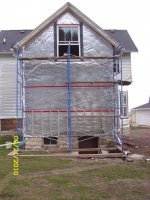
I also purchased a WRB or house wrap thats is a vapor retarder, and is 98.5 aluminum, to act as a radiant barrier. This week I measured a 25 degree difference on the interior face of an exposed exterior ship-lap board, between a wrapped part of the house and non-wrapped. I also lined my attic rafters with the foil house wrap, installed soffit vents, cobra snow country ridge venting, and a power attic fan with a humidistat and thermostat.

The exterior is getting LP Smartside 8' lap siding, on top of a rain screen. Should be tighter than a new home. I also got my bid to spray the bottom of the first floor deck as well, which will effectively totally close up all the air flow that a balloon framed house enjoys.

Also new doors and all new windows, this is my project right now, seeing how Ive been un-employed for a month short of 4 YEARS ! Go Obama !
 
To avoid these ads, REGISTER NOW!

redsky49

Well-known member
Joined
Jan 21, 2009
Messages
582
Location
near the coast in eastern North Carolina
What you are asking about is very doable,... I'm in the middle of it right now. I was running down the same road with the rigid foam board on the exterior, Ive got about 300 pcs of 2" thick 4' x 8' isocyanate rigid foil faced board sitting in a barn. I decided after intensive research, that it was not worth it to use the exterior boards in this heating zone I'm in, (point of diminishing returns) instead I'm spraying open cell foam on the interior walls.

And keep in mind I'm significantly farther north than you appear to be. Turns out at about R11 in your wall, from there on out, adding additional R-value in the walls, the return is really low, and the money is far better spent insulating the lid and stopping air infiltration. I should note, the house I'm re-habbing, BREATHES LIKE A RACE HORSE........

My place is circa 1904, and is wrapped 3/4" tongue and groove ship lap siding (the sheathing), with 2x4 stud walls, balloon framed. I had/has aluminum siding on it, that is being removed daily.

Instead of adding the rigid foam board, Im going the "no air infiltration" route. Basically, I'm sealing the whole house up like and envelope, and not counting on R-Value to save energy. Insulation is worthless when you have air infiltration. Or as I have read time and again, air passing through a fiberglass bat, effectively has an R-Value of ZERO !. And yes, I understand I will air quality problems, that are already being addressed with 2 new HVAC systems (split)

I also purchased a WRB or house wrap thats is a vapor retarder, and is 98.5 aluminum, to act as a radiant barrier. This week I measured a 25 degree difference on the interior face of an exposed exterior ship-lap board, between a wrapped part of the house and non-wrapped. I also lined my attic rafters with the foil house wrap, installed soffit vents, cobra snow country ridge venting, and a power attic fan with a humidistat and thermostat.

The exterior is getting LP Smartside 8' lap siding, on top of a rain screen. Should be tighter than a new home. I also got my bid to spray the bottom of the first floor deck as well, which will effectively totally close up all the air flow that a balloon framed house enjoys.

Also new doors and all new windows, this is my project right now, seeing how Ive been un-employed for a month short of 4 YEARS ! Go Obama !

If you actually succeed in sealing your home that tight, you should consider an air-to-air heat exchanger to ensure healthy indoor conditions. Out gassing of construction materials, cooking odors, pet dander, especially tobacco smoke, etc., can all lead to poor indoor air quality and health problems.

At the minimum, you should plan on at least 0.25 ACH (more if the building is highly occupied) with consideration also given to fuel burning appliances. Even better would be a design based on cfm per occupant. The outside air requirement per code has been found to be deficient, and has been raised for each code cycle. My suspicion, having been involved in a few "sick building" remediations, is that the ventilation air requirements are still too low.

In general, infiltration accounts for only a small portion of a structure's heat loss/gain. Off the top of my head, I would guess that the majority of structures (omitting heavy outside air projects such as restaurants, certain health facilities, etc.) in my experience are less than 10% of the total load. Each building is different of course, and the most cost-effective approach for energy efficiency will also vary. The best approach is always a cost/benefit analysis following a proper heat loss calculation.

And for the record, Obama has been in office for only 21 months of the nearly four years you have been unemployed. Direct your blame accordingly.

As always, offered only as opinion
 

Busted_Knuckles

Well-known member
Joined
Oct 9, 2009
Messages
2,613
Location
Northwest Illinois
If you actually succeed in sealing your home that tight, you should consider an air-to-air heat exchanger to ensure healthy indoor conditions. Out gassing of construction materials, cooking odors, pet dander, especially tobacco smoke, etc., can all lead to poor indoor air quality and health problems.

At the minimum, you should plan on at least 0.25 ACH (more if the building is highly occupied) with consideration also given to fuel burning appliances. Even better would be a design based on cfm per occupant. The outside air requirement per code has been found to be deficient, and has been raised for each code cycle. My suspicion, having been involved in a few "sick building" remediations, is that the ventilation air requirements are still too low.

In general, infiltration accounts for only a small portion of a structure's heat loss/gain. Off the top of my head, I would guess that the majority of structures (omitting heavy outside air projects such as restaurants, certain health facilities, etc.) in my experience are less than 10% of the total load. Each building is different of course, and the most cost-effective approach for energy efficiency will also vary. The best approach is always a cost/benefit analysis following a proper heat loss calculation.

And for the record, Obama has been in office for only 21 months of the nearly four years you have been unemployed. Direct your blame accordingly.

As always, offered only as opinion


Thank you for the input, yes, we are in the processes of bidding a complete split HVAC system, which includes an exchanger.

In reference to turn of the century homes, built with ship-lap sheathing, modern conventional formulas for heat loss/gain can be tossed out the window, along with most of the conditioned air. I'm assuming that the OP, Phil, his house is built with the same sheathing (not sheet goods but boards).

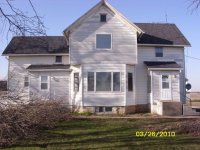
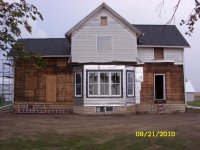
You might have missed the detail "ship-lap" for sheathing part of my post, that translates to a 1/16" horizontal vent, every 8 vertical inches on the house (the amount of space between each board after 100 years of shrinkage). The house has more in common with a corn crib ( for you city slickers its a slatted wall barn, designed to breath to dry corn ) than modern home, surely 10% heat loss in this form of construction is a joke. Ever notice these houses never have a mold or moisture problem ? You cant keep moisture in them long enough for mold to grow. On my place I bought in April, the fuel company reports last years fuel usage at $2800 for 1200 sqft, and I learned at the closing that they had closed off the second floor because they found it to expensive to heat!!! Your surely cant attribute that to lack of insulation ? (btw, electric dryer, stove, and water bottle !)

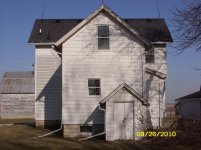
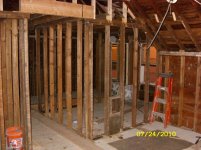
I'm pretty sure a heat loss/gain study isn't necessary in a case like this, even a blind man can see this one. I included some pics...

As far as Obama, I quite familiar with his time in office, it was the "change" he offered to provide (an improved economy/ a job for me), that I'm looking for...not to place blame. I was employed in construction the prior ten years, I know definitively how we got here and who's to blame...

Back to Phil, in reference to the method of adding the sheets to the outside, look hard and long into the details of flashing/trimming windows, and if you decide to pull the trigger, look into polyisocyanate insulation if you are going rigid. It costs more, but provides a significantly higher R-value. What you are talking about doing, is real popular way up north, but not so much around here, might be overkill in your heating zone.
 

Attachments

  • 03-26-2010 069.jpg
    03-26-2010 069.jpg
    148.7 KB · Views: 23
  • 09-21-2010 031.jpg
    09-21-2010 031.jpg
    146.6 KB · Views: 25
  • 03-26-2010 071.jpg
    03-26-2010 071.jpg
    142.9 KB · Views: 23
  • 09-21-2010 026.jpg
    09-21-2010 026.jpg
    147.4 KB · Views: 24
OP
H

HoosierBuddy

Well-known member
Joined
May 9, 2006
Messages
2,922
Location
Southern Indiana
Shiplap?

Yup. That's what I've got too.

Good advice, everyone. I'm going to have to mull on it.

One question, BK if I understand you correctly, you are spray foaming the inside of your walls? You mean, you've removed the plaster and are spraying the back of the shiplap boards? Or, are you spraying the inside of the plaster?

Either way makes me cringe to think about how much work it would be.

Phil
 

glntom

Well-known member
Joined
Oct 2, 2009
Messages
135
Location
Glenwood, AR
Sorry for the OT post, but I think I can get some good advice here.

My situation is I have a circa 1918 home that has been retrofit with:

1. Blown in insulation in the attic (all it will take, basically)
2. Blown in insulation in the exterior walls (cellulose installed before I bought the house). Might be up to 30 years old.
3. Polystyrene insulation on the inside of the basement walls.
4. All new replacement thermopane windows and insulated fiberglass exterior doors.

This is in Indiana. I heat it with forced air gas (93% 2-speed blower). On a cold month, it can cost about $300 to heat the house. Comfort level is good overall in the house. Over the 15 years I've owned it, I've knocked out most of the drafts and air leaks.

I'd like to do an upgrade to the house.

What I'd like to do is remove the exterior aluminum siding. Access the old "fill" holes used to blow in the cellulose and top off as requried to make up for settlement. Then, wrap the house in tyvek (like a new home) tucking and taping around the windows as required. Then, (and here's the part that the two contractors that have looked at this job have looked at me like I'm insane) wrap the whole house in 1 1/2" or 2" Dow or Owens Corning polystyrene (the blue board or the pink board). Then install new vinyl siding over the polystyrene and trim out the windows (etc.) to cover the insulation edges.

Just looking around the internet, this seems like a reasonable approach. The first contractor that gave me a bid (18K) to reside the house quoted using a siding that has a built in white polystyrene backing of 1/2" to 1 1/8" rather than wrapping the house as I requested.

The second contractor just scratched his head and said he'd have to get back with me, but he hasn't.

Is this such a weird thing to do or is it just weird do do around here? Am I off my rocker on this one?

What do you think?

My aluminum siding is peeling really badly, and I need to do something. If I can't get a significant increase in r-value out of this project, I probably need to just get someone to paint the old siding and call it "good". If I can get a boost in r-value and get new siding in a single project, then that would be great.

Phil

That is a common thing to do to a house here in Arkansas. I have seen many people do just that to older homes.
 

Busted_Knuckles

Well-known member
Joined
Oct 9, 2009
Messages
2,613
Location
Northwest Illinois
Shiplap?

Yup. That's what I've got too.

Good advice, everyone. I'm going to have to mull on it.

One question, BK if I understand you correctly, you are spray foaming the inside of your walls? You mean, you've removed the plaster and are spraying the back of the shiplap boards? Or, are you spraying the inside of the plaster?

Either way makes me cringe to think about how much work it would be.

Phil

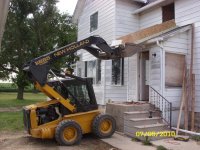
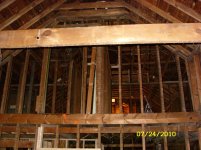
Hi Phil, yes, I am spraying the inside of my walls, yes, I have removed every stitch of lath and plaster, and I'm spraying the back side of the ship lap.

Yes, cringe, severely cringe, it was a MUTHERFUKER knocking out a 2400 sqft home, it took 2 weeks (10 working days), 3 of us, 10 hr days, but there was other demo work done at the same time. We did this in July, is sucked a big one ! (moved through lots of water bottles)

Since you started this thread, we had a wind storm, I was working in the house, and even though the house is two intersecting rectangles, with no storm bracing, the house was a "rockin", so I stopped what I was doing and started sheathing the whole exterior with 7/16" OSB on the exterior to stiffen it up. I also hand re-nailed all the existing ship-lap board nails and have shot 3- 3" x .120 Paslode Galvanized Ring Shank Nails in each piece of ship-lap. Its disturbing how loose that stuff has become since the place was put together.

Im scheduled for the first of November to spray, Im putting in all new windows (22), all resized and relocated, so lots of headers/sills to move/build, or I would already have sprayed the interior.

I'm in it far enough now that I think an excavator would have been a better option.
 

Attachments

  • 07-05-2010 033.jpg
    07-05-2010 033.jpg
    148.8 KB · Views: 19
  • 07-05-2010 049.jpg
    07-05-2010 049.jpg
    127.2 KB · Views: 22
  • 07-24-2010 018.jpg
    07-24-2010 018.jpg
    145 KB · Views: 18
  • 07-24-2010 036.jpg
    07-24-2010 036.jpg
    145.4 KB · Views: 18
Last edited:

Busted_Knuckles

Well-known member
Joined
Oct 9, 2009
Messages
2,613
Location
Northwest Illinois
Shiplap?

Yup. That's what I've got too.

Good advice, everyone. I'm going to have to mull on it.

One question, BK if I understand you correctly, you are spray foaming the inside of your walls? You mean, you've removed the plaster and are spraying the back of the shiplap boards? Or, are you spraying the inside of the plaster?

Either way makes me cringe to think about how much work it would be.

Phil

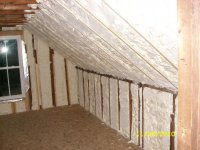
Here's an update on this thread, I had the house sprayed on 11/19, although I didn't get all the windows in prior to spraying, I did get them all framed, so the insulation is in place as needed, I just need to cut out the 1/2" OSB sheathing, and pop in the windows.

I ran out of "framing" time and my insulation date was fixed, as things never go to plan. I removed all the windows in this house, and re-framed every hole, as well added new holes, for larger windows, so effectively re-framed for 22 windows, which was quite an undertaking being that I did it right and cut no corners. I also removed two exterior door ways and added one, and moved some rooms around, and jacked the house off the sill plate to level it all out. Not for the weak at heart DIY person to take on.

Today I started hanging some rock, feels good finally putting something back together, after 6 months of demo and structural repair... might be moving in a couple months,... cant wait :thumbup:

Next year I start on the shop,,,,,....:bounce: Its 5,000 sq ft and a blank canvas at this point, just an empty Morton building (pole barn).

 

Attachments

  • 11-30-2010 052.jpg
    11-30-2010 052.jpg
    146.6 KB · Views: 11
  • 11-30-2010 073.jpg
    11-30-2010 073.jpg
    143 KB · Views: 14
  • 11-30-2010 082.jpg
    11-30-2010 082.jpg
    145.4 KB · Views: 13
To avoid these ads, REGISTER NOW!
Top Bottom