To avoid these ads, REGISTER NOW!

Outdoor electrical box gang size? What am I missing?

NewShockerGuy

Well-known member
Joined
Oct 12, 2010
Messages
2,481
Location
Northern Virginia / DC
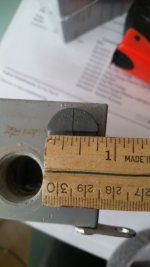
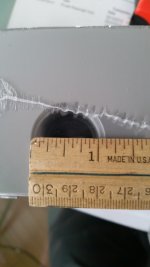
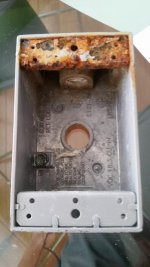
Adding an outlet where there is an existing gang box outside. Take off the cover and it's rusty and the screw is broken off inside. No worries, just go to HD to pick up another one. I measured the threaded holes and they are very close to to 3/4"

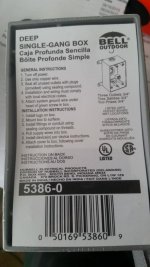
I go pick up a 3/4" without taking the older one and bring it home and say welp that's not right.

Is this normal? I am simply wanting to screw this into the exsisting pipe that is there (outdoor gray pipe).

I figured the threaded part is what to go by but obviously not. In the future how does one determine what size the box is, I take it not from the actual hole?

I know this is a dumb question but figured I'd ask since I don't have a clue...lol

Pictures attached, mine vs the new one. What thread size is mine so I know going forward?

Thanks,
-Nigel
 

Attachments

  • oldbox1.jpg
    oldbox1.jpg
    57.9 KB · Views: 28
  • oldbox2.jpg
    oldbox2.jpg
    142.3 KB · Views: 31
  • oldboxcap.jpg
    oldboxcap.jpg
    144.1 KB · Views: 29
  • newbox.jpg
    newbox.jpg
    70 KB · Views: 29
  • newbox2.jpg
    newbox2.jpg
    140.2 KB · Views: 27
To avoid these ads, REGISTER NOW!

manwithtools

ALLIANCE MEMBER
Joined
Aug 24, 2015
Messages
13,975
Location
Lebanon, TN
Pipe size actually loosely refers to the ID of the pipe not the OD. After you use pipe and conduit for a while you tend to get used to the sizes and keep a mental image of what corresponds to what. It is kind of like being able to look at a bolt head and know if it's 10mm or 7/16" just by sight.

To make it more confusing, pipe threads are tapered, so the argument then becomes where on the thread do you measure it. Perhaps that's why the nominal ID is the standard - you can easily measure that.
 
Last edited:

The FIB

Well-known member
Joined
Jan 8, 2014
Messages
266
Location
chicagoland
When they say 1/2" conduit, they are talking about the inside diameter of the pipe, you are measuring the thread which is the outside of the pipe, that's why it measures larger than a half inch.
 

The FIB

Well-known member
Joined
Jan 8, 2014
Messages
266
Location
chicagoland
manwithtools,
Most of the threads you find in electrical fittings are not NPT, they are usually NPS or NPSM, they are straight and not tapered.
 

manwithtools

ALLIANCE MEMBER
Joined
Aug 24, 2015
Messages
13,975
Location
Lebanon, TN
manwithtools,
Most of the threads you find in electrical fittings are not NPT, they are usually NPS or NPSM, they are straight and not tapered.

That may be true of some fittings, but certainly not all (I'd say not even most) and then it's only the female thread not the male if the fitting has male. Rigid conduit has a 3/4" per foot taper on it (NPT). That is why I was referring to the pipe and not the fitting.

The Steel Tube Institute says the following:

"Rigid Metal Conduit produced in standard lengths of 10 feet (3.05 m) and 20 feet (6.10 m), including a coupling, is threaded on both ends, with a coupling applied to one end and a thread protector to the other. The pitch of threads conforms to the American National Standard for Pipe Threads, General Purpose (Inch), ANSI / ASME B1.20.1. The taper of threads is 3/4 inch per foot (1 in 16). Threads are protected after cutting by an application of molten zinc."

BTW, that Bell 5386-0 box that the OP posted is rated as suitable for wet locations. The threaded conduit openings are all NPT. Same would be true of the old weather proof box he's replacing.
 
Last edited:
To avoid these ads, REGISTER NOW!
Top Bottom