Dick in Wisconsin
Well-known member
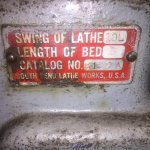
Bought an old South Bend 4x10L lathe (catalog #8187A). Guy I bought it from thought he bought it 25 years ago from a job shop in Milwaukee. Doesn't know how old it is, I'm guess 1940's/50's ... maybe a touch older.
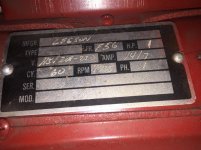
He told me it was 240volt, single phase, 20amp motor. He had it plugged into the garage next to his house ... so I believe the single phase part is solid.
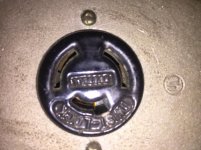
He had it plugged into the twist lock outlet shown in the picture. I went to home depot and bought a 240volt, single phase, 20 amp outlet (NEMA L6-20A). But the old plug wouldn't fit in the new outlet. The "L" on one of the prongs of the old plug points to the outside of the circle and the "L" on the new outlet points to the inside.
It's a three wire set up; the cord to the lathe has single black, white, and green wires. I presume (I'm not an electrician) two hots (black and white) and a single ground or neutral, green).
Rummaging around in Google I found "NEMA wiki" which led me to the Hubbell catalog. In there I found a NEMA L7-20P (20A 277V AC) outlet/plug configuration which has the "L" of a prong pointing to the outside of the circle. I wonder if this was the plug/outlet that was originally used?
Has the configuration of these plugs changed over time? Was the lathe (in the industrial setting) originally wired for a NEMA L7-20P plug and hence outlet?
So ... my question is ... can I use a NEMA L6-20 plug and outlet? I have 12-3 wire (black, red, white, and bare copper ground) coming to the outlet for the lathe that will be wired into the panel by a real electrician. My plan is to not use the bare copper ground wire. From the service panel, black and red will be hots, white will be the ground(?).
Wire from Lathe .... wire to service panel
Green (ground?) ... white
Black (hot) ... black (hot)
White (hot) ... red (hot)
Question about direction of relation of the motor. Does it make any difference how the motor is wired regarding the direction of rotation?
Are my assumptions correct? I'll have this double checked by the electrician when he wires everything to the service panel.
He told me it was 240volt, single phase, 20amp motor. He had it plugged into the garage next to his house ... so I believe the single phase part is solid.
He had it plugged into the twist lock outlet shown in the picture. I went to home depot and bought a 240volt, single phase, 20 amp outlet (NEMA L6-20A). But the old plug wouldn't fit in the new outlet. The "L" on one of the prongs of the old plug points to the outside of the circle and the "L" on the new outlet points to the inside.
It's a three wire set up; the cord to the lathe has single black, white, and green wires. I presume (I'm not an electrician) two hots (black and white) and a single ground or neutral, green).
Rummaging around in Google I found "NEMA wiki" which led me to the Hubbell catalog. In there I found a NEMA L7-20P (20A 277V AC) outlet/plug configuration which has the "L" of a prong pointing to the outside of the circle. I wonder if this was the plug/outlet that was originally used?
Has the configuration of these plugs changed over time? Was the lathe (in the industrial setting) originally wired for a NEMA L7-20P plug and hence outlet?
So ... my question is ... can I use a NEMA L6-20 plug and outlet? I have 12-3 wire (black, red, white, and bare copper ground) coming to the outlet for the lathe that will be wired into the panel by a real electrician. My plan is to not use the bare copper ground wire. From the service panel, black and red will be hots, white will be the ground(?).
Wire from Lathe .... wire to service panel
Green (ground?) ... white
Black (hot) ... black (hot)
White (hot) ... red (hot)
Question about direction of relation of the motor. Does it make any difference how the motor is wired regarding the direction of rotation?
Are my assumptions correct? I'll have this double checked by the electrician when he wires everything to the service panel.