To avoid these ads, REGISTER NOW!

Oven Conversion to Powder Coating Use?

RonRock

Well-known member
Joined
Oct 6, 2007
Messages
1,171
Location
Iowa, USA
I'm in progress of converting my old built in electric oven for use as a powder coating oven. Reason it was replaced is that the control board went bad, and obsolete. So I am going to build my own control system. I have a PID, Thermocouple, and contactor. Should be enough for basic control bells and whistles can be add if needed. A Power on light may be good. Don't see a need for a timer at this point.

That said I have never powder coated before. But WTF I'm in.

So I'm comfortable doing the building of the control. Not to say that I won't have more questions, but I am comfortable and safe enough that I'll get it done.

That may seem pretty cocky after this question.

Are electric oven elements 220 volt? Seems to me that they would have to be 220. But the OEM wiring suppling both elements (Bake, Broil) is 16-gage.

My Fluke meter tells me that my Bake element is 27.4 Ohms resistance. If I use 230V in the calculator I found it tells me that I will draw 8.39A, 1,930.65W
Broil element is 17.9 Ohms resistance. 12.85A, 2,955W

If I plug in the same numbers @ 120v of course the amperage looks more appropriate to the 16-gage.

So I have to ask how could a 16-gage wire handle those amperages? Or have I misunderstood something simple?

As another point of information, the OEM supply wires coming from the oven are 12 gage line, 16 neutral.
 
To avoid these ads, REGISTER NOW!

walta

Well-known member
Joined
Jan 13, 2017
Messages
2,311
Location
Dutzow Missouri
Somewhere in the factory circuit there was safety over temp cut off device be sure to include the over temp device in your new circuit.

I do not think your Ohm meter reading will help you determine your wattage. As the resistance will change as the element heats up. The elements are almost certainly 240 Volt.

For the contactor get a 25 Amp Solid state relay and PID made to run the SSR. Maybe 2 SSR one to run each element.

Reuse the old wiring as it will have the 450° C insulation you will need the wires you find at the store will be 60 -100° C and melt.


Walta
 

no704

Well-known member
Joined
Apr 27, 2016
Messages
5,215
No need to run both elements for powder coat. You can get an Inkbird PID controller with thermocouple and SSR for about $40 on Amazon.
 
OP
R

RonRock

Well-known member
Joined
Oct 6, 2007
Messages
1,171
Location
Iowa, USA
Thanks guys, I'll do as I planned and wire it up on 220v. I will probably only use one of the elements. I only plan to use this oven short term to "get my feet wet with powder coating" eventually building a larger one. So I hope to get this one working then scrap it and reuse the controller and possible elements. So at this point I want to use what I have on hand, if I can reporpous it later great.

Makes sense that the resistance would change with temperature. But I had to start with something. The 16 gage wire still don't seem right. But I'll trust it for now. I'll do some amp testing after I get it working.

Yes I do plan to use the OEM wire as much as possible. Certainly for the elements. And anything that may get heated beyond ambient Temps.

Always open to suggestions for anything that I need to know.

Cheers,
Ron
 

wyliesdiesels

Well-known member
Joined
Aug 14, 2012
Messages
20,002
Location
Modesto, CA
Are electric oven elements 220 volt? Seems to me that they would have to be 220. But the OEM wiring suppling both elements (Bake, Broil) is 16-gage.

My Fluke meter tells me that my Bake element is 27.4 Ohms resistance. If I use 230V in the calculator I found it tells me that I will draw 8.39A, 1,930.65W. Broil element is 17.9 Ohms resistance. 12.85A, 2,955W

If I plug in the same numbers @ 120v of course the amperage looks more appropriate to the 16-gage.

So I have to ask how could a 16-gage wire handle those amperages? Or have I misunderstood something simple?

As another point of information, the OEM supply wires coming from the oven are 12 gage line, 16 neutral.
look at the nameplate on the oven. should list the voltage. but its not gonna be 220v. most likely 240v

one thing you have to remember is that appliance wiring has a higher insulation temperature rating so you can run more amps over smaller gauge wire.
 

wyliesdiesels

Well-known member
Joined
Aug 14, 2012
Messages
20,002
Location
Modesto, CA
Thanks guys, I'll do as I planned and wire it up on 220v. I will probably only use one of the elements. I only plan to use this oven short term to "get my feet wet with powder coating" eventually building a larger one. So I hope to get this one working then scrap it and reuse the controller and possible elements. So at this point I want to use what I have on hand, if I can reporpous it later great.

Makes sense that the resistance would change with temperature. But I had to start with something. The 16 gage wire still don't seem right. But I'll trust it for now. I'll do some amp testing after I get it working.

Yes I do plan to use the OEM wire as much as possible. Certainly for the elements. And anything that may get heated beyond ambient Temps.

Always open to suggestions for anything that I need to know.

Cheers,
Ron
nominal voltage in the US is 240v not 220v. also the resistance of the element should not be changing.
 

The Cobbler

Super Moderator
Staff member
Joined
Oct 24, 2013
Messages
25,876
Location
Niagara Region, Ontario, Canada
I don't think you'll find both elements combined draw more than 20 amps, so 1 should draw half of that .
after all, a stove with 4 top burners and oven all on full operate on 40 amps
 

mm08822

Well-known member
Joined
Jan 13, 2012
Messages
5,904
Location
NJ
Are electric oven elements 220 volt? Seems to me that they would have to be 220. But the OEM wiring suppling both elements (Bake, Broil) is 16-gage.

My Fluke meter tells me that my Bake element is 27.4 Ohms resistance. If I use 230V in the calculator I found it tells me that I will draw 8.39A, 1,930.65W
Broil element is 17.9 Ohms resistance. 12.85A, 2,955W

If I plug in the same numbers @ 120v of course the amperage looks more appropriate to the 16-gage.

So I have to ask how could a 16-gage wire handle those amperages? Or have I misunderstood something simple?

As another point of information, the OEM supply wires coming from the oven are 12 gage line, 16 neutral.
I'm sure they are 240V elements. You can probably find a schematic online for the oven to confirm it.
You are confusing amperages commonly found for building construction materials having lower insulation temperature ratings than that of appliance wiring materials (AWM).
There are many styles of AWM products. Here is an example of TGGT style. Notice the higher end conductor and insulation details.
1716337878117.png
Conductor termination rating is important. The AWM wiring will typically transition to lower rated insulation types but in doing so the conductor cross-section will increase to manage the temperature rise.

Better than a contactor is a solid state relay (SSR), but even better than that is phase-angle fired controllers. These allow the power to module down, somewhere between 0-25-50-75-100%, while contactors and SSRs are either on or off (100% or 0%). The phase angle fired control can provide a much tighter temp control.

A contactor would drive you crazy with its constant on/off chatter.
 

PCustoms

Well-known member
Joined
Jul 23, 2011
Messages
22,692
Location
VT
.

My Fluke meter tells me that my Bake element is 27.4 Ohms resistance. If I use 230V in the calculator I found it tells me that I will draw 8.39A, 1,930.65W
Broil element is 17.9 Ohms resistance. 12.85A, 2,955W

If I plug in the same numbers @ 120v of course the amperage looks more appropriate to the 16-gage.

So I have to ask how could a 16-gage wire handle those amperages? Or have I misunderstood something simple?

Huh?

I think you've misunderstood something. Link to the calculator you're using?
 
OP
R

RonRock

Well-known member
Joined
Oct 6, 2007
Messages
1,171
Location
Iowa, USA
nominal voltage in the US is 240v not 220v. also the resistance of the element should not be changing.

I get it. Pretty sure that you have heard of 110/220v. Apologies for using old terminology.


one thing you have to remember is that appliance wiring has a higher insulation temperature rating so you can run more amps over smaller gauge wire.

Good point. I would have never thought that you could run so much higher amperage based on insulation temperature. 16 gage for a heating element just don't seem right.

I ask so that I can learn.

Ron
 
OP
R

RonRock

Well-known member
Joined
Oct 6, 2007
Messages
1,171
Location
Iowa, USA
Huh?

I think you've misunderstood something. Link to the calculator you're using?

You are probably right. I very well may have misunderstood. I'm on my phone now. The link is on the shop computer. But it was just one of those that you plug in the known numbers and it gives an unknown based on Ohms Law. I put in 230v, and 27.4 Ohms resistance. It calculated 8.39A. Same for the other element with different numbers.
 

PCustoms

Well-known member
Joined
Jul 23, 2011
Messages
22,692
Location
VT
You are probably right. I very well may have misunderstood. I'm on my phone now. The link is on the shop computer. But it was just one of those that you plug in the known numbers and it gives an unknown based on Ohms Law. I put in 230v, and 27.4 Ohms resistance. It calculated 8.39A. Same for the other element with different numbers.
I might be backwards too, been a long *** day....
 
OP
R

RonRock

Well-known member
Joined
Oct 6, 2007
Messages
1,171
Location
Iowa, USA
I'm sure they are 240V elements. You can probably find a schematic online for the oven to confirm it.
You are confusing amperages commonly found for building construction materials having lower insulation temperature ratings than that of appliance wiring materials (AWM).
There are many styles of AWM products. Here is an example of TGGT style. Notice the higher end conductor and insulation details.
1716337878117.png
Conductor termination rating is important. The AWM wiring will typically transition to lower rated insulation types but in doing so the conductor cross-section will increase to manage the temperature rise.

Better than a contactor is a solid state relay (SSR), but even better than that is phase-angle fired controllers. These allow the power to module down, somewhere between 0-25-50-75-100%, while contactors and SSRs are either on or off (100% or 0%). The phase angle fired control can provide a much tighter temp control.

A contactor would drive you crazy with its constant on/off chatter.

I am aware of the noise that a contactor makes. Didn't think about it constantly chattering. If it chatters like that I agree. Good point. I first planned on an SSR but my limited research led me to believe that a SSR failure had a tendency to take out all (possibly) components in the circuit. I figured that I'd put up with the noise. But not if it is as bad as it sounds.
 

walta

Well-known member
Joined
Jan 13, 2017
Messages
2,311
Location
Dutzow Missouri
Please post a photo of the wiring diagram from the oven you are starting with. Let’s see if you have a safety over temp sensor to reuse.

SSR do tend to fail in the ON mode should that happen, the oven will heat until the safety thermostat open.

The SSR simply can not damage any other parts in your circuit the load side is on or off and the control side of the SSR is total isolated from the load circuit. If the load short circuits and draws excessive current often the high current often will damage the SSR and they tend to fail to the ON state. Someone could mistakenly blame the SSR.

Walta
 

Black300zx

Well-known member
Joined
Apr 8, 2019
Messages
782
Location
Elkton, Md
I did a LOT of hobby level powdercoating in a salvaged oven. You'll probably find that you can go quite far with it.

Good luck!
 
OP
R

RonRock

Well-known member
Joined
Oct 6, 2007
Messages
1,171
Location
Iowa, USA
Thanks guys.

I took a look at Amazon and they offered the Inkbird PID, 40A setup and that day delivery. So I ordered and received it same day. Part of my reasoning for the order was to see if they actually did as they say. I've had terrible luck with delivery times. But the PID that I intended to use was actually too good to waste on this project. I'll save it for the bigger and better oven.

So I am in process of wiring up the Inkbird PID and SSR.

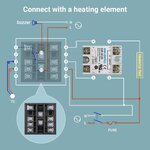
The Inkbird drawing on Amazon assumes 120v supply. I am of course using 240v supply. 4 wire 120/240 30a. Does the PID need to have both "legs" of the heater running through it? The PID is rated for 100-240v supply. So I'm sure that it would work with both legs. But the way my wiring is from the OEM it would be easier (cleaner) for me to use 120v.

1716584461489.jpeg

I have Line 1 supply going to SSR 2, PID 10.
Line 2 supply -OEM overtemp limit---element-----SSR 1

That will allow the PID to switch the SSR 240v power through element.

Can I use the Neutral leg of the supply to PID 9? I assume that PID 9 is simply for PID operation. No need for 240v on 9. Unless it has something to do with the actual PID control of the element.


OP
R

RonRock

Well-known member
Joined
Oct 6, 2007
Messages
1,171
Location
Iowa, USA
Please post a photo of the wiring diagram from the oven you are starting with. Let’s see if you have a safety over temp sensor to reuse.

SSR do tend to fail in the ON mode should that happen, the oven will heat until the safety thermostat open.

The SSR simply can not damage any other parts in your circuit the load side is on or off and the control side of the SSR is total isolated from the load circuit. If the load short circuits and draws excessive current often the high current often will damage the SSR and they tend to fail to the ON state. Someone could mistakenly blame the SSR.

Walta
Thank you walta. That is the way I understood the SSR function. I've trusted them previously in other projects, but not at oven temps, or amperage. I've also used contactors for various projects, or replacement (HVAC). They are noisy.
 
To avoid these ads, REGISTER NOW!
OP
R

RonRock

Well-known member
Joined
Oct 6, 2007
Messages
1,171
Location
Iowa, USA
No need to run both elements for powder coat. You can get an Inkbird PID controller with thermocouple and SSR for about $40 on Amazon.
I didn't want to. But it made sense on this project. Bought the Inkbird. Plan to start with 1 element, see how it works. I fully expect to build a larger oven as soon as I get an idea of WTF I'm doing. Haha
 

no704

Well-known member
Joined
Apr 27, 2016
Messages
5,215
I didn't want to. But it made sense on this project. Bought the Inkbird. Plan to start with 1 element, see how it works. I fully expect to build a larger oven as soon as I get an idea of WTF I'm doing. Haha
I’ve used them on several projects. Have a kiln ramp controller on an old pottery kiln too. So much better control with the PID controller. For the cost it’s a no brainer. Put one on a toaster oven. Went from a 70 degree swing to 2 degrees.
 

walta

Well-known member
Joined
Jan 13, 2017
Messages
2,311
Location
Dutzow Missouri
I do not see any advantage to powering the PID with 120V doing so forces you into 4 conductor cord and plug but maybe you have them on hand.

With 240V you will want 2 fuses one on each hot leg and I think the fuses should be before the switch not after.

One element or 2 is fine the only difference will be how many minutes it takes to come up to temp. The peak current draw will be higher but the watt hours used will be almost the same.

With both elements you will want a heat sink under the SSR.

Walta
 
OP
R

RonRock

Well-known member
Joined
Oct 6, 2007
Messages
1,171
Location
Iowa, USA
That makes sense Walta. It would also make wiring the oven supply much easier. I was planning to install a 4 wire receptical at my subpanel. By going to a 3 wire 240v setup. I can skip that and either use my 50a welder circuit, or an existing 30a receptical. Probably the 30a. Only thing that I will loose is the OEM oven lights. Would be nice, but not that nice.

I plan to use a 30a DPST breaker on the oven as a switch. Serves dual purpose.

Thanks for the help.

Ron
 
OP
R

RonRock

Well-known member
Joined
Oct 6, 2007
Messages
1,171
Location
Iowa, USA
I'm sure they are 240V elements. You can probably find a schematic online for the oven to confirm it.
You are confusing amperages commonly found for building construction materials having lower insulation temperature ratings than that of appliance wiring materials (AWM).
There are many styles of AWM products. Here is an example of TGGT style. Notice the higher end conductor and insulation details.
1716337878117.png
Conductor termination rating is important. The AWM wiring will typically transition to lower rated insulation types but in doing so the conductor cross-section will increase to manage the temperature rise.

Better than a contactor is a solid state relay (SSR), but even better than that is phase-angle fired controllers. These allow the power to module down, somewhere between 0-25-50-75-100%, while contactors and SSRs are either on or off (100% or 0%). The phase angle fired control can provide a much tighter temp control.

A contactor would drive you crazy with its constant on/off chatter.

That is good information to know. I will take some time to look into AWM. I can see from the page that TGGT-16 is rated at 29a. Defiantly need more study time on this subject.

You are absolutely correct I was only considering the building wire that I am familiar with.

Thanks,
Ron
 

Milton Shaw

Well-known member
Joined
Feb 11, 2011
Messages
4,837
Most oven elements have the wattage and volts written on them. Small print and very lightly engraved in mounting plate may have to remove to read. Preheating would be the cure for best paint curing.
 
OP
R

RonRock

Well-known member
Joined
Oct 6, 2007
Messages
1,171
Location
Iowa, USA
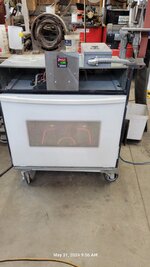
Sorry for the slow reply. I washed the inside of the oven, somehow got the insulation under the bottom wet. Took forever to dry it out. But I did get the top element working well enough to do some powder coating. YAY!

So the oven works as I had expected. But I can not get the temp to stay even close to steady. Very much 20*F fluctuation up and down from setpoint. That is with just the top element. I just got the bottom dried out and installed the bottom element. I'm hoping that will help keep the temps more steady. I have had trouble getting the items at an even temp. Depending on where in the oven they are place the temps vary making it hard to judge cure time. So I'll see if the bottom element helps.

One problem I have is that I have to open the door to check temps. It drops temp like a rock when I do. I try not to "fan" the door, but still have to keep an eye on temp. New to the game so not sure what temperature range is acceptable.

I have done a few parts and they seem to turn out OK. Flat Black. Did have one bad failure though. Silver bad runs in places. Looked great in others. Now I get to learn how to strip and start over. ****. But part of learning.

Any pointers on how to set the perimeters in the PID? I know how to change them, just not sure what they should be.

I am wondering if I could install a switch in the top element so that I could shut it off after things get up to temp and just have the bottom maintain the temps. Would that have a bad effect on the PID? Or would I be best to get a separate PID for the second element? Just a thought.
 

Attachments

  • 2024-05-31 09.56.37 (Medium).jpg
    2024-05-31 09.56.37 (Medium).jpg
    213.1 KB · Views: 25

no704

Well-known member
Joined
Apr 27, 2016
Messages
5,215
PID has a self learning routine you have to run after install.
And don’t have your thermocouple too close to the element, might even want to shield it from radiant heat with that set up.
 

eejack

Well-known member
Joined
May 18, 2021
Messages
166
Location
the garden state
So the oven works as I had expected. But I can not get the temp to stay even close to steady. Very much 20*F fluctuation up and down from setpoint. That is with just the top element. I just got the bottom dried out and installed the bottom element. I'm hoping that will help keep the temps more steady. I have had trouble getting the items at an even temp. Depending on where in the oven they are place the temps vary making it hard to judge cure time. So I'll see if the bottom element helps.

One problem I have is that I have to open the door to check temps. It drops temp like a rock when I do. I try not to "fan" the door, but still have to keep an eye on temp. New to the game so not sure what temperature range is acceptable.

So those of us who bake....

Get several thermometers ( or just one and move it around as you experiment ) and leave them inside the oven so you can see the reading from the closed door. Most super markets and department stores will have them cheap enough.

Any kitchen oven will have hot and cold spots and you learn to adjust your baking to those conditions.

My oven runs 10 degrees cold from the setting and there is around a 10 degree difference inside between rack heights, colder as I go higher within the oven. Doesn't make any real difference for casseroles, plays havoc with cakes and cookies.
 

walta

Well-known member
Joined
Jan 13, 2017
Messages
2,311
Location
Dutzow Missouri
The red number on your PID is the actual temp inside your oven where your probe is located and should be very accurate.

Move the probe around and find someplace as far away from the heating element as possible likely where the factory sensor was located with its heat shields.

If this oven had a convection fan consider powering on when using the oven.

When programing the PID you need to run the training mode this teaches the PID about the amount of lead and lag to expect in your system. Once set up if the red and green LEDs will read with in a degree or less after a preheating cycle.

Try watching this video it will help you understand what some of the parameters you are automatically programing in the training mode.

search YouTube for "PID Control Basics in 10 Minutes"
 

walta

Well-known member
Joined
Jan 13, 2017
Messages
2,311
Location
Dutzow Missouri
I said this twice before and I did not see any response I will make this comment its own post!

To operate safely your oven must have some sort of over temp cutoff device. In the event that anything goes wrong with your control system that will shutdown the heater before this thing can start a fire. The old oven likely had a safety device if not you should add one. They sell thermal fuses that open and break the circuit as say 550°F

 
Last edited:
OP
R

RonRock

Well-known member
Joined
Oct 6, 2007
Messages
1,171
Location
Iowa, USA
Sorry I thought that I had mentioned that I did use the OEM overtemp disc. One leg of my 240v supply goes to it, then each element.

I was able to use all OEM wiring for everything bou the PID control to SSR.

I used an old extension cord for the 120v lights. The whole thing is pretty hack. But as safe as can be. It will never be left powered on without me watching.

I'll check out the YouTube.

My thermocouple is in the same place as the OEM. I figured that they new where the best place would be. And I didn't have to drill any new holes. Although mine is stubby and the original was maybe 3 inches long.

The oven did have a fan attached in the rear. Had some duckting that goes over the top and out. I figured it was for cooling since the unit is a built in oven. I removed it but still have it. Maybe I need to take a better look at what it was actually for.

Hopefully the YouTube will show me how to get the PID to learn. Pretty sure that will help.

Thanks again for the helpful reply,
Ron
 

walta

Well-known member
Joined
Jan 13, 2017
Messages
2,311
Location
Dutzow Missouri
A convevectionoven would have a fan much like the one in this photo the cirulate the hot air inside the oven. Yes some built in ovens will have cooling fans to move air around the outside of the oven that you would non need.

Also use an Ohm meter and check that any metal part you could touch is grounded to the ground pin of your cords plug.

You will need to find and run the learn mode in the instruction for your make and model PID as every model just a little different.

Walta
 

Attachments

  • 1630032298921.jpg
    1630032298921.jpg
    81.7 KB · Views: 18
Last edited:
OP
R

RonRock

Well-known member
Joined
Oct 6, 2007
Messages
1,171
Location
Iowa, USA
Thanks Walta. I will do a check for ground. I left the OEM supply as it was originally. It comes into the oven in flex that I have connected to the breaker box that I mounted as a supply/switch. From there it goes into oven to the OEM junction block for the 2-220 legs, ground is to oven case never removed.

I did try to find instructions on how to run the PID self learn mode. No luck. The included information is not very helpful to me. Maybe because of my lack of knowledge. But I ran it as I understand. It may have helped a little, not much. Still Temps vary widely. I'll keep trying.
 
OP
R

RonRock

Well-known member
Joined
Oct 6, 2007
Messages
1,171
Location
Iowa, USA
I should have added that the PID is Inkbird ITC-106VH. I have been unable to find the instructions online. Odd these days. But here is a photo of the instructions,
 

Attachments

  • 20240603_081825.jpg
    20240603_081825.jpg
    1.1 MB · Views: 23
OP
R

RonRock

Well-known member
Joined
Oct 6, 2007
Messages
1,171
Location
Iowa, USA
The PID is new.

I did set as you describe. Ran Tune several times today. It did seem to make some changes to the PID settings. But never got correct. So I took the settings that it came up with and tried to adjust them in various ways. No joy. For some reason the temp never stops at my setpoint. Always keeps climbing. Weather I am under Auto Tune or making my own adjustments. I kept record of all of the PID settings and temps high and low. If you want to take a look.

Does the setpoint that I use matter? Can I set at 200*F for PID adjustments and expect it to work at 400*. It seems that most powder coating is done around 400. So I used that most of the day as a setpoint. But that takes long time to reach and drop. Slow progress.

I eventually set my D setting at 0 and left it. My reading leads me to beleve that it is not important at this point. And is another setting to guess at. I was hoping for better results adjusting P and I. Then going in to fine tune with D.
 

whateg01

Well-known member
Joined
Mar 13, 2006
Messages
11,260
Location
doo dah, kansas, usa
I've heard of a few cases where the SSR "stuck" so definitely, if you haven't already, include a runaway device. Especially with off brand SSR and contactor, I prefer to go up a size or 3 beyond what's needed.
 

no704

Well-known member
Joined
Apr 27, 2016
Messages
5,215
I find with this type of set up they tend to over shoot a lot. If you set at 400 does it eventually settle out and hold?
 

no704

Well-known member
Joined
Apr 27, 2016
Messages
5,215
These types of elements just don’t respond quickly. Been a while since I’ve done this on that type of system. I would suggest setting the Intragral setting Way higher. Not like 10, like 8000. Or just set to 300 and when it starts to stall set to 400. Otherwise you need a ramp controller that you can set to heat up more slowly.
 
To avoid these ads, REGISTER NOW!
Top Bottom