To avoid these ads, REGISTER NOW!

Overhead wire connections; split bolt technique and routing questions

Dusty Floor

Active member
Joined
Feb 20, 2011
Messages
34
I have an overhead wire supplying power to my detached garage. Didn't see a marking on the first foot or so (didn't look much further as I was looking from the edge of the roof) but the (aluminum) conductors are close to 1/4" diameter. On the house end, it connects to 12/3 coming out of weatherhead attached to the side of the house. At the garage end, a similar setup, instead of a weatherhead, it connects to 12/3 UF stapled along the rake board and then entering through the rake board. There is a metal trim piece where the cable enters the building, and another where it comes away from the building to join the overhead cable. The connections at each end of the overhead cable are split bolts.

I need to temporarily relocate the entrance to the garage in order to make repairs to the siding and trim. I've never used split bolts before, so I want to make sure I have it right when I reassemble it.
* There is a gray paste on the copper conductor. Should I clean and re-apply? What specifically should I buy?
* The connections are taped (and taped and taped...). Is there a specific grade of tape for sunlight resistance?
* How tight should the bolts be? Should I crank down pretty hard?

The wire is suspended from an insulator lagged into the face of the building, near the corner. Can I move the entrance around the corner, or must it be on the same face of the building?

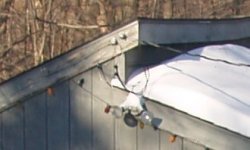
The attached picture (sorry about the small size) shows the layout. The 12/3 enters the building just above the orange Christmas light, I'd like to run it in through the short wall above the flood lights. (There is enough wire; that's how I have it run temporarily).

Btw, for those that are concerned about the 12/3 -- there are only two 20a circuits in the garage, and it's connected to a double pole breaker at the house end.

Thanks.
 

Attachments

  • garage-mc274286.jpg
    garage-mc274286.jpg
    29.6 KB · Views: 110
To avoid these ads, REGISTER NOW!

Alchymist

Well-known member
Joined
Mar 1, 2009
Messages
4,423
Location
Central PA
Not what I'd consider the safest installation in the world. If it were possible, run a new feed, with a disconnect in the garage, preferably underground.

As to the grey paste, it's an oxide preventer for the aluminum, and where you connect aluminum to copper, it's a must have. Trade name is Noalox, among others. Available at the big box stores. JMHO, YMMV.
 
OP
D

Dusty Floor

Active member
Joined
Feb 20, 2011
Messages
34
No option to run underground -- it's about 60' of paved parking area. Might consider if/when we repave, but that is some time off.

Edit: A disconnect in the house end would be directly below the panel. Is there any advantage to doing that? In the garage, it goes from the entrance straight to the breakers. Is there an advantage to a disconnect before the breakers?

What is the safety concern?
 
Last edited:

Alchymist

Well-known member
Joined
Mar 1, 2009
Messages
4,423
Location
Central PA
No option to run underground -- it's about 60' of paved parking area. Might consider if/when we repave, but that is some time off.

A disconnect in the garage would be directly below the panel. Is there any advantage to doing that?

What is the safety concern?

1) 12-3 - is there a ground as well as a neutral run overhead to the garage?
2) Separate ground rod at the garage - isolated neutral and ground bus?
3) On the 12-3 at the house - is this UF also? If not, romex can't be exposed to the weather.
4) GFCI's in the garage?
5) UF routed exposed on the exterior of the garage - subject to damage.
8) Split bolts with tape cannot be exposed to the weather.

Thats right off the top of my head...there may be others....
 
OP
D

Dusty Floor

Active member
Joined
Feb 20, 2011
Messages
34
Thanks for the feedback. As long as I have this open, I'd like to fix what I can, short of trenching across the driveway.

1) 12-3 - is there a ground as well as a neutral run overhead to the garage?
At the garage end, the ground in the 12-3 is not connected to the overhead neutral. The overhead is 3 conductors (it's similar to the cable often used from the pole to the house -- two insulated conductors and a bare neutral twisted.

2) Separate ground rod at the garage
Yes.

- isolated neutral and ground bus?
Have not opened the box; will do so this weekend.

3) On the 12-3 at the house - is this UF also? If not, romex can't be exposed to the weather.
Haven't gotten a ladder out that can get to this end. I'll take a look inside the panel. I'm assuming they would have done the same on both ends, but ...

4) GFCI's in the garage?
Yes for the convenience outlets (2). I don't recall for the overhead door opener outlet.

5) UF routed exposed on the exterior of the garage - subject to damage.
One reason I'd prefer to enter the building closer to the junction with the overhead, although at about 16' above ground, damage seems pretty unlikely. Btw, I did notice that it is marked for exposure to sunlight.

8) Split bolts with tape cannot be exposed to the weather.
What are the alternatives?
 
To avoid these ads, REGISTER NOW!

Alchymist

Well-known member
Joined
Mar 1, 2009
Messages
4,423
Location
Central PA
At the garage end, the ground in the 12-3 is not connected to the overhead neutral. The overhead is 3 conductors (it's similar to the cable often used from the pole to the house -- two insulated conductors and a bare neutral twisted.

- isolated neutral and ground bus?
Have not opened the box; will do so this weekend.

I'm assuming they would have done the same on both ends, but ...

8) Split bolts with tape cannot be exposed to the weather.
What are the alternatives?

The ground should not be connected to the neutral at either end of the overhead, nor in the garage panel. There should, however, be a 4th conductor (ground) continuous from house panel to garage panel, else an equipment fault may not trip the breaker. However, it's probably legal, as older dryer circuits were allowed 3 wires, new require 4. Not a good situation, though. And check that the breaker in the house panel is no bigger than 20 amps.

Alternatives to tape on split bolts? Don't know, power companies have special insulators they use, crimped connector.

All in all, you are in kind of an "in between a rock and a hard spot" situation.

Might be time to talk to a local electrician who is familiar with local codes and may have a suggestion or two.
 
Last edited:
OP
D

Dusty Floor

Active member
Joined
Feb 20, 2011
Messages
34
I finally get a chance go look a little further...
Breaker in the main panel is 20a
Feed to the overhead is 3 wires in conduit; no ground wire; exits from a weatherhead attached to house just below the hanger that
On the detached garage end, the ground in the UF is not connected at the overhead end, but is connected to the ground bus in the box.
Ground bus is connected to a ground rod outside the building; no connection to neutral.
Two 10A circuits in the garage (lights, two outlets, door opener); one on each leg. Outlets are GFCI.
As you could guess, this not not a working garage... used for parking and storage. I do occasionally run a chop saw or circular saw off of one of the outlets, but other than that, the Christmas lights are the main load.

When the garage was built (by a prior owner, around 1996), it was done with a permit, so I'm assuming it passed inspection at the time, although I realize that may or may not say much about the quality of the install.

@rburke65 -- that photo was taken Dec 27, so the lights were "still" up. (The part I cropped was me running the snowblower the first time this winter... By the end of January, the snow was almost waist deep on the roof and you could barely tell there were two separate roof lines).
 
To avoid these ads, REGISTER NOW!
Top Bottom