To avoid these ads, REGISTER NOW!

Overkill or smart?

e-tek

Well-known member
Joined
Dec 19, 2007
Messages
10,690
Location
Saskatoon, SK
Ran into a situation today in the shop that I thought I'd run past y'all:

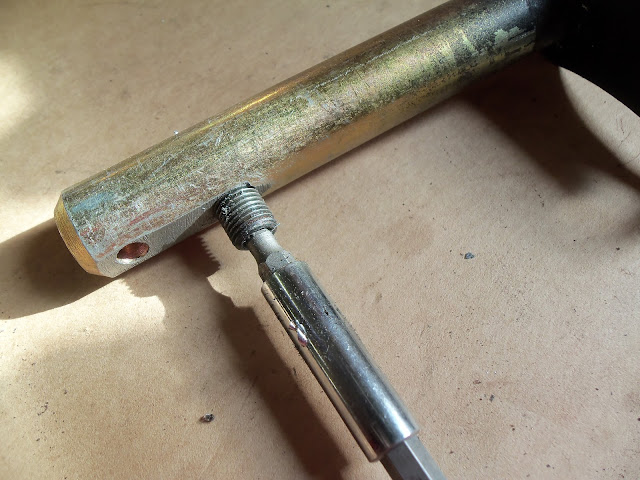
In building the brake-rod assembly for the 1940 Ford Rod I'm working I put a flat-spot on the shaft so that the pedals set-screw wouldn't slide - which, should it not positively engage the shaft, could cause possible catastrophic brake failure.

106_2432.JPG


106_2433.JPG


106_2437.JPG


Now here's the question: Do you think that's enough? I doubt the factory would have gone any further, but now I'm thinking about either drilling a pocket to seat the set-screw in even further, or maybe even drilling a hole straight through the shaft and putting a bolt right through it all.

What would you do?
 
Last edited:
To avoid these ads, REGISTER NOW!

KinzeMech

Well-known member
Joined
Jul 15, 2012
Messages
1,164
Is the set screw carrying torque, or just keeping something from sliding down the shaft?
 

machine_punk

Well-known member
Joined
May 14, 2011
Messages
2,540
Location
Napa Valley, California
I would send the shaft and socket to a machinist to be splined (just kidding).

My concern would be about the possibility of the set screw coming loose (although I assume you used thread locking compound). I like the idea of drilling and tapping a bolt at least part of the way through the shaft, but you would still need a lock nut/thread locking compound/safety wire.

I would probably at least drill a pilot hole, for the set screw to 'grab onto.'

I don't work on cars much, but those are my ideas, unless you have the ability to machine a slot and key (not sure of the real machinist's terms for that).

M_P
 

Omphaloskeptic

Well-known member
Joined
Oct 11, 2008
Messages
2,346
Location
Ultima Ratio, Wa.
Considering how important that shaft is and the fact that it will be cycled every time you put your foot on the brake, I'd drill it through, insert a pin with a cotter pin retainer rather than a tiny machine screw.
 
OP
E

e-tek

Well-known member
Joined
Dec 19, 2007
Messages
10,690
Location
Saskatoon, SK
Is the set screw carrying torque, or just keeping something from sliding down the shaft?

The set screw ends up taking a lot of torque, every time the pedal is depressed....

....and upon writing that and reading the comments above, I think I'll be taking Omphalo's suggestion. Thanks O!
 
Last edited:

KinzeMech

Well-known member
Joined
Jul 15, 2012
Messages
1,164
The key would have been sufficient to keep the piece from sliding, but really for a transfer of torque. That needs a spline, or a key, or a roll pin or solid pin. The pin he suggested sounds to me like the best idea.
 

Lotek

Well-known member
Joined
Dec 9, 2007
Messages
9,098
Location
Los Angeles, Ca.
I'm thinking that threading the end of rhe shaft and the eye fitting and using a jam nut would be the most positive way to secure the rod, that's the way the oems do it. Considering that this is possibly the most important joint in the entire car...
 

Sureshot

ALLIANCE MEMBER
Joined
Jan 3, 2011
Messages
3,134
Location
Bridge Creek, OK
I would be tempted to have a backup. Leave what you have and drill a seperate hole for a pin or space the pedals "collar" end out the width of the hole and have a notch in the side of the "collar".
 

gorilla

Well-known member
Joined
Dec 13, 2007
Messages
1,654
I would drill through, ream to size and press in a dowel pin. If you decide to use a bolt make sure that the threaded area is outside the pedal area.
 

Big-Foot

Well-known member
Joined
Jan 30, 2005
Messages
1,951
Location
Midlothian, TX
I would drill into the shaft a good .125" or so where the set screw engages. Allowing the screw to set deeper into the shaft. Important to note that if you drill all the way through that shaft, you will have weakened the shaft substantially by creating a pretty large stress riser..
 

Brad54

Well-known member
Joined
Jun 13, 2006
Messages
4,646
Here's one of those situations where you just gotta wonder...
The brake pedal slides onto a round shaft, and is only secured by a set screw.
That's about the flimsiest way imaginable to do that.

On the other hand, how many millions of these cars were on the road? How many of them have been street-rodded and still use the same set-up?
I've never heard of it being a problem.

If it were mine though, I'd damn-sure want something more positive. I'd drill through the rod and use a grade-8 bolt and thru-bolt it... or even a cold-rolled pin and thread each end. It's going to be used in sheer, which a standard bolt isn't designed to do.

As for weakening the rod with the thru-hole, I don't see that as being a problem. The metal would have to break all the way through from the pin applying pressure as it went through its range of motion, which is a controlled rotation. I just don't see that causing a failure.

On my '54 Buick, it has an underfloor mount pedal mount as well--But the base of the pedal is C-clamp type, with a bolt-boss on both sides of the slit; you slide the pedal end over the shaft, then tighten the bolt and it decreases the radius of the pedal end and clamps it tight to the shaft.
There's a boss on the bottom of the thing that the brake rod connects to. The rod you are working with, is simply a pivot on the Buick.

-Brad
 

timewarp

Well-known member
Joined
Feb 24, 2008
Messages
272
Location
Silverdale, WA
I would be tempted to have a backup. Leave what you have and drill a seperate hole for a pin or space the pedals "collar" end out the width of the hole and have a notch in the side of the "collar".

I would do this, a thick washer on the other side of the collar to move it over so you could put a pin in the already existing hole and cut notches in the collar that the pin would sit in, and also locktite the existing setscrew.
 
OP
E

e-tek

Well-known member
Joined
Dec 19, 2007
Messages
10,690
Location
Saskatoon, SK
I would do this, a thick washer on the other side of the collar to move it over so you could put a pin in the already existing hole and cut notches in the collar that the pin would sit in, and also locktite the existing setscrew.

I like that idea^^^^^!
 
OP
E

e-tek

Well-known member
Joined
Dec 19, 2007
Messages
10,690
Location
Saskatoon, SK
Here's one of those situations where you just gotta wonder...
The brake pedal slides onto a round shaft, and is only secured by a set screw.
That's about the flimsiest way imaginable to do that.

-Brad

Exactly what I was thinking Brad and since I'm working on this for someone else - so I want it bomb-proof.
 

kbs2244

Well-known member
Joined
Nov 11, 2006
Messages
14,065
I am afraid of the through idea.
It will weaken the rod too much.
I would second the thread the end of the rod and use jam nuts.
 

KinzeMech

Well-known member
Joined
Jul 15, 2012
Messages
1,164
Drilling all the way through the rod will weaken it, but it is still going to be orders of magnitude stronger than the OEM use of a set screw.

I still find it hard to believe it was originally built that way.
 
To avoid these ads, REGISTER NOW!

Crusty Nut

Well-known member
Joined
Mar 16, 2008
Messages
475
This has been bouncing in my head this AM. That isn't a stock setup. Ford didn't build them that way. The shaft doesn't rotate. The pedals pivot on the shaft.
Here is a stock one found on ebay http://www.ebay.com/itm/39-40-MERCU...Parts_Accessories&hash=item23233aac2d&vxp=mtr

I don't have one here are the shop to look at in person. If memory serves, since I can't fully tell in the pictures, a stock setup holds the pedals to the shaft with a sir clip and the set screw in your pedal should be a zerk fitting.
 
OP
E

e-tek

Well-known member
Joined
Dec 19, 2007
Messages
10,690
Location
Saskatoon, SK
This has been bouncing in my head this AM. That isn't a stock setup. Ford didn't build them that way. The shaft doesn't rotate. The pedals pivot on the shaft.
Here is a stock one found on ebay http://www.ebay.com/itm/39-40-MERCU...Parts_Accessories&hash=item23233aac2d&vxp=mtr

I don't have one here are the shop to look at in person. If memory serves, since I can't fully tell in the pictures, a stock setup holds the pedals to the shaft with a sir clip and the set screw in your pedal should be a zerk fitting.

I WAS THINKING THE SAME THING ALL DAY(!) and you are right - it's not a stock set up. The pedal in my case has to actuate an aftermarket brake set up through the pin in the other side of the frame piece. The pedal on the stock set-up is supposed to rotate on the shaft, this one isn't.

Anyways, I decided to drill PART-WAY into the shaft so as to keep it's strength intact and then use a longer set-screw that would seat into it. I woould like to find a Grade 8 set screw.....

Of course I'll Loctite everything in once I'm satisfied this is the way to go.

Just uploading todays pics.....
 

trbomax

Well-known member
Joined
Mar 21, 2010
Messages
2,556
Location
starvation lake,mi.
I WAS THINKING THE SAME THING ALL DAY(!) and you are right - it's not a stock set up. The pedal in my case has to actuate an aftermarket brake set up through the pin in the other side of the frame piece. The pedal on the stock set-up is supposed to rotate on the shaft, this one isn't.

Anyways, I decided to drill PART-WAY into the shaft so as to keep it's strength intact and then use a longer set-screw that would seat into it. I woould like to find a Grade 8 set screw.....

Of course I'll Loctite everything in once I'm satisfied this is the way to go.

Just uploading todays pics.....

If I were doing it this way I'd use a square head set screw and saftey wire it.

But if I were BUILDING the car I would put a keyway in the shaft and pedal first,then put the square head set screw at 180 deg from the keyway and safety wire it..
 
Last edited:

ydna

Well-known member
Joined
Jul 23, 2012
Messages
66
There is no way that will last. A foot long lever with you stomping on it over and over again? That set screw will turn to mush in the firs drive. A keyway is the proper way to do it. Going right through with somthing hard might get you by but even that isn't really proper for this application. Think about how hard you hit that pedal in a panic. You'll break that joint for sure.
 

gorilla

Well-known member
Joined
Dec 13, 2007
Messages
1,654
Setscrews on flats are only used in the industrial world for light load applications. The proper way to do that is with splines or with a key or with a properly fitted pin. Have you considered taking it to a machinist to have it done properly? IMHO what you are doing is unsafe and dangerous.
 
OP
E

e-tek

Well-known member
Joined
Dec 19, 2007
Messages
10,690
Location
Saskatoon, SK
There is no way that will last. A foot long lever with you stomping on it over and over again? That set screw will turn to mush in the firs drive. A keyway is the proper way to do it. Going right through with somthing hard might get you by but even that isn't really proper for this application. Think about how hard you hit that pedal in a panic. You'll break that joint for sure.

Setscrews on flats are only used in the industrial world for light load applications. The proper way to do that is with splines or with a key or with a properly fitted pin. Have you considered taking it to a machinist to have it done properly? IMHO what you are doing is unsafe and dangerous.

Maybe you guys should read the entire post before chiming in with "unsafe and dangerous" drivel.... :bounce:

E-Tek, I couldn't copy this PDF excerpt from the 'Machinist's Handbook', but you might find this article helps you in your decision.

http://calliope.ualr.edu/wp-uploads/calliope.ualr.edu//2012/05/fasteners.pdf

P.S.- Especially the section titled 'Shaft Coupling'.

Thanks O - for being helpful. If I can't find a Grade 8 set-screw, then I'll put a Gr.8 pin through it as per your original comment.
 

Crusty Nut

Well-known member
Joined
Mar 16, 2008
Messages
475
grade 8 stuff is typically more prone to shearing than grade 5 due to it being harder.

The more I think about this, without seeing the whole pedal assembly, makes me want to recommend you **** can the whole works. There are some absolute **** parts out there for sale, right along side good stuff, that works well. What all are you working with for a pedal setup?
 

mellamoesrico

Well-known member
Joined
Aug 13, 2011
Messages
54
Weld it. Seriously though, none of this looks strong enough to last on a go kart. Even a full pin passing all the way through the pivot rod would need to be such a small diameter in order to leave any material in the pivot rod that I wouldn't trust it from shearing off. If you made the pin large enough, then the pivot rod will be too weak.

I don't see why you wouldn't use the original setup where the pedal rotates on the shaft and the brake master cylinder pushrod is attached to the brake pedal arm with a clevis pin.

Maybe you have a horizontal offset to consider? Then use a welded up bellcrank linkage like the factories used on clutches before hydraulic master/slave cylinder arrangements took over.

Ever seen how beefy this stuff is from the factory? And that's with a power brake booster supplying much of the force downstream of the pedal linkage.
 

Worsedog

Well-known member
Joined
Mar 2, 2008
Messages
1,515
Location
Central FL
There is no way that will last. A foot long lever with you stomping on it over and over again? That set screw will turn to mush in the firs drive. A keyway is the proper way to do it. Going right through with somthing hard might get you by but even that isn't really proper for this application. Think about how hard you hit that pedal in a panic. You'll break that joint for sure.

Setscrews on flats are only used in the industrial world for light load applications. The proper way to do that is with splines or with a key or with a properly fitted pin. Have you considered taking it to a machinist to have it done properly? IMHO what you are doing is unsafe and dangerous.

E-Tek, I couldn't copy this PDF excerpt from the 'Machinist's Handbook', but you might find this article helps you in your decision.

http://calliope.ualr.edu/wp-uploads/calliope.ualr.edu//2012/05/fasteners.pdf

P.S.- Especially the section titled 'Shaft Coupling'.

Maybe you guys should read the entire post before chiming in with "unsafe and dangerous" drivel.... :bounce:

I read all the posts, it is not drivel and they are right. As referenced in the most helpful document provided by "O" see page 8 about where not to use a set screw. And also page 15 about shaft coupling.
Even if you could find a strong enough set screw, how hard is your shaft if you were able to put your flat area on with a hand file easily?


Thanks O - for being helpful. If I can't find a Grade 8 set-screw, then I'll put a Gr.8 pin through it as per your original comment.

See the above bit in bold.
 

Outlawmws

Well-known member
Joined
Aug 9, 2011
Messages
39,302
Location
The Badlands
Lets see, a fairly soft iron shaft designed for having something rotate on it, (BTW that pedal also has a bronze bushing in it IIR)

and then (using some simple basic math) you want a set screw to hold against peak rotational pressures of say, 300-500 lbs at the pedal, (not considering any shock values here at all. those numbers go way bigger...) multiplied by the length of the pedal lever, divided by the radius of that shaft.

Let's guess the shaft is 1" Dia the the pedals fulcrum length is 12" so 12/.5=24

300 X 24 = 7200 lbs of shear force

500 X 24 = 12,000 lbs of shear force...

What size did you say the set screw was?

This needs to be re-engineered...
 
OP
E

e-tek

Well-known member
Joined
Dec 19, 2007
Messages
10,690
Location
Saskatoon, SK
I don't see why you wouldn't use the original setup where the pedal rotates on the shaft and the brake master cylinder pushrod is attached to the brake pedal arm with a clevis pin.

Maybe you have a horizontal offset to consider? Then use a welded up bellcrank linkage like the factories used on clutches before hydraulic master/slave cylinder arrangements took over.

Exactly. The owner put an aftermarket booster in that mounts to the left frame rail. The pedal needs to be on the right side of the steering column. Believe me, I half considered putting the pedal on the other side of the steering column so as not to have to deal with this issue!

I agree this set-up isn't gonna be strong enough. I'm all about doing it right - hence the thread. So thanks to the guys trying to help, but I think we can do without the "doom and gloom" scenarios :willy_nil

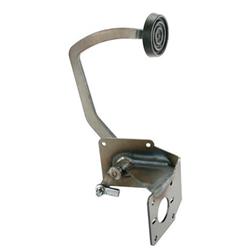
If you look at the aftermarket set up for this vehicle, it has the same "remote shaft" set-up. I just can't see how they have attached the pedal on the other side. May just have to buy one and be done with it.

91631941_R.jpg
 

mellamoesrico

Well-known member
Joined
Aug 13, 2011
Messages
54
Believe me, I half considered putting the pedal on the other side of the steering column so as not to have to deal with this issue!

91631941_R.jpg

I would try to get rid of the offset somehow, either by moving the pedal or the master cylinder. There's a good reason that the factory keeps these linkages in a single plane. That is to minimize unwanted sid-to-side torque moments that just tend to twist and bind up the linkage and cause more stress in all the joints. This forces you to go with bigger, heavier materials throughout the design than an in-plane
 

Drunken Yak inc

Well-known member
Joined
Sep 4, 2011
Messages
759
Location
Osceola, IN
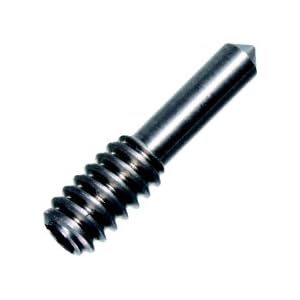
I would use something like this, possibly turning the pin down to a smaller diameter as to facilitate removing the least amount of material from the shaft.

21PpD7uekYL._SL500_AA300_.jpg
 

SVE Performance

Well-known member
Joined
Feb 14, 2012
Messages
157
Location
Milford,Connecticut
Without being able to see the entire assembly my thought would be to leave the brake pedal pivot on the shaft and connect it to a bellcrank assembly via linkage coming from the stock location on the pedal. Don't know about your state but mine requires the brake pedal be on the right side of the steering column. Bill
 

tcianci

Well-known member
Joined
Feb 7, 2009
Messages
4,242
Location
Walpole, Ma
Hi Ed,
I'm going to assume that you need to assemble this thing and that precludes welding the arm to the shaft? If it can be assembled and installed in to the car as a unit, I would weld it IF the pedal arm is forged and not cast. You can identify a forging by a wide parting line on the sides of the arm, a cast piece probably wouldn't have any line at all. In the absence of that option, your best bet would be to take it to a local machine shop and have a keyway cut in the arm and the shaft. The keyway would provide much more surface area to bear the forces that would be applied to it and allow you to assemble the pieces in the car.
The setscrew approach probably wouldn't be able to take the forces applied to it for very long and would fail at the worst possible time and you also need to be careful of the pin method too because of the amount of material you would be removing from the shaft in order to install an adequate pin.
 
OP
E

e-tek

Well-known member
Joined
Dec 19, 2007
Messages
10,690
Location
Saskatoon, SK
Thanks T - You're right in that it has to be assembled. The pedal side is very close to the ******, so I can't even weld that side and slide it in - but I was able to weld the other side where there's more room. It has a through-tube that it rotates on.

I like the key-way idea for sure and I'm researching that now. I'd like to think I can come up a safe system, but if not, I'll let the owner take care of that part.

Thanks to all for all the ideas and (most of) the input! ;)
 
To avoid these ads, REGISTER NOW!
Top Bottom