To avoid these ads, REGISTER NOW!

Oxyacetylene torch issue

trooper1954

Well-known member
Joined
Nov 4, 2016
Messages
197
Location
Salmon Arm, BC, Canada
Hello everyone,
Had a few issues with my oxyacetylene set up recently but other issues have now been resolved. I currently have a problem with the torch blowing out when O2 is introduced.
Pressure on acetylene regulator set at 5 psi static
Pressure on O2 regulator set at 7 psi static
I crack the acetylene knob and light....no issues......I adjust so there's no soot
I crack very gently the O2 knob and the torch immediately goes out.
All connections have been checked, tightened and no leaks
What am I doing wrong?
Thanks
 
To avoid these ads, REGISTER NOW!

LopezBart

Well-known member
Joined
Oct 13, 2023
Messages
2,563
Location
Lopez Island, WA
The O2 valve may open somewhat suddenly if you have a small flame. Try turning the O2 on and turning the pressure down to zero. Light the acetylene and slowly increase the O2 pressure using the regulator with the valve open.


I think you'll find out that with the tip size you're using, you need to have a bigger flame before opening the O2 valve. I generally start with the flame just about to leave the tip before opening the O2 valve.

You may find this useful... it's more than 60 years old, but still relevant: https://www.amazon.com/Oxy-Acetylen...Procedures/dp/B001GD36C4?tag=atomicindus08-20

Edited: just looked, my copy is from 1943.
 

rlitman

Well-known member
Joined
Oct 18, 2010
Messages
24,662
Location
Long Island
...
I crack the acetylene knob and light....no issues......I adjust so there's no soot
...
That's your problem. A stream of acetylene blowing out of a hole drilled in a torch tip made for oxy-acetylene is not going to burn in air without soot. Even a puny Bic-lighter-running-out-of-butane flame is going to smoke with straight acetylene in air without a venturi and mixing. Give it some more fuel and try again. If you're outdoors, you'd be shocked about how sooty and comically flamethrowery an acetylene flame you can achieve without any oxygen added. Don't try that indoors though, or you'll find carbon streamers floating around that land on everything and make a terrible mess.
 

MoonRise

Well-known member
Joined
Nov 5, 2010
Messages
4,031
Location
NJ
As said by @LopezBart Bart and @rlitman , you probably need more fuel and a bigger flame with just the fuel before adding oxygen.


Also, what brand, type, and size tip are you trying to use? Different parameters usually for a welding tip versus a cutting tip versus a heating tip (aka rosebud).

And 'small' welding tips that I'm familiar with (Victor, Harris, etc) usually have equal pressure for the acetylene and the oxygen. Yes, the tips can be used within a small range of pressures (example: 3-5 psi, or 5-8 psi, etc) but I mostly start with equal pressure settings on both gases.

And make sure that the pressure settings are appropriate for the tip size being used. Different size (and type) of tips often use different pressures.

And I also set the pressure not at static conditions (no flow) but to the desired pressure during my purge of the lines with the gases flowing. Sometimes it makes a difference, sometimes it's pretty much the same pressure.

And do you have a properly sized acetylene cylinder (big enough) to support the flow rate your tip is requiring? Old requirement was no bigger than 1:7 of the cylinder volume as the flow rate in SCFH, but that has changed to now only 1:10 of the cylinder volume as the acceptable acetylene flow rate. ex: 75 ft^3 cylinder should only be used at a flow rate less than 7 SCFH under the new guidelines/rules, the old guidelines/rules said you could use that cylinder at a flow rate less than 10 SCFH.
 

2oolhound

Well-known member
Joined
Dec 18, 2010
Messages
5,918
Location
BC Canada
I always set ace to 7lb and oxy to 21 lb. I go beyond the no soot setting (until it gets noisy) that when you're hitting capacity. Then gently open the oxy to adjust the feather. If you have a cutting tip on you need lots of oxy for when you hit the big lever to open the straight oxy jet in the center.
 
OP
T

trooper1954

Well-known member
Joined
Nov 4, 2016
Messages
197
Location
Salmon Arm, BC, Canada
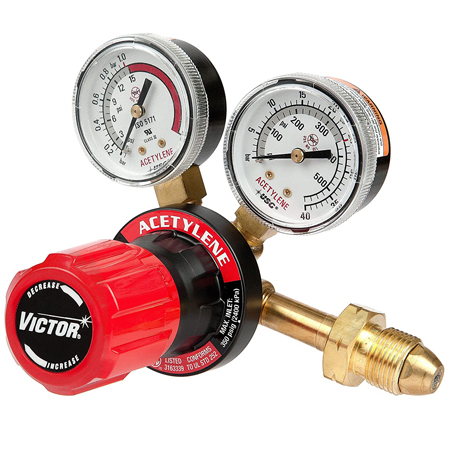
Thanks everyone for all the suggestions. I now have another question...I noticed yesterday that the needle on my low pressure gauge was below the stop. I have no idea how it got there, I assume it must have gone 360 but I don't know why. Anyhow, I just placed it back above the stop,(I didn't go 360 backwards to do so) and now it 's stuck at 5psi. Is this gauge buggered now,or should I try and rewind it 360 backwards to see if it will work? Also, its mounted on a Victor SR 410 A...if I have to replace it can I use any manufacturers gauge or should I try and get a Victor one?
Thanks again for the help so far
 

rlitman

Well-known member
Joined
Oct 18, 2010
Messages
24,662
Location
Long Island
Thanks everyone for all the suggestions. I now have another question...I noticed yesterday that the needle on my low pressure gauge was below the stop. I have no idea how it got there, I assume it must have gone 360 but I don't know why. Anyhow, I just placed it back above the stop,(I didn't go 360 backwards to do so) and now it 's stuck at 5psi. Is this gauge buggered now,or should I try and rewind it 360 backwards to see if it will work? Also, its mounted on a Victor SR 410 A...if I have to replace it can I use any manufacturers gauge or should I try and get a Victor one?
Thanks again for the help so far
I sure hope your acetylene gauge hasn't gone 360! And if it did, I'm glad to see you're still posting. Acetylene should never be allowed to get over 15PSI (that's why the gauge stops there), and past 30PSI it can explosively decompose on its own WITHOUT the presence of oxygen. Having the needle peg around 360 is a symptom of a failed regulator, and replacing the gauge is probably not the safest choice.

The calibration on a bourdon tube gauge can be thrown off by stuff like this, but you have two options if you just want to reset the zero. You can pull the hand and place it back on in the right orientation, or you can adjust zero by doing some bending of the S linkage.
 
To avoid these ads, REGISTER NOW!

MoonRise

Well-known member
Joined
Nov 5, 2010
Messages
4,031
Location
NJ
Just replacing just the gauge may not be enough if the regulator has failed in some way.

And what do you mean by 'replaced the needle back above the stop' ??? You popped the gauge 'lens' (gauge cover) off and physically moved the needle or bent/forced the needle back to zero? There's a pin at zero. If the needle is not at zero with zero pressure, then the regulator and/or gauge are no good.

Contact https://regulatortorchrepair.com/ and see if they can do a service/rebuild on the regulator.


Their blind estimate for a single-stage regulator rebuild is ~$80 if only soft parts are needed. So you are about 1/2 the price of a completely new brand name single-stage acetylene regulator right there.

The SR410A is an older model of regulator. If they say there are no parts (besides the gauge itself) to rebuild the regulator fully, then scrap and replace the regulator.

As @rlitman mentioned (in case you weren't aware), acetylene is an inherently UNSTABLE molecule. Which is good and useful if it is used within its safe working pressure limits of no more than 15 psi (which means that you NEED both a good and properly working pressure gauge AND a good and properly working regulator). If the acetylene pressure goes over 30 psi, the the molecule spontaneously (and violently) breaks apart and releases energy and goes BOOM all by itself. No air or oxygen or spark/flame needed, just BOOM.

Old regulator, possible fuel problems (your problems lighting the torch), gauge not reading properly, for acetylene equipment all tell me that the quickest and safest course is to just replace the old-and-possibly-malfunctioning acetylene regulator completely.

Victor Single-stage acetylene regulator with a CGA 510 connection is only ~$150 or so (American $, so in Canadian that is what about $300 CAD :LOL: ).

 
OP
T

trooper1954

Well-known member
Joined
Nov 4, 2016
Messages
197
Location
Salmon Arm, BC, Canada
Thanks everyone. Bought tip cleaners and did clean the tip thoroughly. The only problem I have now is to replace the low pressure gauge. Having been told in the past that the system should always have the manufacturers parts (Victor in this case)
would it be okay to just put a generic low pressure gauge as a replacement, or should I try and source a victor one? Problem is the regulator (SR 410A) is older and I may not be able to find an exact replacement.
Appreciate everyone's help and patience with this one(y)
 

welder4956

Well-known member
Joined
Apr 8, 2010
Messages
3,081
Location
Birmingham, AL USA
If you are new to using oxygen-acetylene torches, I highly recommend watching the videos in this playlist from start to end. There may be some info that does not apply to you right now, but it is good to know before you need it:
 
Last edited:
To avoid these ads, REGISTER NOW!
Top Bottom