I need to paint my car trailer in the spring. It's all steel. The deck is a mix of smooth and diamond plate steel. Of course, the deck being metal is slick in the rain. What should I add to the paint to add some grit and traction? Is sand acceptable? Has anyone here had good results?


You are using an out of date browser. It may not display this or other websites correctly.
You should upgrade or use an alternative browser.
You should upgrade or use an alternative browser.
Paint grit for a steel trailer deck
- Thread starter 472scout
- Start date
HoosierMark
Well-known member
When I painted my marine plywood pontoon boat deck last spring I went to my local hardware store. They have an additive to mix in with regular paint to create a non slick surface. I was pleased with the results.
four.cycle
Well-known member
I've done this.
My sister's old house required climbing 14 wooden stairs - with a landing in the middle - to get up to her front door.
Of course, the landing was on the north side of the house, so in winter any moisture would freeze and that landing and stairway was like an ice rink. Several people fell.
The deck already had several coats of "exterior deck stain" on it, so there was no way it was going to get stripped to bare wood. I asked around at a couple paint stores for some tips.
I bought 8 5-gallon containers of the solid color deck stain, and one large can of a finely-ground aggregate - intended for use in exactly these situations.
Instructions: dump entire contents of box into one gallon of paint. Mix well. Apply. They make it sound so easy.
Reality is: When you load the roller up in the pan, you pick up MOST of the aggregate, because by the time you pour the paint into the pan, grab the roller, and stick it into the paint, the aggregate has all sunk to the bottom.
Then you lay the roller down on the work surface, and the roller dumps 90% of the aggregate you just loaded onto it in the first 6 inches.
The rest of the pass you get paint, but very little aggregate.
"Well....****... this isn't going to work," was what went through my mind after I got up to the third stair.
I found a steel can with a lid, and with a big nail punched a whole bunch of holes in the lid.
MASKED off the area where I wanted the aggregate (it didn't need to cover the entire stair tread - just the leading edge and a few inches in.)
Laid on a thin coat of stain in the masked-off area, and then used the "salt shaker" method to apply the aggregate - sprinkling it onto the wet paint.
I started at the top, worked my way down, allowed that coat to dry a full day, then went back the next day and laid on a heavy coat.
Worked great.
Deck was re-painted by a "pro" crew several years later - my "gritty" stair treads held up quite well.
YMMV
My sister's old house required climbing 14 wooden stairs - with a landing in the middle - to get up to her front door.
Of course, the landing was on the north side of the house, so in winter any moisture would freeze and that landing and stairway was like an ice rink. Several people fell.
The deck already had several coats of "exterior deck stain" on it, so there was no way it was going to get stripped to bare wood. I asked around at a couple paint stores for some tips.
I bought 8 5-gallon containers of the solid color deck stain, and one large can of a finely-ground aggregate - intended for use in exactly these situations.
Instructions: dump entire contents of box into one gallon of paint. Mix well. Apply. They make it sound so easy.
Reality is: When you load the roller up in the pan, you pick up MOST of the aggregate, because by the time you pour the paint into the pan, grab the roller, and stick it into the paint, the aggregate has all sunk to the bottom.
Then you lay the roller down on the work surface, and the roller dumps 90% of the aggregate you just loaded onto it in the first 6 inches.
The rest of the pass you get paint, but very little aggregate.
"Well....****... this isn't going to work," was what went through my mind after I got up to the third stair.
I found a steel can with a lid, and with a big nail punched a whole bunch of holes in the lid.
MASKED off the area where I wanted the aggregate (it didn't need to cover the entire stair tread - just the leading edge and a few inches in.)
Laid on a thin coat of stain in the masked-off area, and then used the "salt shaker" method to apply the aggregate - sprinkling it onto the wet paint.
I started at the top, worked my way down, allowed that coat to dry a full day, then went back the next day and laid on a heavy coat.
Worked great.
Deck was re-painted by a "pro" crew several years later - my "gritty" stair treads held up quite well.
YMMV
Attachments
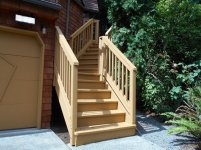
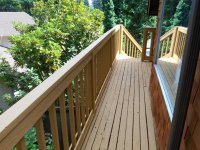

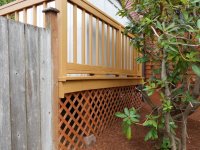
My thoughts are the same as @four.cycle, roll on some paint, sprinkler and second coat.
Jacko264
Well-known member
Use kiln dried. Sand not builders sand
G
G
four.cycle
Well-known member
^ Don't even think about dumping the aggregate into the paint: it all sinks to the bottom even while you've got the swizzle stick in there with the drill motor running full speed.
That job required me to go over to the paint store and by another can of the aggregate stuff.
Just use the "salt shaker" trick and it'll come out perfect. Spend some time punching the holes in the can so you can get it nice and even.... I think I used an old coffee can.... I suppose any old container with a lid would work.
I think I painted that deck for her three times during the 36 years she lived in that house - it's a geodesic dome, and the deck wraps all the way around the house. Took forever to paint with all that fancy railing and stuff.
That job required me to go over to the paint store and by another can of the aggregate stuff.
Just use the "salt shaker" trick and it'll come out perfect. Spend some time punching the holes in the can so you can get it nice and even.... I think I used an old coffee can.... I suppose any old container with a lid would work.
I think I painted that deck for her three times during the 36 years she lived in that house - it's a geodesic dome, and the deck wraps all the way around the house. Took forever to paint with all that fancy railing and stuff.
Strange, I didn't have this problem. The grit in the paint I used stayed fairly mixed.Instructions: dump entire contents of box into one gallon of paint. Mix well. Apply. They make it sound so easy.
Reality is: When you load the roller up in the pan, you pick up MOST of the aggregate, because by the time you pour the paint into the pan, grab the roller, and stick it into the paint, the aggregate has all sunk to the bottom.
Then you lay the roller down on the work surface, and the roller dumps 90% of the aggregate you just loaded onto it in the first 6 inches.
The rest of the pass you get paint, but very little aggregate.
If available, Aluminum Oxide blasting media is a good option to mix with paint to create a grip surface. We have several in-plant operations where the floors are constantly oily. Since we also have a media blast operation, our maintenance persons borrowed some of the blast media (DuPont StarBlast XL) and mixed it into epoxy floor paint.
Earlier they tried using garnet (for our waterjets), but the grains were too small to be effective.
Earlier they tried using garnet (for our waterjets), but the grains were too small to be effective.
Ilikeike
ALLIANCE MEMBER
I just used bed liner from the auto parts store
robin1731
Well-known member
How well will any paint stick unless you scuff up the surface?
racecougar
Well-known member
Poorly.How well will any paint stick unless you scuff up the surface?
cmandp
Well-known member
My first thought was to sand blast the surface to increase roughness and surface area. But I couldn't say what grit or type of media would give the best result. Then you don't have paint that can fail at some point in the future.
I also found this epoxy paint that seems like it would be right for the application (high UV resistance, tough and slip resistant) but it's pricy.
https://slipdoctors.com/collections...ustrial-non-skid-paint?variant=40653290438726
For my laziness I would probably look at adding the self-adhesive grip strips to properly cleaned metal in key areas around the deck. Maybe stripes or some pattern.
I also found this epoxy paint that seems like it would be right for the application (high UV resistance, tough and slip resistant) but it's pricy.
https://slipdoctors.com/collections...ustrial-non-skid-paint?variant=40653290438726
For my laziness I would probably look at adding the self-adhesive grip strips to properly cleaned metal in key areas around the deck. Maybe stripes or some pattern.
Ilikeike
ALLIANCE MEMBER
I went over my steel car hauler deck quickly with a DA sander, this was in 2018, my bedliner paint job still holding up fine after almost 8years.How well will any paint stick unless you scuff up the surface?
The trailer has only been parked in the weather the last year or so, mostly parked under an enclosure, so that helps,
and has only hauled rolling cars, no dragging junk up on the deck or anything.
txvwnut
Well-known member
I haven't convinced myself to do this yet due to your last post mentioning dragging stuff across it. I like the ability to pull and slide stuff and I'm thinking the bedliner would hinder that to a point. I replaced my wood decking with diamond plate steel seven years ago and so far the mill scale is keeping the rust at bay so there's a strong possibility that it will stay that way for while longer... possibly never unless I get energetic.I just used bed liner from the auto parts store
I went over my steel car hauler deck quickly with a DA sander, this was in 2018, my bedliner paint job still holding up fine after almost 8years.
The trailer has only been parked in the weather the last year or so, mostly parked under an enclosure, so that helps,
and has only hauled rolling cars, no dragging junk up on the deck or anything.
Bedliner peeling off is definitely a concern as I don't plan to completely strip off all the rust. What bedliner did you use?
Ilikeike
ALLIANCE MEMBER
Hurculiner the roll on stuff.Bedliner peeling off is definitely a concern as I don't plan to completely strip off all the rust. What bedliner did you use?
The spray on stuff seems to work well in painted truck beds, my work truck hauls all kinds of junk, I know they didn’t strip the paint off that.
CraigStu
Well-known member
I used this in the max grit version on our deck. It is very no slip and somehow they keep the grit well mixed in the paint. You would need to check if it adheres to steel though.