To avoid these ads, REGISTER NOW!

Panel change from interior to exterior

sodaparis

Active member
Joined
Oct 4, 2023
Messages
26
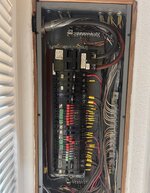
My next project after my meter swap is completed is to replace our existing interior 200 amp panel with a new 200 amp outdoor panel. The existing panel is from 1981 and is a gte / zinsco panel. The reason to move outside is because the area the panel is located is a closed off guest suite. I plan to install the outdoor panel so that I can run conduit from the bottom back of the outdoor panel through the wall and connect to the bottom of the old panel. The left side of the old panel will right behind the left side back of the outdoor panel, perpendicular. The new panel has a 2” knockout at the bottom back or a 2 1/2 if I use the center or bottom left side location. I will use the existing panel as a junction box to extend the circuits to the new panel. I haven’t found a similar setup to mine online, but I’ve seen conflicting info on what’s acceptable regarding wire type, fastening, and de rating on some other inside to outside scenarios. Conduit length between panels is less than 24”, all the existing circuits in the old panel come in through cable clamps, and I would be extending them through that single 2” or 2 1/2” ******.
Circuits to extend are
(1) 100 amp sub panel feed
(1) 30 amp dryer circuit
(14) 20 amp
(6) 15 amp
I’ve checked the conduit fill and all those wires in a 2” is a little less than 35% and in 2 1/2 less than 25% and if it were considered a ****** it could go higher than a conduit.

Can I run individual thwn wires all through the same entry?
Would the wires need to be secured at the old or new panel as they enter?
Is there a better way to get the circuits to the outdoor panel?
Can I extend the grounds using the existing ground bars?

It seemed straight forward at first until I started researching and it seems electricians have different interpretations of what is code compliant in different parts of similar scenarios.
All will be inspected by the city electrical inspector.
After the meter move, the feeder will be coming in the bottom right or bottom right side of the new outdoor panel if that makes a difference.

Thanks for any help.
 
To avoid these ads, REGISTER NOW!

dave*99

Well-known member
Joined
May 5, 2009
Messages
4,322
Location
Coastal NJ
I've seen it done where the old panel is gutted and the door on the old panel gets screwed shut. That said, I don't know if it is permitted or not. I suspect most of the advice you will get is to ask the inspector before you start. That is what I would do.
 
Last edited:
OP
S

sodaparis

Active member
Joined
Oct 4, 2023
Messages
26
I've seen it done where the old panel is gutted and the door on the old panel gets screwed shut. That said, I don't know if it is permitted or not. I suspect most of the advice you will get it to ask the inspector before you start. That is what I would do.
Thanks, I’m fairly sure he’ll be okay with the old panel as a junction box, since he already okayed me using the old meter base to junction with ser to the old panel when the meter swap happens. My concern is extending the circuits. From what I’ve been able find online, if install conduit from the back of the new panel into the old, keep the length between 18” and 24” and extend circuits with thwn I should be code compliant. Minimum of 18” makes the wires entering the new panel secured and less than 24” avoids derating. The two other issues I see is that the extended circuits need to be secured within 12” of entering the conduit at the old panel? And that I don’t exceed 60% fill for the conduit/******.
 

wyliesdiesels

Well-known member
Joined
Aug 14, 2012
Messages
20,179
Location
Modesto, CA
I've seen it done where the old panel is gutted and the door on the old panel gets screwed shut. That said, I don't know if it is permitted or not. I suspect most of the advice you will get it to ask the inspector before you start. That is what I would do.
If its got splices in it, not sure id consider that readily accessible..
 
OP
S

sodaparis

Active member
Joined
Oct 4, 2023
Messages
26
If its got splices in it, not sure id consider that readily accessible..
Thanks. the old panel would remain with the same access but with door secured closed. The rest of the of the wall cavity below the old panel has a removable plywood cover. The conduit connecting both panels would be below the old panel and also accessible if needed all except where it goes through the wall. The old panel and the area below sit behind a tall louvered door.
 

Attachments

  • IMG_4040.jpeg
    IMG_4040.jpeg
    903 KB · Views: 17
To avoid these ads, REGISTER NOW!

Norcal

Well-known member
Joined
Mar 16, 2008
Messages
13,783
I hope you are relocating the SE cable into the new panel & not splicing it.
 
OP
S

sodaparis

Active member
Joined
Oct 4, 2023
Messages
26
I hope you are relocating the SE cable into the new panel & not splicing it.
The se cable comes from the existing meter on the outside wall close to the old panel. Once the outdoor panel is installed the individual feeders will come from the new meter location in conduit for the entire run and will enter into the bottom or bottom side of the outdoor panel. When the meter swap happens I plan to either splice to a length of 4/0 4/0 4/0 2/0 ser at the old meter pan to replace the 3 wire se cable, or if I have room on the outside wall, get the new outdoor panel mounted and connected to the old with conduit and feed straight through it with the feeders from the new meter main and no splice, but also bond the new enclosure.
 

sparky 1971

Well-known member
Joined
Oct 9, 2018
Messages
8,112
Location
Central Iowa
If its got splices in it, not sure id consider that readily accessible..
When I was younger and hungrier and was willing to do service upgrades, we would gut a panel and turn it into a j-box quite often. The cover comes off just like a screw cover box would. They wanted the door screwed shut so some curious kid wouldn't open it up and start screwing around with the wire nuts.
 
To avoid these ads, REGISTER NOW!
Top Bottom