All active devices have a quiescent current. This is a depressing, demoralizing engineering reality of active components and digital electronics. It’s worth the price of admission, but you can’t make it go away if you want to use things very basic things like op amps, FETs, microcontrollers, and so on in your design — totally normal stuff.
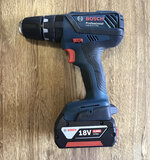
If you leave your battery pack attached to your tools, then naturally the total quiescent current will be the sum of that of the battery management system in the pack, and that of whatever is in the tool, which these days could even include **** like a radio module, because sometimes what you really need on a job site is to synchronize your drill to a Taylor Swift song. However, in a well-designed system, this is at absolute, embarrassingly-bad-worst maybe 25 microamps (uA,) i.e 25e-6 A. A microamp-hour (uA-h) is 10^-6 A-h. That would be why you don’t notice it so much.
It is tempting to think that because there is a switch or trigger in most battery operated tools, that this is like some kind of hard slicer switch that physically removes power. That is unfortunately very naive. The reality in a modern tool may be far more complex, with many electronic components in-circuit in spite of the “open” switch.
Personally, I think leaving battery packs attached to tools is undisciplined and generally unsafe because you are leaving the tool in a state where it could be activated, outside of a context where this is expected. A saw should really not turn on out of nowhere.
Don’t call this a “rumor,” though, that’s ignorant. It’s just typically very, very small.
As to OP’s son, if you were an institutional buyer of powertool battery packs, you might be motivated to care.