
You are using an out of date browser. It may not display this or other websites correctly.
You should upgrade or use an alternative browser.
You should upgrade or use an alternative browser.
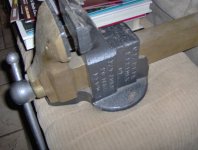
Parker 46 coach with bronze dynamic ????????
- Thread starter ALLFAST
- Start date
Fretters
Well-known member
That looks more like gold paint to me.
drivesitfar
Well-known member
AF: i'd also say PAINT. if it's not far maybe you can see it in person and tell us?
not sure why Parker would build half a BRONZE vise either so if it might be a bronze dynamic is a FRANKENVISE or WHY?
not sure why Parker would build half a BRONZE vise either so if it might be a bronze dynamic is a FRANKENVISE or WHY?
Shiftless
Well-known member
Easy to test...
Bronze is completely non magnetic. Even the strongest magnets will not stick.
Pure copper is the same.
Brass might show a bit of attraction if the magnet is strong enough.
Bronze is completely non magnetic. Even the strongest magnets will not stick.
Pure copper is the same.
Brass might show a bit of attraction if the magnet is strong enough.
KMScott
Well-known member
I have seen several Parker's with bronze collars. Not to rare. Bronze is a good material for collars.
Fretters
Well-known member
He says it's bronze.
It may well be. The surface appearance just seems too consistent to me, but the only way to know for definite is to inspect it in person.
davethorik
Well-known member
I'm guessing its paint too. Looks like the whole thing was repainted recently.
I believe it was va.grouseman that has a couple Columbian combos that are made entirely out of bronze. So I suppose its possible, just unlikely.
I believe it was va.grouseman that has a couple Columbian combos that are made entirely out of bronze. So I suppose its possible, just unlikely.
Roberts210
Well-known member
With a Tread title like this the OP needs to take a magnet and see if the thing is painted cast iron or bronze. OP, can you do the test and come back on and post the results?
So is this some rare duck or what's the story ?
It is supposed to have an original all bronze dynamic jaw.
Any thoughts from the vise historians ?
Shawn
Hi, Shawn,
As others have said, the first thing to suspect is bronze paint.......that said, if a magnet doesn't 'stick', and that movable jaw really is a bronze casting, there could be a plausible good reason.
That style is meant to be a woodworkers' vise, of course, and so would likely be used in a pattern shop. If the original jaw was broken, the obvious repair, to a patternmaker, would be to glue the broken parts back together, make up a core-box for the core, and cast a replacement jaw from one of the high-strength bronzes, using the temporarily repaired past as a pattern, after building up its dimensions for shrink with glued-on leather or some such improvisation. Such a replacement part would be quite adequate for woodworking use, I should think.
(complete cast bronze Emmert pattern vises are rare, to be sure, but they are occasionally found, as the workers at a non-ferrous foundry could, and did, simply dissect an original Emmert, plug the machined holes, and use the Emmert parts as patterns for new bronze castings.)
cheers
Carla
Last edited:
jimreed2160
Well-known member
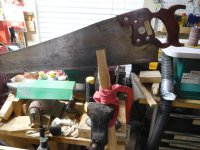
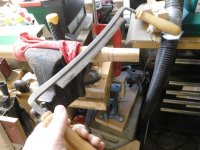
Carla--What a great detective you are. I think your theory is spot on. I have seen bronze parts married to handplanes. There is the occasional lever cap and sometimes even a body. But the most common body I have found in bronze is a most uncommon plane--the router. And the router plane is used by--patternmakers. So it makes perfect sense that someone broke the dynamic and the patternmakers made it work again. I'll wager that they found it in the trash or over in the corner. You are right that it makes a good woodworking vise--I have one on a bench in my shop. Here are some shots of it working.
Attachments

KMScott
Well-known member


drivesitfar
Well-known member
Carla: i know Americans in general were handier concerning industrial type things in your day, but since vises were fairly cheap wouldn't it have been easier to just buy a new vise? or was it like some of us that like to fix something to make it work and say DAMN TO THE COSTS and time to do it?
or maybe shipping costs or being in an area that wouldn't even ship something to you might have been cause for the creative minds of some to just make a new tool by using the old one to make their molds?
KM: yep i agree some of the Parker's have brass holders, but can't say i've seen any vises whole or half made by PARKER.
ALL: I'm still leaning on the side of it being PAINTED GOLD color.
or maybe shipping costs or being in an area that wouldn't even ship something to you might have been cause for the creative minds of some to just make a new tool by using the old one to make their molds?
KM: yep i agree some of the Parker's have brass holders, but can't say i've seen any vises whole or half made by PARKER.
ALL: I'm still leaning on the side of it being PAINTED GOLD color.
Rileysan
Well-known member
Hi, Shawn,
As others have said, the first thing to suspect is bronze paint.......that said, if a magnet doesn't 'stick', and that movable jaw really is a bronze casting, there could be a plausible good reason.
That style is meant to be a woodworkers' vise, of course, and so would likely be used in a pattern shop. If the original jaw was broken, the obvious repair, to a patternmaker, would be to glue the broken parts back together, make up a core-box for the core, and cast a replacement jaw from one of the high-strength bronzes, using the temporarily repaired past as a pattern, after building up its dimensions for shrink with glued-on leather or some such improvisation. Such a replacement part would be quite adequate for woodworking use, I should think.
(complete cast bronze Emmert pattern vises are rare, to be sure, but they are occasionally found, as the workers at a non-ferrous foundry could, and did, simply dissect an original Emmert, plug the machined holes, and use the Emmert parts as patterns for new bronze castings.)
cheers
Carla
The scenario of any shop making a pattern and casting their own dynamic jaw is highly improbable. Aside from the pattern, one would also have to make a core to fit the void inside the slide, so you need both a pattern and a core box. An engineer would then have to draw up plans for a sprue, gating, runners, and risers. I'm not saying it can't be done, just that it would be cost prohibitive. One could buy dozens of new vises for less than the cost of creating one dynamic jaw.
If the dynamic is bronze, the most likely reason is that it was salvaged from an all-bronze vise.
Brian
Last edited:
hard to tell from the pic, but I would think if it was paint, there would be some tell tale signs of scraping or scratches when it was assembled or used at all...
would a shop have used the bronze casting as apprentice or trainee type work? I know in some trades something like that would be given to someone to prove their mettle...
would a shop have used the bronze casting as apprentice or trainee type work? I know in some trades something like that would be given to someone to prove their mettle...
wrenchguy
Well-known member
2 me it looks bead blasted brass or bronze. a very small amount of bronze is magnetic, most being decorative stuff made in india.
Roberts210
Well-known member
OP, will you come back on and end the speculation?
drivesitfar
Well-known member
Roberts: i think you might have missed that the vise is a 4 hour drive one way to see it in person hence him asking us for our opinions. if he has time to see it in person or bring it home that would be nice or maybe another member he knows might be closer to take a peek at it.
Riley: that's what i was thinking. thanks for mentioning the difficulty that maybe Carla knew, but had seen a few of her friends or herself actually make one.
Riley: that's what i was thinking. thanks for mentioning the difficulty that maybe Carla knew, but had seen a few of her friends or herself actually make one.
As DIF explained, it's way far from me to visit. I appreciate Carla's usual wisdom and history of these things. I sent the seller what I thought was a very non threatening query as to whether or not he did the magnet test to confirm it's status as per Shiftless, and just received a not too friendly response about 5 minutes ago.
Hopefully it's legit and be gets a good price.
Hopefully it's legit and be gets a good price.
drivesitfar
Well-known member
AF: with a not too friendly response i'd wager to say a SCAMMER thinking that all our talk about bronze or non sparking vises makes his more valuable. how much is he asking and if you don't want to go take a look maybe i know or somebody here is close enough to see it in person since we all like a good mystery solved?
Shiftless
Well-known member
All our doubts aside, remember that Parker cast quite a few promotional Parker Bear paperweights back then... THEY were bronze, right?
Roberts210
Well-known member
Allfast, I apologize--I saw the second post about it's being so far away but didn't connect it to you--the original poster.
Here's the CL ad. Looking at the rest of the pictures I can see it just might be bronze.
https://modesto.craigslist.org/tls/d/antique-machine-vise/6409229636.html
Here's the CL ad. Looking at the rest of the pictures I can see it just might be bronze.
https://modesto.craigslist.org/tls/d/antique-machine-vise/6409229636.html
Last edited:
Carla: i know Americans in general were handier concerning industrial type things in your day, but since vises were fairly cheap wouldn't it have been easier to just buy a new vise? or was it like some of us that like to fix something to make it work and say DAMN TO THE COSTS and time to do it?
or maybe shipping costs or being in an area that wouldn't even ship something to you might have been cause for the creative minds of some to just make a new tool by using the old one to make their molds?
Hi, DIF,
Its true enough that equipment such as vises may be found relatively cheaply today, relative to the generality of pay scales, these days, but the situation was quite different, years ago, in the 'hard times', when $ was tight, and later, during the war, when you had to have a pretty good priority level to buy even something as basic as a vise (other than the cheap 'homeowner' types).
Have a look through a few 1920's through '40's 'Popular Mechanics' magazines, and note all the articles about 'How I made this nifty (drill press, grinder, table saw, etc.) from discarded car parts and a salvaged washing machine motor'. A lot of this class of improvised equipment might look 'hokey' to us, today, and might not have worked all that well, but the builders were ever so proud of their 'American ingenuity', and the 'get it done' tradition.
In those days, a broken vise would be repaired, rather than scrapped, if any reasonable sort of repair could be improvised with available equipment and materials. Even today, we often find old vises which were broken, and brazed back together, sometimes with improvisational steel strap re-enforcement added.
You may see a good modern example of this 'American ingenuity' on the internet 'Youtube' video programme, with a search on 'Tom Lipton' or 'ox-tool', and 'baby bullet'.
Tom is a machine shop owner, and a highly skilled toolmaker. For his own amusement, he made up an exquisitely detailed copy of a small Wilton vise 'from scratch', i. e., suitable pieces of steel.......literally a 'work of art'.
cheers
Carla
Fretters
Well-known member
The scenario of any shop making a pattern and casting their own dynamic jaw is highly improbable. Aside from the pattern, one would also have to make a core to fit the void inside the slide, so you need both a pattern and a core box. An engineer would then have to draw up plans for a sprue, gating, runners, and risers. I'm not saying it can't be done, just that it would be cost prohibitive. One could buy dozens of new vises for less than the cost of creating one dynamic jaw.
If the dynamic is bronze, the most likely reason is that it was salvaged from an all-bronze vise.
Brian
Engineers? Who needs 'em.

Last edited:
McBrownie
Well-known member
Hi, DIF,
Its true enough that equipment such as vises may be found relatively cheaply today, relative to the generality of pay scales, these days, but the situation was quite different, years ago, in the 'hard times', when $ was tight, and later, during the war, when you had to have a pretty good priority level to buy even something as basic as a vise (other than the cheap 'homeowner' types).
Have a look through a few 1920's through '40's 'Popular Mechanics' magazines, and note all the articles about 'How I made this nifty (drill press, grinder, table saw, etc.) from discarded car parts and a salvaged washing machine motor'. A lot of this class of improvised equipment might look 'hokey' to us, today, and might not have worked all that well, but the builders were ever so proud of their 'American ingenuity', and the 'get it done' tradition.
In those days, a broken vise would be repaired, rather than scrapped, if any reasonable sort of repair could be improvised with available equipment and materials. Even today, we often find old vises which were broken, and brazed back together, sometimes with improvisational steel strap re-enforcement added.
You may see a good modern example of this 'American ingenuity' on the internet 'Youtube' video programme, with a search on 'Tom Lipton' or 'ox-tool', and 'baby bullet'.
Tom is a machine shop owner, and a highly skilled toolmaker. For his own amusement, he made up an exquisitely detailed copy of a small Wilton vise 'from scratch', i. e., suitable pieces of steel.......literally a 'work of art'.
cheers
Carla
Carla,
I have been spending the past two months catching up on Tom’s videos. Great stuff and thanks for bringing him into the conversation. It mean’s a lot coming from you.
-Bill
Allfast, I apologize--I saw the second post about it's being so far away but didn't connect it to you--the original poster.
Here's the CL ad. Looking at the rest of the pictures I can see it just might be bronze.
https://modesto.craigslist.org/tls/d/antique-machine-vise/6409229636.html
I agree, the rest of the pictures really lead me to think it's bronze and not paint. dents, the pins for the jaws, etc...it'd be a lot of work to fake something that well when it would be so easy to test when picking up...
drivesitfar
Well-known member
ALL: yep with more pictures it does look like bronze dynamic. again i'd have to ask WHY?
also WHY did the seller have ATTITUDE when AllFast asked nicely for some more proof? i wouldn't pay his asking price, but I don't need another vise and i have several nicer Coachmaker's vises that i'm not sure i'd get $200 for if I wanted to sell them. I do like the old Coachmaker's look and was it's original use for leather and maybe wood and not steel?
Carla: thanks for that great post and one of many I've read of yours over the years.
Allfast: even if you don't go look at the vise this thread sure became interesting mostly because of Carla's posts. thanks for starting it.
also WHY did the seller have ATTITUDE when AllFast asked nicely for some more proof? i wouldn't pay his asking price, but I don't need another vise and i have several nicer Coachmaker's vises that i'm not sure i'd get $200 for if I wanted to sell them. I do like the old Coachmaker's look and was it's original use for leather and maybe wood and not steel?
Carla: thanks for that great post and one of many I've read of yours over the years.
Allfast: even if you don't go look at the vise this thread sure became interesting mostly because of Carla's posts. thanks for starting it.
DIF,
Last evening I sent the seller a lengthy email explaining the lively exchange we had over here. I believe he read it as he responded later with another email, and his closing comment related that "even the experts are sometimes wrong. "
I believe he was commenting on the input of Carla, with respect to it being a repair/recast. Sounds like he stands behind it being original. I would sure love to go drool over it, but again, it's 3 to 6 hours away one way (if I'm leaving work,3 or home 6 !).
Hopefully a GJer will buy it, or a civilian tool person, and then they can check back with the speciman.
Last evening I sent the seller a lengthy email explaining the lively exchange we had over here. I believe he read it as he responded later with another email, and his closing comment related that "even the experts are sometimes wrong. "
I believe he was commenting on the input of Carla, with respect to it being a repair/recast. Sounds like he stands behind it being original. I would sure love to go drool over it, but again, it's 3 to 6 hours away one way (if I'm leaving work,3 or home 6 !).
Hopefully a GJer will buy it, or a civilian tool person, and then they can check back with the speciman.
Roberts210
Well-known member
I also sent the CL seller a message and he got testy with me too. I'd never consider paying $200 for something that I'd never seen in person, and that I had asked about and had gotten a bad attitude reply. I mean ALL the guy had to do was either put a magnet on it or take a file and scrape the bottom of the slide to satisfy all the doubters.
drivesitfar
Well-known member
AllFast: I think you are right that this is an old style swivel base and unless it's sticking in a hole it's missing the bottom bolt, plate and huge wing nut so as is it wouldn't be easy to even mount to a bench.
ALL: I'm still trying to figure out if it is a BRONZE DYNAMIC what is the reason WHY? or maybe that silver paint is covering up the BRONZE STATIC?
Roberts: some sellers think they are selling GOLD and apparently this one does and not only wants his asking price, but doesn't want to have to answer ANY QUESTIONS EITHER.
ALL: I'm still trying to figure out if it is a BRONZE DYNAMIC what is the reason WHY? or maybe that silver paint is covering up the BRONZE STATIC?
Roberts: some sellers think they are selling GOLD and apparently this one does and not only wants his asking price, but doesn't want to have to answer ANY QUESTIONS EITHER.
Farmer J.
Well-known member
Hi, DIF,
In those days, a broken vise would be repaired, rather than scrapped, if any reasonable sort of repair could be improvised with available equipment and materials. Even today, we often find old vises which were broken, and brazed back together, sometimes with improvisational steel strap re-enforcement added.
cheers
Carla
Carla, it's good to hear you say this, thanks for posting. We have a leg vise which was welded together about 70 years ago using original jaws and pieces of metal from an old steam farm cultivator with a thread from somewhere and a bushing to make it all fit.. Always loved the way it was made from salvaged parts when we had no money, and it still works fine, my blacksmith son has it and uses it now.