To avoid these ads, REGISTER NOW!

Parking slab thickness question

gtae07

Well-known member
Joined
Mar 6, 2015
Messages
2,962
Location
Fayetteville, GA
I’m looking at pouring a pad in front of my shop to serve as additional working space and potential parking for a vehicle. I might also invest in something like Bendpak lifts for use out there as need arises. Approximate size 14x28 or so.

What kind of thickness /specswould I be looking at for a pad like this? What would the footer requirements be (if any)? I prepped the foundation for my shop (mono slab) and that had some easy-to understand guidelines in the wind code book and city inspection guide, but I don’t have any good references for this.

Additionally, should it be tied into the foundation of the shop (e.g. drill and epoxy rebar stubs in the footer walls of the shop) or should it be independent?
 
To avoid these ads, REGISTER NOW!

dutchgray

Well-known member
Joined
Sep 28, 2014
Messages
6,461
Location
Dorset. England.
Independent slab, remove all organics/ topsoil from the area if there is some, min 4" crushed stone layer properly compacted on the dirt then min 4" slab, I would always put a layer of steel mesh in for anti crack.
If you want to put a lift on it the lift manufactures will have a minimum spec, do that or better.
Thicker is better, your slab at 4" is less than one full concrete truck so I would increase the thickness until it was just shy of a full load.

Obviously everything depends upon actual ground conditions where you are.
 

ConCretin

Well-known member
Joined
Jan 20, 2011
Messages
3,378
Location
Central Maine
Four or five inches is more than adequate for most uses although I'd thicken the edges to 8" or so. This will provide a little more support where you drive on and off the apron and help hold everything together. For an apron adjacent to a mono-slab, I would pin the apron to the main slab. I'd also try and prep the base in a similar way to the main structure to have everything supported as uniformly as possible.

I'd go with rebar or wire to hold everything together including a bar or two in the perimeter haunch. I'd also go with a higher psi concrete, say 4000 to provide a more durable surface. If the slab is exposed to freeze/thaw, air entrained concrete is a must. A broom finish provides slip resistance. Other than that just follow good concrete construction practices including control joints, curing, etc
 

Jking24

Well-known member
Joined
Feb 27, 2018
Messages
258
3500 psi, rebar or wire meshFour inches is fine five if you want to go over kill. Unless your parking large equipment and trucks but from the size of it one would assume that's not the case. As stated above the sub grade is what's most important. Remove all organics put in at least 4"of compacted 3/4" stone larger if the ground is soft. The performance of your concrete is directly related to the sub grade
 

skulldrinker

Well-known member
Joined
Dec 25, 2011
Messages
1,171
Location
Bolingbrook, IL
If your slab will be outdoors exposed to winter you are advised to use air entrained concrete. Exposed where people will see it go with 6bag/4000#. Also why would you only go 4"? you'll never have another chance to go 6". Code for my driveway is 6". And of course all the rest of the suggestions of rebar or wire mesh. Don't fall for fiber mesh scam as the primary strength you need metal wire or bars.

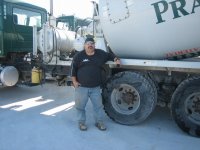
That's me and my mixer. 22 years.
 

Attachments

  • IMG_0085.jpg
    IMG_0085.jpg
    133.9 KB · Views: 83

Bondo

Well-known member
Joined
Dec 22, 2007
Messages
2,549
Location
Greenfield, Maine
I’m looking at pouring a pad in front of my shop to serve as additional working space

Ayuh,...... Thickness of the concrete, depends on the vehicles you intend to work on, on it,......

If yer jackin' up an empty pickup, I'd think 4" is plenty,......

If yer jackin' up 30 ton loaded dump trucks, I'd want 8",......
 
OP
G

gtae07

Well-known member
Joined
Mar 6, 2015
Messages
2,962
Location
Fayetteville, GA
I keep losing my post, so I’ll try on something else...

Thanks for the information! Definitely helpful. I’ll prep the base as the slab was prepped.

Not looking to park or work on anything too heavy, just one of the family vehicles (minivan/F150 size).

What does the aerated concrete do? We don’t really have winter concerns here in coastal Georgia and generally only see sub-freezing temperatures for a couple hours at a time.
 
To avoid these ads, REGISTER NOW!

Bondo

Well-known member
Joined
Dec 22, 2007
Messages
2,549
Location
Greenfield, Maine
What does the aerated concrete do? We don’t really have winter concerns here in coastal Georgia and generally only see sub-freezing temperatures for a couple hours at a time.

Ayuh,..... Basically, it's hyway bridge deck mix,.....

It resists crackin', 'n spalding in freezin' temps,....

Well worth the effort of askin' for it when orderin' concrete,.....
 

wssix99

Well-known member
Joined
Mar 2, 2011
Messages
5,155
Location
Chicago, IL
Not looking to park or work on anything too heavy, just one of the family vehicles (minivan/F150 size).

Structurally, there's no need for "footers" because the loads on a slab are so small. (Compared to a house that needs them.) The pressure your vehicles put on the slab is equal to the pressure of the tires - so that should give you an idea of how your 4000 psi concrete will perform against 35 psi from vehicles. :)

From there, the pressures reduce with the square of the distance to the bottom of the slab. So, that 35 psi translates to just above 2 psi of pressure to the gravel under the slab. From there, the pressures keep reducing by a square of the depth of the gravel until you get to the dirt.

^ So the trick to strength and performance is depth. Depth of the concrete and depth of the base. (They work together.) The base is less expensive than the top, so you should really figure out if you are going to put in a lift, or not and make the call for your concrete depth based on what that equipment manufacturer calls for, plus a little extra to make sure you get the full depth.

Thickened edges will perform also, as mentioned above. If you do that, you will need rebar in those edges to avoid cracking.


What does the aerated concrete do? We don’t really have winter concerns here in coastal Georgia and generally only see sub-freezing temperatures for a couple hours at a time.

It performs well in winter climates, but if your finisher doesn't know it and doesn't know how to work with it; you could end up with more trouble than good.
 

Jking24

Well-known member
Joined
Feb 27, 2018
Messages
258
air entrained concrete is used for outdoor applications basically they inject air bubbles into the mix to help prevent the concrete from cracking during freeze thaw cycles .the theory is it gives the water a place to expand in preventing the hydraulic effect that usually cracks stuff when water freezes inside of it
 

GTFiero

Well-known member
Joined
Sep 7, 2016
Messages
74
Do car work here. Inside building is 4" 6 bag slab with wire mesh, 2" foam board except where 4 point lift is and a compacted sand base. Apron outside is 24'x48' 4" 6bag with wire mesh and rebar on a compacted sand base, also thickened to 6-8" around the edges and at pole barn door entrances. Both were done in 2017 and located in northern MI. Many freeze thaw cycles. Today we have done all sorts of car, boat and pickup truck work out there with no issues. The apron has survived 3 winters now with many a UPS, or FedEx, truck turning around on it.
 

ConCretin

Well-known member
Joined
Jan 20, 2011
Messages
3,378
Location
Central Maine
I What does the aerated concrete do? We don’t really have winter concerns here in coastal Georgia and generally only see sub-freezing temperatures for a couple hours at a time.

As has been alluded to, air entrained concrete contains an admixture that creates millions of microscopic air bubbles to prevent damage from the freeze/thaw action of the moisture in the concrete. I'd check around and see if it is available and recommended in your area. Up my way it's alway used in exterior concrete.

Also mentioned is the importance of proper finishing when using air entrained concrete. If the surface of the concrete is sealed too soon, air and bleed water will pool under the surface creating voids that separate the thin surface layer from the concrete below resulting in de-lamination. A broom finish is the best way to accomplish this
 
To avoid these ads, REGISTER NOW!
Top Bottom