

You are using an out of date browser. It may not display this or other websites correctly.
You should upgrade or use an alternative browser.
You should upgrade or use an alternative browser.
Parts washer fluid
- Thread starter srosa707
- Start date
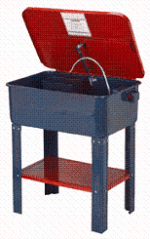
Charles (in GA)
Well-known member
Many of these are not designed for a solvent base fluid, and only water based cleaners, so read the instructions carefully.
One of the better solvent based cleaners is Graymills brand Agitiene and they have a water based cleaner called Aquitiene (sp). Both are expensive but effective. Most water based cleaners work better heated.
Charles
One of the better solvent based cleaners is Graymills brand Agitiene and they have a water based cleaner called Aquitiene (sp). Both are expensive but effective. Most water based cleaners work better heated.
Charles
srosa707 said:Im thinkin of pickin up this parts washer. What fluid do i put in it and where do i get it? This will be for home use on automotive parts. Thanks!
I've got the same one. I use Mineral Spirits, works great. Can buy it pretty cheap at a Home Depot or Lowes in a 5-gallon can. Don't know if there's issues with mineral spirits in CA though. Some brands just call it "paint thinner". Don't get lacquer thinner though, it's a little too agressive.
I use my "used" stuff in the campfire. Works great there!
Phil
Ryan Wilke
Well-known member
Although the main purpose of the fluid in a parts cleaning unit is to cut the grease and grime, there are other things you may want / should consider.
The Flash Point (related to the vapor concentration that will ignite if exposed to a flame/spark), the Evaporation Rate of the particular cleaning fluid (loss to the air) and is also closely associated with the odor issues.
I believe you may find the water-based cleaner fluids will have a much lower Flash Point and evaporate slower than say a petroleum-based product like Mineral Spirits. I know of a local semi-truck repair shop that uses fuel oil (common diesel fuel, $3/gallon) in their parts cleaner. It works great, but it does evaporate readily (especially on days over 75*F), has a distinct odor and they have lots of air movement inside the bays, so it isn't very noticable anyway. Evaporation rates are closely related to the odor issues. For instance, if you have a "pretty" relatively small (1 or 2 car) garage attached to your house, you wife may not appreciate the distinct odor of diesel fuel or other parts cleaner fluid evaporating into the air and migrating into the house.
Both the evaporation & odor issues can be miminized IF you use a lid to cover the parts cleaner basin while not being used. If you don't use the parts cleaner real often, then you can also use the lid as a secondary work/assembly bench while no parts cleaning is required.
The Flash Point or flammability of the fluid is more of an issue if you're using the unit in a fairly small (1 or 2 car garage) or fairly tight work area. If you can utilize an exhaust fan to the outside located near the the parts cleaner and open a supply/incoming air grille across the room (to allow air in while you are trying to exhaust air out at the fan), that will help reduce any buildup of cleaner fluid vapors & odors within the work space. Chances are you won't need an explosion-proof fan motor, as the vapors likely won't get THAT thick.....
In reviewing your illustrated parts cleaner unit, you may want to consider looking at adding/constructing some 'side curtains' for it to help control any splashed fluid. I constucted an approximate 15" x 15" wire frame and attached flexible plastic 'shower curtain'-like side shields that extend into the basin, allowing any splash to drain back into the basin, and when done, the curtains fold inward & under the lid when not in use.
Of course, you'll likely want to locate the unit under a good, overhead light or plan to install a good light above the unit to allow you to see well with curtains and such in place.
Consider using a good pair of neoprene gloves and a protective apron while working with any of the cleaning fluids. While they remove the grease & grime from your parts, they also remove the oils from the skin on your hands if not protected. In the case of small parts, there are protective hand creams available that will protect your skin to a degree against many petroleum or water-based cleaning products. Check the manufacturer's labels to ensure that the apron, gloves and/or protective hand cream are compatable with the cleaning fluid of choice. No, protective hand cream isn't for sissys.... some of it works VERY well! I have found that it also makes the 'end-of-the-day' or lunchtime wash-up much easier as well.
While this shouldn't be necessary, it is HIGHLY recommended - of course, I'm referring to eye protection. Goggles or at least safety glasses should be worn while using pressurized cleaning fluid. If possible, use a metering valve to regulate the fluid supply pressure to a minumim will help a lot towards reducing the splashing onto yourself and out of the basin. Use of a parts cleaning brush will work much better at removing grime rather than high-pressure cleaning fluid. The fluid only is to rinse away the grime, not power-wash it off............
If you ensure that it has a fluid/particulate filteration system inline before the pump, the pump will last longer. A piece of stiff window screen fastened to a wire framework lying in the bottom of the basin works well to catch small parts and will extend the life of a disposeable filter element.....my friend at the diesel truck repair shop uses coffee filters as a pre-filter in his parts cleaner... ....
....
Good Luck! (sorry, for being soo long... )
)
RW
The Flash Point (related to the vapor concentration that will ignite if exposed to a flame/spark), the Evaporation Rate of the particular cleaning fluid (loss to the air) and is also closely associated with the odor issues.
I believe you may find the water-based cleaner fluids will have a much lower Flash Point and evaporate slower than say a petroleum-based product like Mineral Spirits. I know of a local semi-truck repair shop that uses fuel oil (common diesel fuel, $3/gallon) in their parts cleaner. It works great, but it does evaporate readily (especially on days over 75*F), has a distinct odor and they have lots of air movement inside the bays, so it isn't very noticable anyway. Evaporation rates are closely related to the odor issues. For instance, if you have a "pretty" relatively small (1 or 2 car) garage attached to your house, you wife may not appreciate the distinct odor of diesel fuel or other parts cleaner fluid evaporating into the air and migrating into the house.
Both the evaporation & odor issues can be miminized IF you use a lid to cover the parts cleaner basin while not being used. If you don't use the parts cleaner real often, then you can also use the lid as a secondary work/assembly bench while no parts cleaning is required.
The Flash Point or flammability of the fluid is more of an issue if you're using the unit in a fairly small (1 or 2 car garage) or fairly tight work area. If you can utilize an exhaust fan to the outside located near the the parts cleaner and open a supply/incoming air grille across the room (to allow air in while you are trying to exhaust air out at the fan), that will help reduce any buildup of cleaner fluid vapors & odors within the work space. Chances are you won't need an explosion-proof fan motor, as the vapors likely won't get THAT thick.....
In reviewing your illustrated parts cleaner unit, you may want to consider looking at adding/constructing some 'side curtains' for it to help control any splashed fluid. I constucted an approximate 15" x 15" wire frame and attached flexible plastic 'shower curtain'-like side shields that extend into the basin, allowing any splash to drain back into the basin, and when done, the curtains fold inward & under the lid when not in use.
Of course, you'll likely want to locate the unit under a good, overhead light or plan to install a good light above the unit to allow you to see well with curtains and such in place.
Consider using a good pair of neoprene gloves and a protective apron while working with any of the cleaning fluids. While they remove the grease & grime from your parts, they also remove the oils from the skin on your hands if not protected. In the case of small parts, there are protective hand creams available that will protect your skin to a degree against many petroleum or water-based cleaning products. Check the manufacturer's labels to ensure that the apron, gloves and/or protective hand cream are compatable with the cleaning fluid of choice. No, protective hand cream isn't for sissys.... some of it works VERY well! I have found that it also makes the 'end-of-the-day' or lunchtime wash-up much easier as well.
While this shouldn't be necessary, it is HIGHLY recommended - of course, I'm referring to eye protection. Goggles or at least safety glasses should be worn while using pressurized cleaning fluid. If possible, use a metering valve to regulate the fluid supply pressure to a minumim will help a lot towards reducing the splashing onto yourself and out of the basin. Use of a parts cleaning brush will work much better at removing grime rather than high-pressure cleaning fluid. The fluid only is to rinse away the grime, not power-wash it off............
If you ensure that it has a fluid/particulate filteration system inline before the pump, the pump will last longer. A piece of stiff window screen fastened to a wire framework lying in the bottom of the basin works well to catch small parts and will extend the life of a disposeable filter element.....my friend at the diesel truck repair shop uses coffee filters as a pre-filter in his parts cleaner...
....Good Luck! (sorry, for being soo long...
) RW
atch
Well-known member
you might wanna look at these links:
parts washer fluid1
parts washer fluid2
parts washer fluid3
maybe something in here will interest you...
parts washer fluid1
parts washer fluid2
parts washer fluid3
maybe something in here will interest you...
BoostAddiction
Well-known member
I use a great cleaner called Blue Gold. It's expensive, but does a great job (esp when heated) and doesn't have any of the problems that solvent-based cleaners do.
It is a potent degreaser, though, which includes the natural oils on your hands. so you do need to use gloves.
I dilute it and use it as a great cleanup degreaser as well (a certain race car had a oil leak problem all last year...) and even use it for tough cleaning jobs.
You can get it at http://www.bluegoldcleaners.com
-Will
It is a potent degreaser, though, which includes the natural oils on your hands. so you do need to use gloves.
I dilute it and use it as a great cleanup degreaser as well (a certain race car had a oil leak problem all last year...) and even use it for tough cleaning jobs.
You can get it at http://www.bluegoldcleaners.com
-Will
MXTMOPR
Member
I tried the non-toxic water based cleaner from Northern Freight were I got my parts washer. HMMMM lets just say I followed the directions exactly. It cleans about the same as dish detergent and has now started to grow mold in my new parts washer. Does anyone know of a GOOD cleaner that may work without forming mold and all kinds of wierd floating masses in the tank?
Does anyone know of a GOOD cleaner that may work without forming mold and all kinds of wierd floating masses in the tank?66RICH
Well-known member
Like pgreen I use mineral spirits, I used to use the Safety Kleen brand
of cleaner. It's harder to get around here now, and I went with the
mineral spirits which seems to clean just as well. The Safety Kleen
service tech who took care of the parts cleaners in my old shop
showed me trick they used to prolong the life of the cleaner. Use a
plastic bag to line the drum, pour in about 2 gal of water, than fill
with cleaner. The solids will sink to the bottom, and congeal, when cleaning
pump off the cleaner till you get water, strain the muggy mess of water.
Let it dry, and throw away the solids with the bag in the garbage. I've
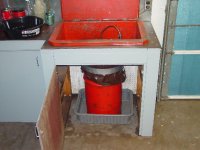
had this parts cleaner for almost 20 yrs, I set a plastic lid over the drain
when not in use, have no odors. I made a cabinet to surrond mine with
metal top, and back splash.
of cleaner. It's harder to get around here now, and I went with the
mineral spirits which seems to clean just as well. The Safety Kleen
service tech who took care of the parts cleaners in my old shop
showed me trick they used to prolong the life of the cleaner. Use a
plastic bag to line the drum, pour in about 2 gal of water, than fill
with cleaner. The solids will sink to the bottom, and congeal, when cleaning
pump off the cleaner till you get water, strain the muggy mess of water.
Let it dry, and throw away the solids with the bag in the garbage. I've
had this parts cleaner for almost 20 yrs, I set a plastic lid over the drain
when not in use, have no odors. I made a cabinet to surrond mine with
metal top, and back splash.
Attachments
There are some good points against plain ol mineral spirits here, but I haven't found any reason to change. Works great, pretty minimal smell, and haven't lost much due to evaporation since my cleaner (exactly what you are looking at) has a lid that stays closed when not in use.
The mineral spirits also won't grow mold, or need heating to work correctly.
As far as side curtains, etc... these parts washers don't have the flow or pressure that the "real" parts washers have. Since this is the case, I spill very little outside the wash tank, and haven't seen the need for them.
Funny thing about used cleaner... before I moved out to the boonies from the Detroit metro area, I called to see what to do to "properly" dispose of the used mineral spirits... After about an hour or so of telephone runaround, they sent me to a place near downtown Detroit that would accept it...at something like $20/gallon! Well, it has made very nice fire starter in my backyard fire pit. Not quite as fun as plain old gasoline, but works fine and is $20/gallon cheaper to burn!
Phil
The mineral spirits also won't grow mold, or need heating to work correctly.
As far as side curtains, etc... these parts washers don't have the flow or pressure that the "real" parts washers have. Since this is the case, I spill very little outside the wash tank, and haven't seen the need for them.
Funny thing about used cleaner... before I moved out to the boonies from the Detroit metro area, I called to see what to do to "properly" dispose of the used mineral spirits... After about an hour or so of telephone runaround, they sent me to a place near downtown Detroit that would accept it...at something like $20/gallon! Well, it has made very nice fire starter in my backyard fire pit. Not quite as fun as plain old gasoline, but works fine and is $20/gallon cheaper to burn!
Phil