ianguilly
Well-known member
I guess I'm missing something, but what makes pass through sockets different from ratcheting wrenches? I have 3 sets of gearwrenches and I just don't feel I need the pass through, but mabe I.m missing their point.


The pass through are nice but it seems like just adding more to the tool box. A good set of ratchet wrench can do the same, have a slimmer profile also. I do prefer spline over 12 point. They grab better on 6pt nuts and bolts.

i did one of those once; iirc the nuts were 21mm or soThis VW strut mount nut is hidden in a sort of a "well" which doesn't allow a wrench to be fitted around it. Wrenches that have a 45-degree elbow bend also won't work here, as the sidewalls of the "well" are kind of steep. However, regular sockets won't work as the strut shaft needs to be counter-held by a hex-key in a similar fashion as the stabilizer link bolt on the picture a couple of posts above. Regular socket may work only with the help of an impact gun but not everybody has the liberty of using one. Thus, the three choices here are - specialized tool from VW, a 90-degree elbow wrenches or the pass-through sockets. Pass-through socket sets are way more common nowadays in most of the auto parts or tools stores than the 90-degree wrenches or VW-specific tools. Also, aftermarket shocks for these vehicles have another "nut" on the end of the strut shaft rather than the hex-shaped depression, which requires another socket (10 or 11 mm) to be fitted on it in order to hold the shaft from spinning. Here the pass-through sockets come very handy as they usually have opening large enough for the smaller socket to pass through it. Hope that helps.
Cheers.
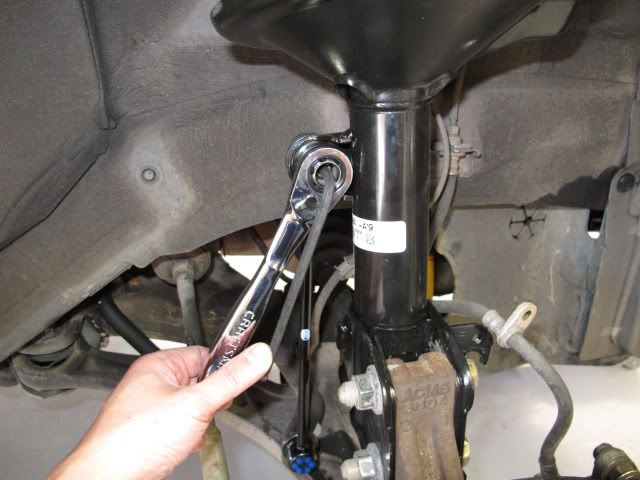
Wrong. There are cases where this tool is an absolute necessity. The situation on 6-Speed's picture can definitely be handled using a regular wrench and a hex-key, but some vehicles like the much-loved Volkswagen, require the pass-through socket to do the job.
Please note that I am not the author of the following picture nor do I have any rights to it. I found it on the Internet and posted here for the sole purpose of illustration.
This VW strut mount nut is hidden in a sort of a "well" which doesn't allow a wrench to be fitted around it. Wrenches that have a 45-degree elbow bend also won't work here, as the sidewalls of the "well" are kind of steep. However, regular sockets won't work as the strut shaft needs to be counter-held by a hex-key in a similar fashion as the stabilizer link bolt on the picture a couple of posts above. Regular socket may work only with the help of an impact gun but not everybody has the liberty of using one. Thus, the three choices here are - specialized tool from VW, a 90-degree elbow wrenches or the pass-through sockets. Pass-through socket sets are way more common nowadays in most of the auto parts or tools stores than the 90-degree wrenches or VW-specific tools. Also, aftermarket shocks for these vehicles have another "nut" on the end of the strut shaft rather than the hex-shaped depression, which requires another socket (10 or 11 mm) to be fitted on it in order to hold the shaft from spinning. Here the pass-through sockets come very handy as they usually have opening large enough for the smaller socket to pass through it. Hope that helps.
Cheers.

I bought the Kobalt set from Cripe Distributing for dirt cheap several years ago. I have yet to even pull a socket off the rail. However, it may be "just the right tool" someday so it remains in the specialty tool drawer of my box.
What did they use to use before these?