To avoid these ads, REGISTER NOW!

Patching Stem Wall

radio63

Member
Joined
May 16, 2016
Messages
24
Location
El Cajon, CA (San Diego area)
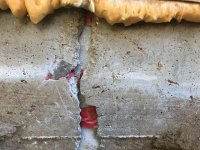
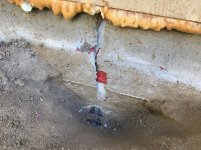
About a year and a half ago, I had this slab poured for my new detached garage. We laid in some sewer pipe in one corner for a future bathroom. When the slab was poured, which also has stem walls, the vent pipe was put too close to the outside edge of the stem wall, resulting in a crack which let moisture from rain water seep in through another crack which has developed on the floor from this same spot. I have dug out the area as shown, and have chipped out the thin, loose concrete until I have solid concrete around the opening. The bottom is solid as that's where the stem wall meets the slab. The red and white you see inside the crack is bubble material to protect the pipe, and duct tape which holds the bubble material in place. I'm seeking advice as to how to best deal with repairing this. I was thinking about packing in hydraulic cement, and after curing, followed by UGL Drylok as a sealer or something similar. I know that tar has been used for sealing masonry walls before. Any input or advice would be appreciated. There is a downhill slope that lets rain water accumulate in this spot if enough rain falls. Unfortunately, I can't go back to the contractor because he has gone out of business as of late last year. The rest of the slab and stem walls are fine except for this situation. Thanks for any input or advice.
 

Attachments

  • IMG_6558.jpg
    IMG_6558.jpg
    149 KB · Views: 83
  • IMG_6559.jpg
    IMG_6559.jpg
    152.3 KB · Views: 75
  • IMG_6560.jpg
    IMG_6560.jpg
    149.6 KB · Views: 75
To avoid these ads, REGISTER NOW!

mrramsey

Well-known member
Joined
Sep 23, 2016
Messages
261
Location
North East Ohio
Maybe something like quikrete strongwall. it is a structural top coat for dry stacking block walls. I is fiber reinforced. I am using it to repair my interior garage wall that has some pretty moderate pitting. it its uses as the structural coat as well as the top coat.
 
To avoid these ads, REGISTER NOW!

larry4406

Well-known member
Joined
Jan 27, 2006
Messages
18,970
Location
Northern Virginia
I think I would use a screw driver to remove some of the foam/bubble wrap pipe protection as the chance for damage is over. This will allow a thicker concrete patch and allow the new material to get deeper into the wall cavity. Keep the edge lip so the patch can mechanically lock behind it.

I think I would try the UGL Drylock unless you have access to epoxy concrete repair products. I had good luck with UGL Drylock once in a basement wall.

Do something to the exterior grade to divert the water. Maybe at worst a french drain to collect and route the water elsewhere.
 

PWC Repair

Well-known member
Joined
Dec 27, 2012
Messages
3,165
Location
Arkansas
I would patch it with hydralic cement, then tar over it, then lay 6 mil plastic over/in the tar just wide enough to overlap the area. Then tar over everything then plastic again overlapping everything. Finally one more coat of tar. This is how leaky basement cracks in old houses are fixed in my area.
 
OP
R

radio63

Member
Joined
May 16, 2016
Messages
24
Location
El Cajon, CA (San Diego area)
Many thanks to everyone for the great responses! I feel better knowing I appear to be on the right track. Larry 4406, many thanks for the excellent suggestion. I will remove that bubble material from the pipe. That will certainly help with getting a more stable patch in place with the hydraulic cement. And PWC Repair, thanks for suggesting the 6 mil plastic. I'm thinking Hydraulic Cement, UGL drylok, and the plastic and tar treatment over that.
 
To avoid these ads, REGISTER NOW!
Top Bottom