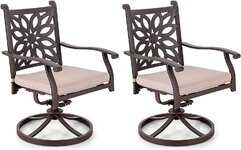
How are you so confident in saying it's aluminum? ...nor is it something as critical as you are all making it out to be...
1) I know THAT chair. I've seen many of them in stores and have sat in many of them in people's homes. The ring on the bottom is steel, the two horizontal bars bolted to the base are steel truck/buggy springs. The chair upper is aluminum, welded from a mixture of extrusions, tube and castings. You can also clearly see it's aluminum by the whiteness of the extrusion's interior under the break. No mill scale looks like that!
2) Look at how the chair attaches to the base. If this were a 4-legged chair, I'd agree that it's not that critical. This is a "rocking" chair that balances the seat on a pair of buggy springs that flex back. The points that broke are probably the ONLY parts of that chair that take any serious stresses, but that area is both highly stressed AND critical to keeping you from falling on your head. The factory welds failed in tension, and do not appear to be defective, since the metal ripped around the weld, so no, the weld was not lacking in surface area. How exactly do you propose to weld your way around that?
If I had to fix it, I'd throw out that broken U piece attached to the springs, and replace that with a similarly dimensioned steel pipe welded to half-pipe sections that cradle the steel chair tube (so it looks like a capitol
I from above), and bolt those on. If those half-pipes are long enough to straddle the broken welds by maybe 2" on each side (so say 6" long), that should take the stress off the aluminum and put it onto your new steel piece. The bonus is you can hide your painted steel under the sweat and don't have to repaint the aluminum. You just need the fabrication skills, but what I'm describing could be done with a 120V FCAW welder. Take a look at hos this similar chair was constructed.